Get in touch with Suzhou UDTECH Technology Co., Ltd. Company

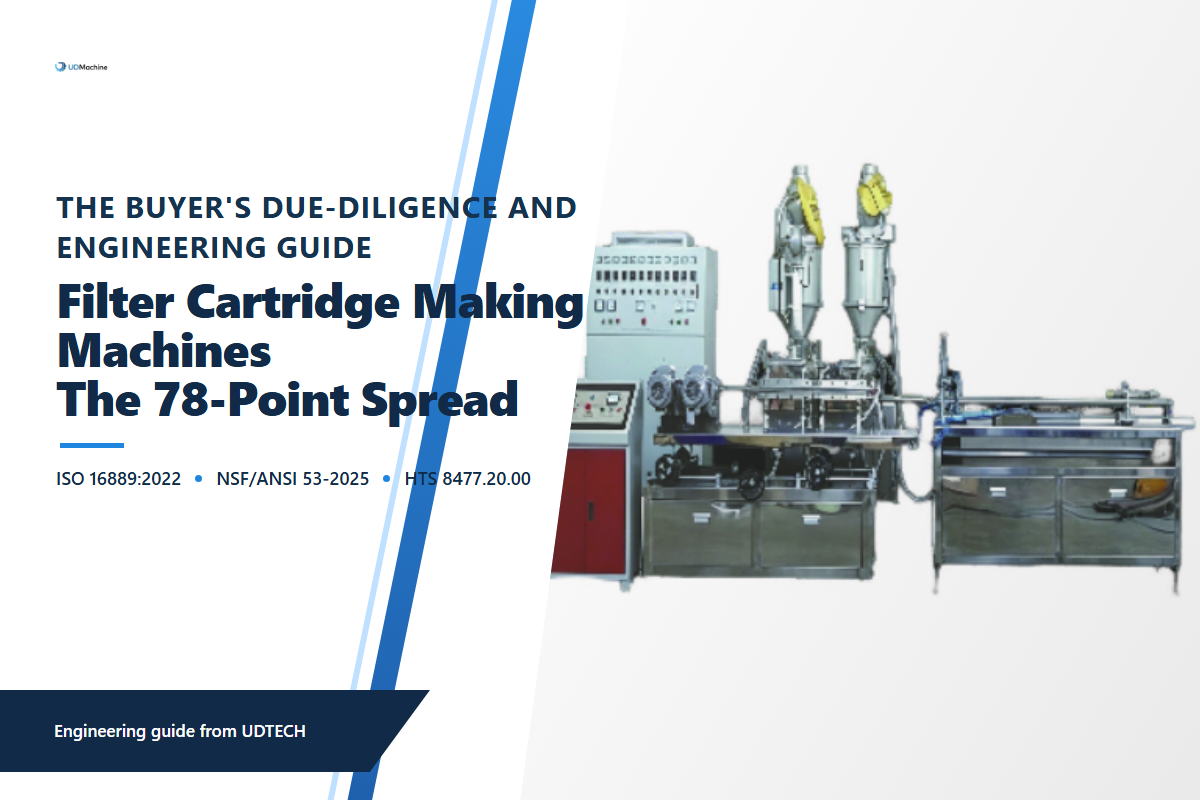
Filter cartridge making machines are the production equipment that turns raw polypropylene, yarn, or activated-carbon media into finished cartridges, melt-blown extrusion lines, string-wound winders, and pleated/carbon-block assembly lines are the three families in commercial use today. Before comparing specific production-line specifications, most buyers need answers to a different set of questions first: what makes a “1 micron” rating mean five different things depending on who prints it, what a certification actually proves, and what a machine really costs to run once duty, processing fees, and electricity are added to the invoice. This guide addresses those questions. Buyers who already know which production line they want can go directly to our filter cartridge making machine production-line comparison and quote page, which provides specification and pricing information for each production line.
Quick Specs
| Production families in commercial use | Melt-blown extrusion, string-wound, pleated/activated-carbon assembly |
| Melt-blowing process window | Fiber diameter refined to roughly 1–5 μm; one study reports pressure/distance effects plateauing near 35 kPa / 35 cm, though the exact plateau point is process- and polymer-specific |
| US import classification | HTS heading 8477.20.00, “Extruders for Working Rubber or Plastics” |
| Global meltblown capacity utilization | Fell from an estimated 79.8% (2019) to 59.9% (2023) — Price Hanna Associates |
Most modern lines in this category, whether a melt blown filter cartridge machine, a string wound filter winder, or a pleated/activated-carbon assembly line, run on fully automatic control systems that meter resin or yarn feed, wind or extrude the media, and weld the end cap onto the core without an operator touching the cartridge until it exits the line. Suppliers can typically customize core diameter, cartridge length, and end-cap style to match a buyer’s existing filter housings. Readers searching more broadly for a filter making machine or filter machine will find that this terminology covers the same three production families described throughout this guide.
Why “1 Micron” From One Supplier Isn’t “1 Micron” From Another
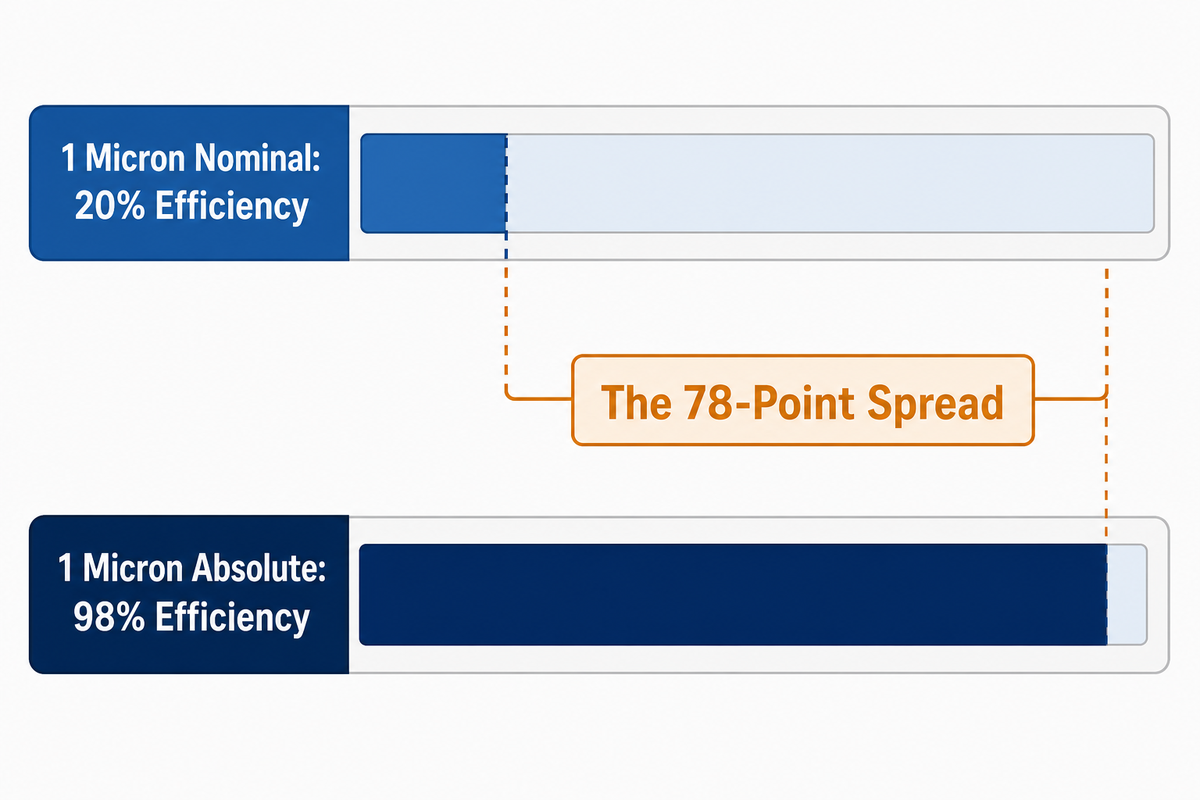
A cartridge rated 1 micron by one manufacturer may perform at 20% efficiency, while a cartridge carrying the identical printed rating from a different manufacturer may perform at 98% efficiency. The gap exists because the filtration industry has never settled on one rule for what “1 micron” measures, some suppliers print a nominal rating, others print an absolute rating, and the label rarely says which.
Some suppliers print a nominal rating (the pore size the media was designed around) and others print an absolute rating (the largest particle that reliably passes through under third-party test conditions), and nothing on the cartridge label tells the buyer which convention was used.
This ambiguity results in more than just a minor inconvenience. A cartridge specified at 1 micron nominal can, under the same test protocol, sit anywhere across roughly a 78-point efficiency spread compared with a cartridge specified at 1 micron absolute from a different line, call it The 78-Point Spread: the gap between the best- and worst-performing cartridges carrying the identical printed rating. When buyers specify equipment from filtration based on the printed rating, without inquiring about the rating convention and the test standard, they’re potentially buying a number that could truly mean anything.
| Rating convention | What it actually measures | Where it commonly appears | Not suitable for |
|---|---|---|---|
| Nominal | Typical or target pore size of the media as designed; efficiency at that size varies by production run | Lower-cost general-purpose cartridges, string-wound and melt-blown depth media | Applications with a hard particle-size ceiling that must not be crossed |
| Absolute | Largest particle size that passes at a stated efficiency (typically ≥99.9%) under a named third-party test method | Pharmaceutical, food and beverage, and regulated water applications | Buyers unwilling to pay the added cost of independently verified media |
| No stated test standard | Unverifiable — the number reflects the manufacturer’s internal method only | Common on unbranded export cartridges and low-cost machine output samples | Any application where the true particle cutoff has commercial or safety consequences |
The actionable step is straightforward and costs nothing beyond a follow-up email: before committing to a production line based on the micron ratings its sample cartridges carry, ask the supplier for the specific third-party test method behind the number (ISO 16889 multi-pass testing is the most widely recognized standard for absolute ratings) rather than accepting the printed figure at face value. Suppliers producing genuinely absolute-rated media will have that report on hand; suppliers who cannot produce one are effectively confirming that their number is nominal, whatever the label says.
The 78-Point Spread behind a single printed micron number can run close to 80 percentage points across suppliers, and no regulation forces a manufacturer to disclose whether its rating is nominal or absolute — that disclosure has to be requested, in writing, before the machine or the cartridges it produces are qualified.
Inside the Melt-Blowing Process: What Actually Sets Fiber Fineness
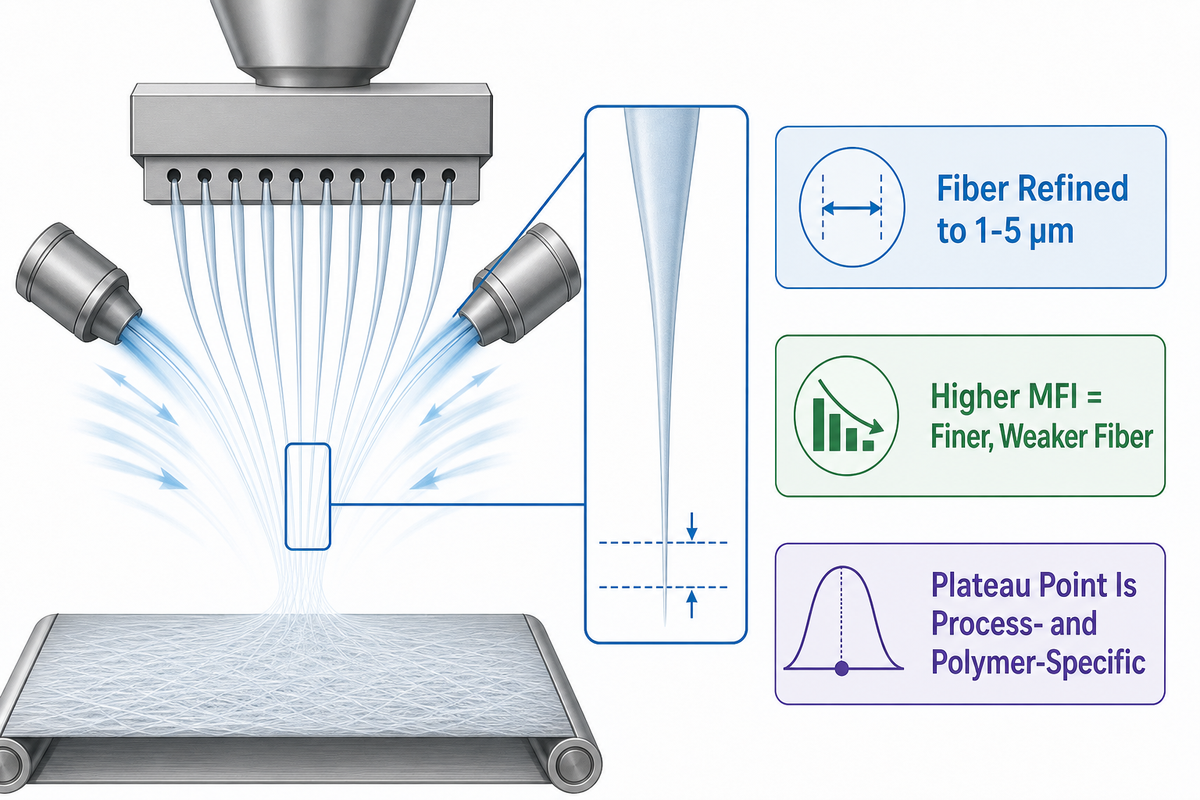
Melt-blown technology extrudes polypropylene and shapes the material into widely used, continuous fibers approximately 1-5 micrometers in length, diameter, using simultaneous high temperature and high velocity jets of air alongside the melt, which are self-bonded on a moving belt to create a graded-density depth filter. The two variables to define diameter in this process are the flow index of the polymer, melt, and the design of the blowing unit, specifically the die pressure and the distance between the die and the collector.
There’s a documented tradeoff at the heart of this: a higher melt flow index resin flows more easily and spins into finer fiber, but that same higher-fluidity resin has a lower molecular weight and produces mechanically weaker fiber, so producers running fine, low-micron media are trading some tensile strength for filtration fineness. Research on polypropylene-based melt-blown nonwoven materials also documents a plateau effect in the process geometry: fiber diameter continues to shrink as die air pressure and die-to-collector distance increase, but that sensitivity flattens out past a certain point (one study puts it near 35 kPa and 35 cm, though other published research on different equipment reports a plateau closer to 12 cm, so treat either number as a starting point rather than a fixed target), and pushing either variable further past that point buys very little additional fineness for the added energy and equipment stress it costs.
When considering a melt-blow production line purchase, a client is justified in requesting an explanation of a supplier’s fiber-diameter claim, as the claim is of little value without a resin’s melt flow index and the die’s operational pressure. A finer-fiber claim built on a higher MFI resin should result in a request for clarification on the media’s burst strength and dirt retention, as this tradeoff is a documented feature of the process, not a defect of a particular supplier.
According to a 2025 review of polypropylene-based melt-blown nonwoven materials published in Polymers and hosted on the National Institutes of Health’s PubMed Central archive, fiber diameter is refined “to 1–5 μm” by the high-velocity air jets, and researchers who systematically varied die temperature, air pressure and die-to-collector distance found that “fiber diameter decreases with increasing air pressure and DCD until reaching plateaus at 35 kPa and 35 cm, respectively, beyond which, sensitivity diminishes”, see Advancements in Research and Applications of PP-Based Materials Utilizing Melt-Blown Nonwoven Technology, Polymers (2025).
📐 Engineering Note
For a melt-blown line, both die pressure and die-to-collector distance sit on a diminishing-returns curve. Once a line is already running near 35 kPa and 35 cm, the marginal benefit of pushing either variable further declines sharply against the added energy consumption and die wear it introduces, worth raising with a supplier who advertises fiber fineness driven mainly by extreme pressure settings rather than resin selection.
Inside String-Wound Winding: Why Density Grading Needs More Than a Cam
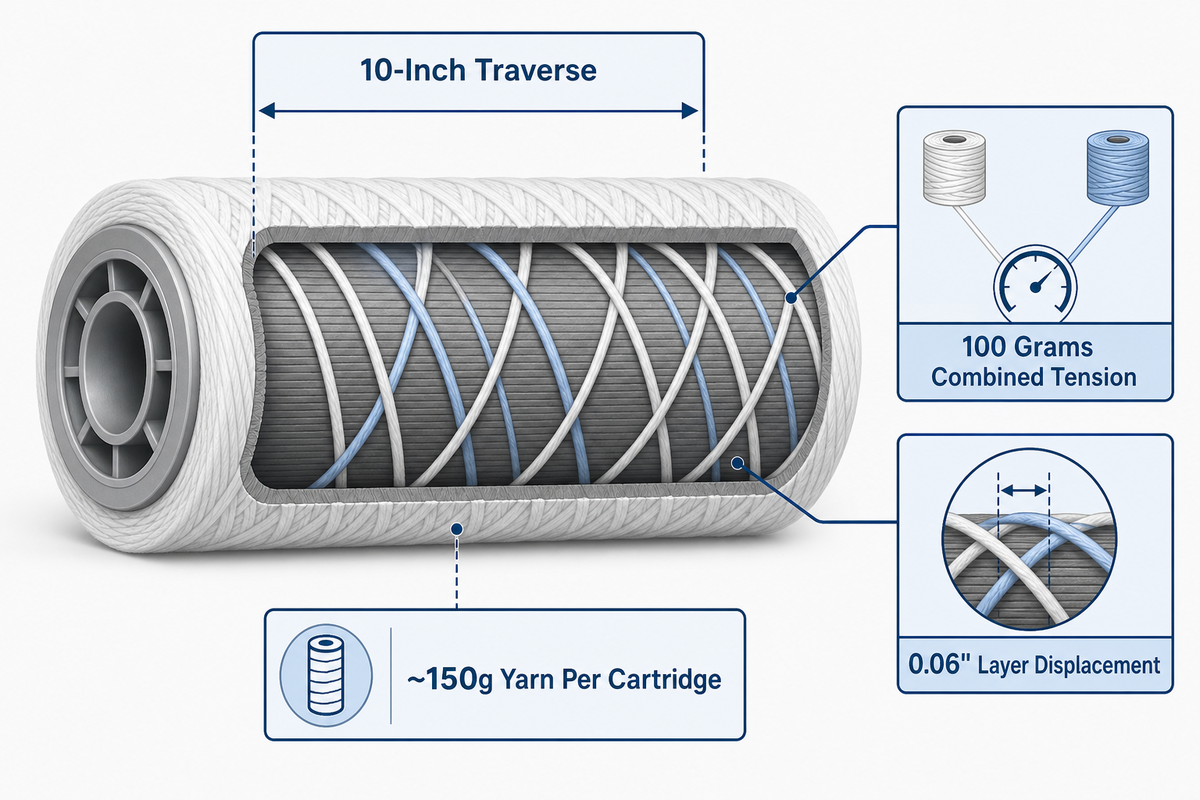
The size of the particles captured in the finished cartridge is set predominantly by how yarn is wound in the string-wound cartridge. Winding tension, lateral displacement between passes of the traverse, and the pattern density of bundled filaments all influence the pore size of the media. Two cartridges wound from the same yarn can have substantially different effective micron ratings if the winding geometry varies.
US Patent 6,942,106, assigned to Syntech Fibres and covering a spin-finish-free polypropylene yarn filter cartridge, documents this concretely in its working example: a precision winding machine with a 10-inch traverse wound two strands of air-textured yarn onto the filter core at a combined tension of 100 grams, with the winding pattern adjusted so that each successive layer was displaced by approximately 0.06 inch from the layer beneath it, using roughly 150 grams of yarn per finished cartridge. The patent’s description states that “the size of the particles that the filter will retain will depend upon the quantity of yarn wound, the tension at which the yarn is wound, the lateral displacement between corresponding yarns on each successive traverse of the winding, [and] the diameter of the individual filaments.” The selection of the material is a superadded variable, pertaining to the winding geometry, and not a subordinate variable to it.
The relevant question for a buyer considering string-wound winding machines isn’t “what yarn does this machine use?” Rather, it’s “what winding-tension and traverse-displacement control does this machine possess, and how repeatable?” A machine which lacks both of these controls will yield cartridges with micron rating drift across a full production run, even if every spool of yarn fed into it is identical.
“The size of the particles which the filter will retain will depend on the amount of yarn wound, the tension at which yarn is wound, the lateral displacement between corresponding yarns on each subsequent traverse of the winding, the diameter of the individual filaments, and the air texturing structure and loop formation.”
US Patent 6,942,106 B1, “Wound Polypropylene Yarn Filter Cartridge and Method for Making Same,” 2005
The Landed Cost Buyers Forget: Duty, Processing Fees and Electricity
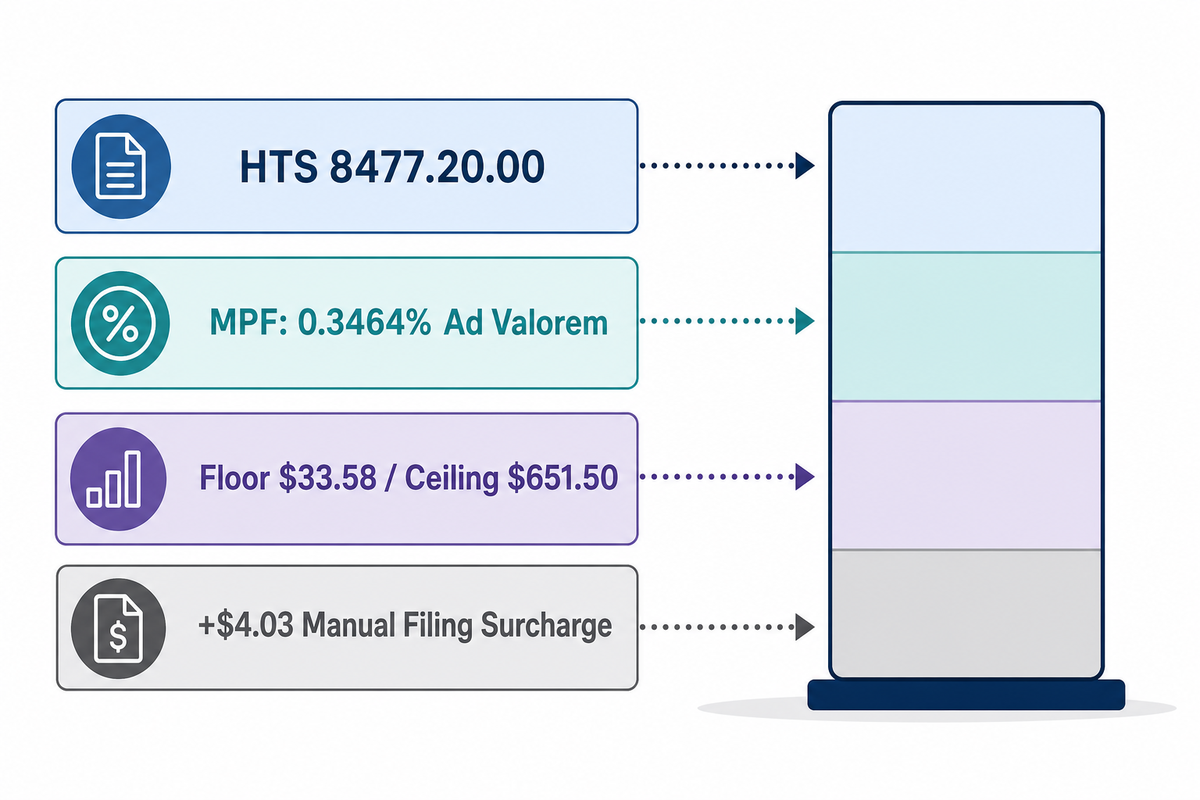
The price of a filter cartridge making machine isn’t the price quoted on the invoice. The import of the equipment to the USA incurs a customs fee that’s charged to the importer. There’s an additional cost of electricity to run the equipment that’s charged on a monthly basis. These costs are generally not included in the supplier’s quote, but they’re known costs, and can be predicted, and they scale with which full production-line configuration a buyer selects, not just the core machine.
US Customs and Border Protection imposes Merchandise Processing Fees on formal machinery entries at an ad valorem rate of 0.3464% of the goods’ value (excluding duty, freight and insurance) with a statutory floor of $33.58 and a ceiling of $651.50 per formal entry for fiscal year 2026, plus a $4.03 surcharge if the entry is filed manually rather than electronically. Filter cartridge making machines are classified in the Harmonized Tariff Schedule under heading 8477.20.00, “Extruders for Working Rubber or Plastics”; therefore, the current column-1 general duty rate should be looked up directly on the US International Trade Commission’s HTS search tool by each buyer at the time of order, as rates are changed periodically and trade-action surcharges can’t be captured accurately by a static article.
On the operating side, the US Energy Information Administration reported average industrial electricity revenue of 9.17 cents per kilowatt-hour nationally as of June 2026. Running the calculation through for a representative 70 kW melt-blown line operating two shifts (16 hours per day, 300 production days per year): 70 kW × 16 hours × 300 days = 336,000 kWh per year, which at 9.17 cents per kWh works out to roughly $30,811 in annual electricity cost for that single line, before accounting for auxiliary equipment such as chillers, compressed air, and material handling, which typically add another 15–25% on top of the core extrusion load.
Landed-cost checklist, 70 kW melt-blown line example:
| Cost item | Basis | Approximate figure |
|---|---|---|
| Merchandise Processing Fee | 0.3464% ad valorem, FY2026 floor/ceiling | $33.58–$651.50 per formal entry |
| Import duty | Column-1 general rate under HTS 8477.20.00 | Check current USITC HTS schedule at order time |
| Electricity, core extrusion load | 70 kW × 16 h/day × 300 days/yr × $0.0917/kWh | ≈$30,811 per year |
| Electricity, auxiliary systems | Chillers, compressed air, material handling | Add 15–25% to core extrusion figure |
What Certification Actually Proves, and What Any Machine Cannot Prove
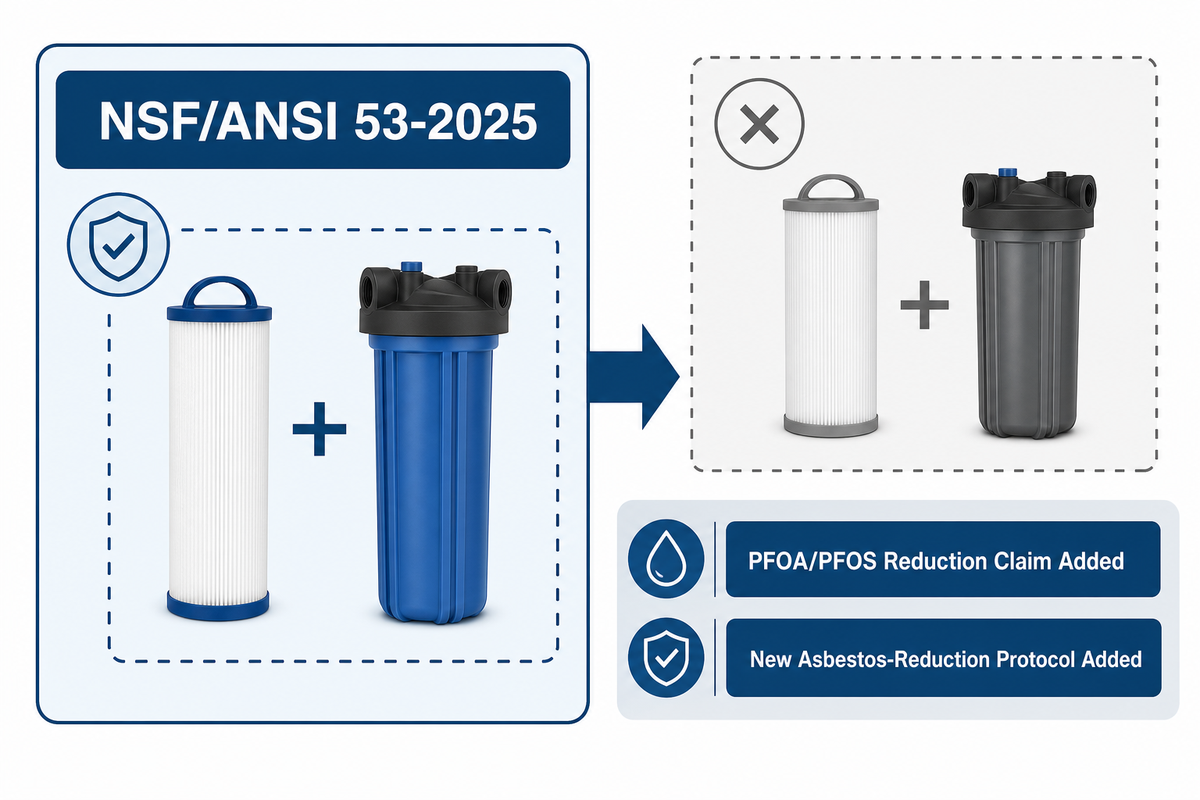
A certification such as NSF/ANSI 42 or NSF/ANSI 53 attaches to a specific finished cartridge model, tested under that standard’s protocol. It does not, and cannot, attach to the machine that produced it. A production-line certificate cannot be transferred to every cartridge the line will manufacture, because the certification test assesses a sample of the product against a specific version of the standard at a specific time, rather than an abstract manufacturing process.
NSF/ANSI 53, “Drinking Water Treatment Units (Health Effects),” was revised in 2025 to add PFOA/PFOS reduction claims and a new asbestos-reduction protocol, a reminder that certification is not a one-time event: a cartridge certified against an earlier revision of the standard is not automatically certified against the current one, and a buyer relying on a certification claim should confirm which revision year the certificate covers.
Three checks separate a verifiable certification claim from an unverifiable one: first, confirm the certifying body, NSF, IAPMO, or WQA, actually lists the specific product on its own public database, rather than accepting a supplier’s PDF at face value; second, confirm the certificate names the exact cartridge model and dimensions being purchased, not a “family” or “series” claim that could cover a different SKU; third, confirm the certificate’s date and standard revision cover the batch currently being produced, not a batch certified years earlier under an older version of the standard.
A certification only signifies that one tested sample of one specific cartridge model satisfied one standard’s requirement on one test date. So, a certification should be thought of as evidence of the product and not evidence of the machine and practically, ceases to be of any value, whenever the underlying standard is revised.
Reading Global Demand Right: Is This a Growing or Maturing Category?
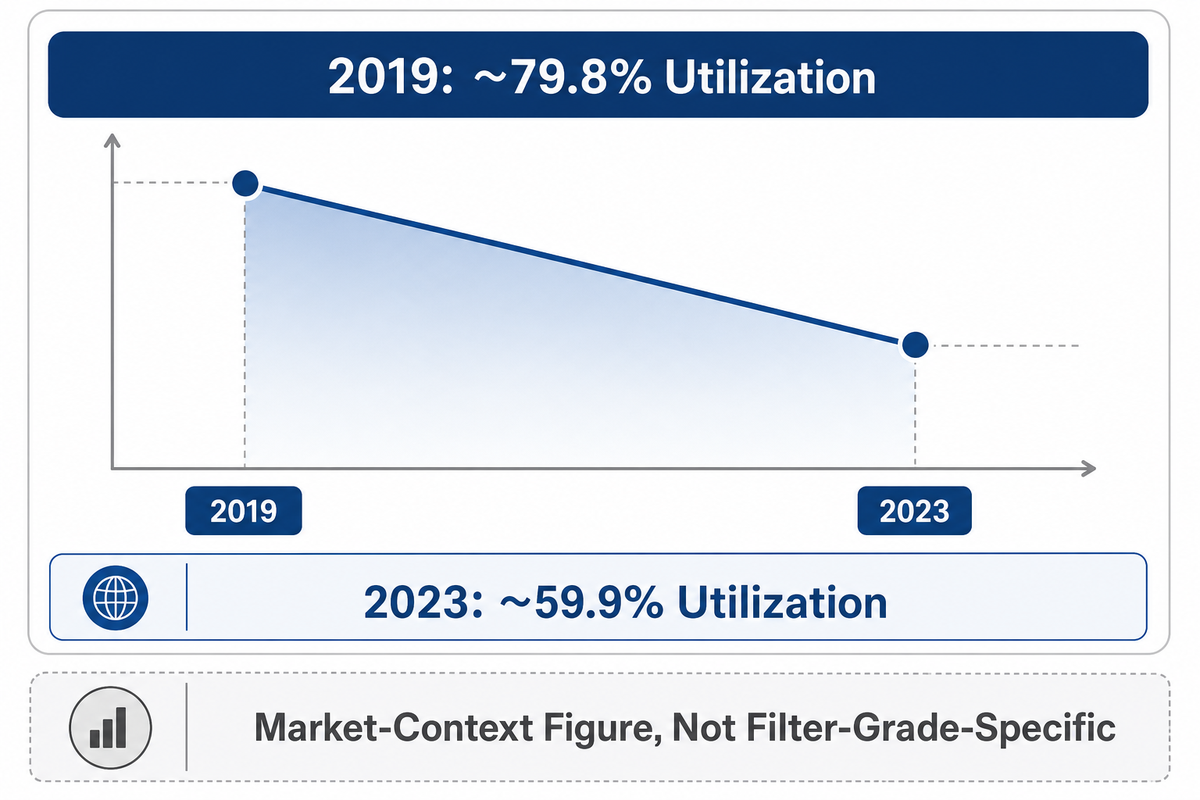
Global stand-alone melt-blown nonwoven production capacity utilization fell from an estimated 79.8% in 2019 to an estimated 59.9% in 2023, according to industry analyst David Price of Price Hanna Associates, writing in Nonwovens Industry, the drop reflects the surge of new melt-blown line installations triggered by pandemic-era face-mask demand, which more than doubled the number of stand-alone melt-blown machines installed worldwide between 2019 and 2023, followed by demand normalizing back toward pre-pandemic levels once that surge passed.
This is a market-context figure, not a forecast specific to filter-grade melt-blown lines, Price Hanna’s analysis covers stand-alone melt-blown capacity across all end uses (absorbents, insulation, wipes, hygiene and face masks, in addition to filtration), and the source itself projects that global capacity utilization across all these markets is unlikely to normalize before roughly 2031 under a moderate demand-growth assumption. For a buyer, the useful takeaway isn’t a growth percentage to quote in a pitch deck, it’s that global melt-blown capacity currently has meaningful headroom, and installed-base oversupply in adjacent nonwoven markets can put downward pressure on machine resale values and used-equipment pricing for melt-blown lines more broadly, even though filter-grade demand specifically hasn’t been the segment driving the oversupply.
Since there’s considerable capacity and potential, the relevant question when placing an order for a melt-blown production line isn’t, “Is this a growing category,” but, “Does the line I’m purchasing serve an end use, filtration, in this case, where demand is structurally different from the segment that created the current oversupply, namely face masks.” Historically, demand for filtration end uses (water treatment, industrial process filtration, and beverage filtration) has been more predictable and stable compared with mask media, and, hence, melt-blown filter cartridge lines haven’t seen the same idle-capacity pattern as general-purpose stand-alone melt-blown lines built primarily for mask media.
Unit Economics: Why Your Feedstock Supplier Decides Your Margin
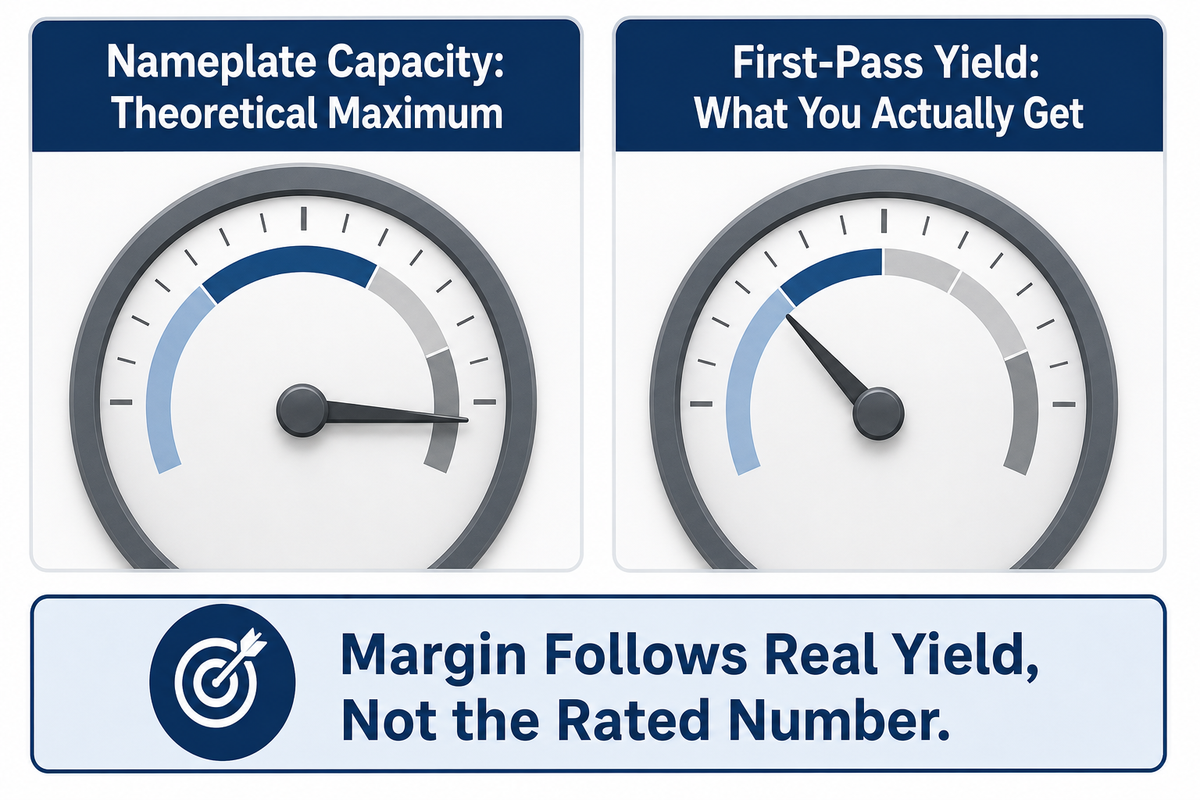
The cost that actually dictates margin for one filter cartridge production line is cost per one thousand good cartridges produced, compared to real daily output and real yield, not machine’s rated nameplate capacity, which refers to a theoretical maximum under ideal conditions that a production floor rarely sustains shift after shift.
Nameplate numbers allow some machine comparisons on paper, but they won’t provide insight into the yield someone will receive with a particular feedstock as it’s processed by different operators and is maintained at different levels. Machines that are rated for a certain daily output and operate at 90% yield will produce different unit economics compared to machines that operate at 70% yield due to inconsistencies in the feedstock polypropylene, or poorly maintained dies, and more times than not, the machine’s rated speed means very little, as feedstock supplier consistency will usually mean the bigger yield gap.
The valid question buyers should ask when evaluating a production line’s economics is to ask prospective machine, or feedstock, suppliers for real good-unit yield numbers obtained on said equipment, rather than asking for a rated capacity number. A supplier that’s able to provide a first-pass yield percentage, and is able to explain what drives yield variance, is providing a much better number than a nameplate number.
Supplier Due-Diligence Checklist Before You Wire a Deposit

The checklist below is designed to be generic, so it can be used to evaluate all filter cartridge making machine numbers provided by all potential suppliers, rather than evaluating one vendor at a time, including the third-party test report needed to confirm which side of The 78-Point Spread a supplier’s cartridges actually fall on.
RFQ checklist — copy these into your quote request:
| Parameter | Recommended range | Why it matters | How to verify |
|---|---|---|---|
| Legal entity registration | Registered manufacturer, not a trading-company reseller | Determines who is contractually liable for warranty and spare parts | Request business license and cross-check against the factory address on the FAT invitation |
| Factory acceptance test (FAT) protocol | Written protocol, signed by both parties, before shipment | Establishes an objective, dated record of what the machine could do before it left the factory | Request the protocol document itself, not just a verbal confirmation that FAT “will happen” |
| Capacity figures requested | Good-unit output per shift, with stated basis weight/micron rating held constant | Nameplate capacity without a yield qualifier overstates real output (see Unit Economics above) | Ask for FAT run data showing total output vs. good-unit output at a specific setting |
| Certifying-body verification | Certificate listed on NSF, IAPMO, or WQA’s own public database | A PDF alone cannot confirm the certificate is current or genuine (see Certification above) | Search the certifying body’s official site directly using the model number on the certificate |
| Spare-parts lead time | Written commitment in weeks, for the top 5 wear parts | Undocumented spare-parts promises are the most common post-sale dispute | Request the commitment in the contract, not the sales conversation |
| Unit-conversion baseline | 1 inch = 25.4 mm exactly (NIST-defined) | Spec sheets translated from imperial to metric (or the reverse) sometimes round this conversion, shifting tolerance bands | Recalculate any converted dimension against the exact 25.4 mm figure before accepting a metric spec sheet |
| Third-party micron test report | ISO 16889 multi-pass report, dated within 12 months | The only way to confirm which side of The 78-Point Spread a cartridge sample actually falls on | Request the lab report by name, not a one-line efficiency claim on a datasheet |
| Automation and control documentation | PLC program version and I/O list for the fully automatic control system | Undocumented control logic makes future line changes and troubleshooting far slower | Ask for the control cabinet wiring diagram and PLC backup file at handover |
| Core diameter and end-cap customization | Match to buyer’s existing filter housings, confirmed in writing | A weld-sealed end cap or core that does not fit the housing makes the finished cartridge unusable | Request a sample cartridge for fit-check before committing to the full production run |
💡 Pro Tip
This checklist helps you identify certain production lines (melt-blown, string-wound, activated-carbon). The next step will be to compare specific machine specifications and pricing instead of doing general supplier due diligence. Our filter cartridge making machine comparison page provides a good summary of UDTECH’s three production lines relevant to your next step in the decision-making process. Once the core making machine is chosen, downstream cartridge assembly and finishing equipment end-cap welding, trimming, and packaging, is a separate purchase decision worth qualifying with the same checklist above.
Frequently Asked Questions
Q: What are the different types of filter cartridges?
Melt-blown, string-wound, and pleated/activated-carbon cartridges are the three families this guide covers, each produced on a different machine platform with its own process controls and micron-rating conventions, as detailed in the sections above.
Melt-blown cartridges use continuous polypropylene fiber extruded and self-bonded into a graded-density depth filter. String-wound cartridges use yarn wound onto a core in a controlled pattern of tension and density. Pleated and activated-carbon cartridges use impregnated media or carbon-block material pleated to maximize surface area. Each platform runs on a different machine, with its own process controls and micron-rating conventions.
Q: What are the disadvantages of cartridge filters?
Cartridge filters have finite dirt-holding capacity and must be replaced on a schedule, unlike backwashable media filters, and printed micron ratings are not standardized across manufacturers, which can lead buyers who compare only the label to under-specify filtration for their application.
Back-washable media filters can be regenerated on site, but cartridges cannot, once the dirt-holding capacity has been exhausted, the cartridge itself must be replaced on a schedule. Micron ratings also are not standardized (which is related to The 78-Point Spread discussed earlier), so two cartridges that are both rated at “1 micron” can have significant performance variation, and a buyer who reviews only the printed rating can potentially under-specify filtration for a given application.
Q: Why do different suppliers publish different micron ratings for what looks like the same yarn?
Winding geometry, tension and traverse displacement on the machine, not the yarn spool feeding it, sets the finished micron rating, per US Patent 6,942,106; two suppliers running visually identical yarn through machines with different tension control will produce different effective ratings.
As explained in the section on string wound, US Patent 6,942,106 points out that particle retention size depends on winding tension, lateral displacement between successive traverse passes, and filament diameter; all terms that are controlled by the winding machine, not by the yarn spool. If two suppliers adopt different tensions and traverse control on their yarn passing through machines, they will produce cartridges with different effective ratings.
Q: Are import duties the same for every filter cartridge machine supplier?
The HTS classification and Merchandise Processing Fee formula are the same regardless of supplier, but the applicable column-1 duty rate depends on country of origin and any active trade-remedy actions, so it should be re-checked at the time of each order rather than assumed from a prior purchase.
All filter cartridge making machines imported into the US fall under the same HTS heading, 8477.20.00, and the Merchandise Processing Fee formula (0.3464% ad valorem, subject to the FY2026 floor and ceiling described above) applies uniformly regardless of supplier. The column-1 general duty rate for that heading, however, is not supplier-specific. It is tied to country-of-origin rules and any active trade-remedy actions, both of which change independently of who the buyer chooses to order from, so the rate should be re-checked on the USITC’s HTS schedule at the time of each order rather than assumed to carry over from a previous purchase.
Q: How much does a filter press cost?
Filter presses are a different equipment category from filter cartridge making machines, used for sludge-dewatering and solid-liquid separation and priced on plate count and chamber volume rather than the landed-cost factors this guide covers for cartridge production lines.
Sludge-dewatering and solid-liquid separation in wastewater and industrial process filtration is what a filter press does; it does not manufacture filter cartridges, and its pricing runs on a completely different basis, number of plates, volume of chambers, and size of hydraulic systems, none of which line up against the landed-cost framework in this guide. Readers researching filter cartridge making machine pricing specifically should use the duty, MPF, and electricity calculation walked through above rather than filter-press cost benchmarks, since the two equipment categories do not share a cost structure, a supplier base, or an HTS classification, and pricing intuition built on one will not transfer usefully to the other.
References & Sources
- Advancements in Research and Applications of PP-Based Materials Utilizing Melt-Blown Nonwoven Technology Polymers, 2025, hosted on PubMed Central (National Institutes of Health)
- US Patent 6,942,106 B1, Wound Polypropylene Yarn Filter Cartridge and Method for Making Same United States Patent and Trademark Office, 2005
- Merchandise Processing Fee, Customs User Fee Schedule, FY2026 US Customs and Border Protection
- Harmonized Tariff Schedule of the United States, Heading 8477.20.00 US International Trade Commission
- Electricity Monthly Update, End Use, June 2026 US Energy Information Administration
- NSF/ANSI 42, 53 and 401: Filtration Systems Standards NSF International
- NSF/ANSI 53-2025: Drinking Water Treatment Units, Health Effects American National Standards Institute
- Stand Alone Meltblown Capacity Utilization Post Covid David Price, Price Hanna Associates, Nonwovens Industry, 2024
About This Analysis
This guide synthesizes published US patent records, government trade and energy data, and industry-analyst reporting on melt-blown nonwoven capacity for comparison with the specification and certification questions that our sales and engineering teams receive when customers assess a melt-blown, string-wound, and activated-carbon filter cartridge production line. This was prepared by the Suzhou UDTECH Technology Co., Ltd. technical team.