Get in touch with Suzhou UDTECH Technology Co., Ltd. Company

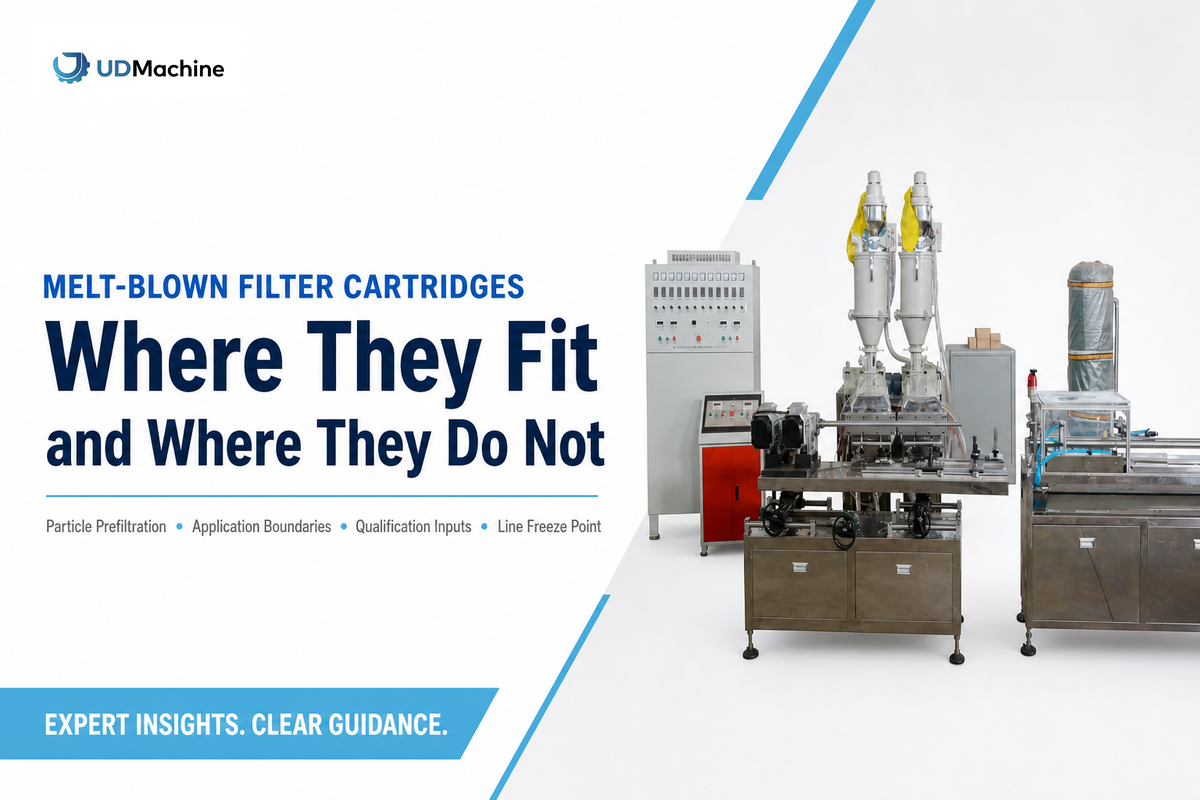
Melt blown filter cartridge applications are uses of a polypropylene depth cartridge for suspended-particle removal: sediment removal, equipment protection, clarification and pre-filtration ahead of a more discriminating downstream step. Melt-blown depth filter cartridges span a wide range, from water filtration to other liquid filtration duties, but the right cartridge is not chosen by industry name alone; the fluid, contaminant, rating basis, flow, temperature, differential pressure and connection all have to agree.
This guide covers practical use groups across water, reverse osmosis, food and beverage, chemicals, plating, coatings, electronics, cosmetics and pharmaceutical prefiltration. It also marks the rejection point for each use, because “polypropylene,” “5 micron” or “melt blown” does not prove chemical compatibility, food-contact compliance, sterile filtration or a predictable service life.
The short answer
Use an ordinary polypropylene melt-blown cartridge when you need economical depth capture of suspended solids and can define a changeout limit. Choose another medium, or a validated downstream stage, when the job is dissolved-contaminant removal, sterile final filtration, high-solids recovery, unusually high temperature, or a chemistry the complete cartridge hasn’t been qualified to handle.
What Does a Melt-Blown Filter Cartridge Actually Remove?
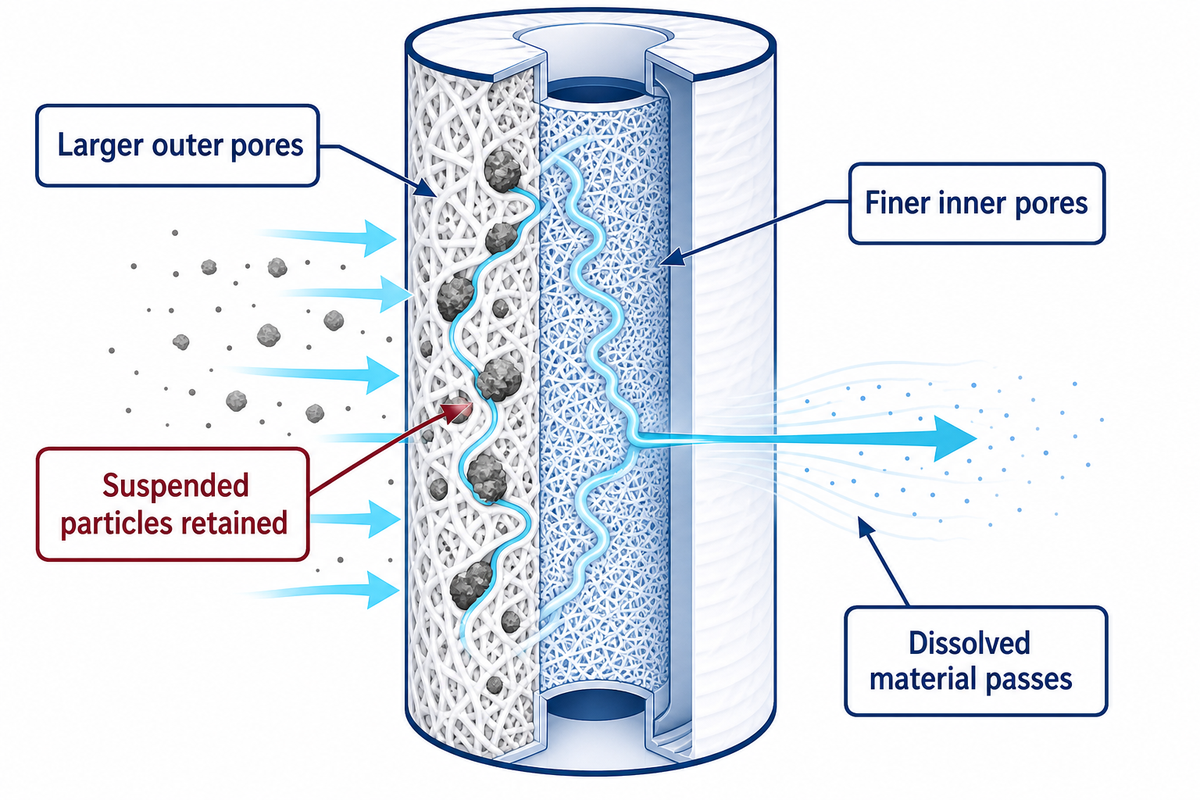
An ordinary, unmodified polypropylene melt-blown cartridge is a depth filter for suspended particles. It can trap silt, rust, process fines and other solids through a tortuous fibre matrix, but its micron label alone does not prove removal of dissolved chemicals, microorganisms or every particle above the printed size.
Melt blowing forms fine polymer fiber into a bonded three-dimensional web. Graded density places more open pores near the outside and finer pores deeper in the wall, allowing larger particles to load first while smaller particles travel farther into the media. A peer-reviewed depth-filter loading study found that deposits accumulate around fiber intersections and change local pore structure as loading progresses. That’s why pressure drop, dirt-holding capacity and filtration efficiency can evolve during a run instead of remaining fixed; high dirt-holding capacity should be verified for the qualified design, not inferred from the construction name.
The word “micron” still needs a rating basis. Nominal ratings state a manufacturer-defined removal level, while an absolute claim should be tied to a stated efficiency and test method. As an illustrative product-specific example, a manufacturer-published 3M Betapure NT-T technical document reviewed for this guide defines its own absolute rating at a beta ratio of 1,000, equal to 99.9% initial removal at the rated size. That historical document is not a current procurement specification or a universal definition; confirm the current series data with the supplier.
Even labels such as 0.5 µm, 1 µm and 5 µm remain incomplete until the supplier states whether each is nominal or absolute and how filtration efficiency was measured. The number names a particle-size reference; it doesn’t establish identical performance across different media, densities or test fluids.
Product-specific benchmark, not a universal specification: Pall’s reviewed brochure reports 99.98% retention for selected 1, 3, 6, 12 and 20 µm grades, 99.9% for selected 40, 70 and 90 µm grades, and a manufacturer-published 90% for selected 100, 150 and 200 µm grades. For its Claris example, the brochure derates the published maximum differential pressure from 3.45 bar at 20 °C to 1.72 bar at 60 °C. These values show why grade, temperature and test basis must travel with the number; they are not defaults for other liquid filter cartridges.
Important exception: chemically grafted, composite, adsorptive and photocatalytic PP melt-blown media can be engineered for ion or organic-pollutant removal. A 2025 peer-reviewed review documents those functionalised research materials. Do not transfer their results to a conventional unmodified cartridge without the same chemistry, construction and test evidence.
Sediment Removal and Reverse-Osmosis Prefiltration
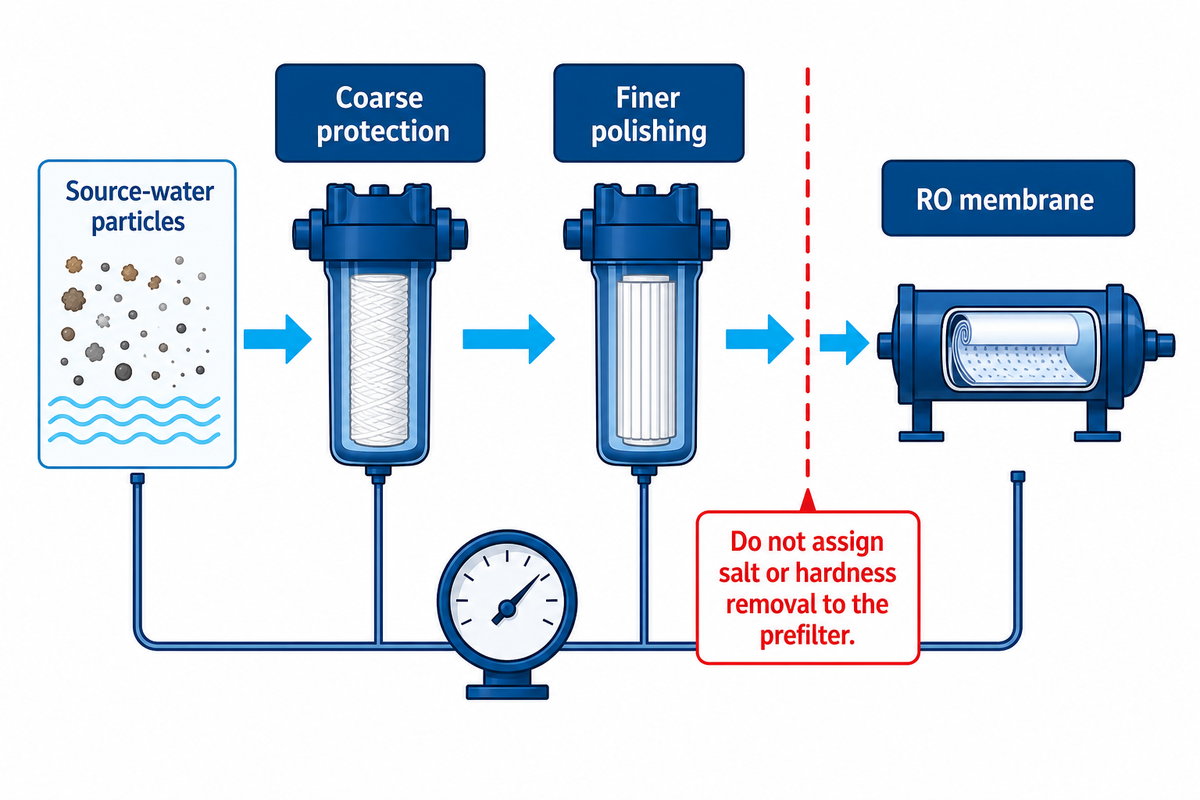
In their simplest implementation, melt-blown cartridge applications cover sediment control and RO pre-filtration: the filter is placed upstream of valves, a carbon bed, a membrane or a spray device to protect fine elements or sensitive downstream components. The reviewed study of particulate loading in gradient melt-blown fibrous filters supports the depth-loading mechanism, not a universal downstream-protection guarantee. Size the filter against the intended load, overall capacity and allowable pressure loss.
In ordinary source water, the application might remove sand, pipe scale, corrosion products, piping debris, process fines or oxidised iron. On an RO, the application is reducing particulate loading on the membrane and protecting fine passages without reducing feed capacity. These filters cannot, by virtue of position, remove hardness, dissolved salts or chlorine.
Trying the finest available micron rating has backfired many times. For broad-spectrum particle loading, this can result in premature filter blinding, high differential pressure and/or reduced throughput even on fine media. Staging a coarser cartridge before a finer polishing cartridge may provide more stable operation, but any claim about filter life or high filtration efficiency still depends on housing area, solids load, fluid properties and the efficiency basis of both elements.
| Application category | Candidate role | Verify before selection | Reject or redesign when |
|---|---|---|---|
| Well-water sediment | Depth capture of sand, silt and oxidised solids | Particle distribution, peak turbidity, clean flow and housing area | Solids loading makes disposable changeouts uneconomic |
| Municipal or process-water protection | Catch pipe scale and intermittent particulate events | Upset load, bypass risk and downstream sensitivity | The target is dissolved taste, odour or ionic contamination |
| RO prefiltration | Protect membrane and small flow passages from particles | Required feed flow, rating basis, pressure budget and upstream treatment | The cartridge is being asked to remove salt, hardness, chlorine or microorganisms by itself |
| Beverage rinse water | Reduce particles before a validated downstream step | Wetted materials, sanitation and finished-system claim | A material label is being used as proof of final compliance |
| Food ingredient stream | Remove unwanted suspended solids | Viscosity, product yield, migration and extractables | The target solid is a valuable product fraction |
| Plating bath | Capture compatible bath particulates | Full chemistry, temperature, seals and waste route | Any wetted component lacks compatibility evidence |
| Paint or coating | Intercept hard agglomerates before application | Pigment size, gels, viscosity and finish acceptance | The filter removes an intended pigment or additive |
| Electronics process water | Particle prefilter before high-purity polishing | Wetted materials, extractables, ionic cleanliness, traceability and final-stage acceptance criteria | The generic cartridge must carry the final purity claim |
| Pharma or cosmetic prefilter | Reduce particulate load inside a validated train | Bioburden, endotoxin, sanitation, change SOP and final filter | It is being treated as a stand-alone sterile barrier |
Don’t blindly reuse the “changeout pressure” from the datasheet for the new cartridges. “Clean” differential pressure at specified operating conditions is the starting value for a new filter; the final differential pressure limit is defined by the housing design and cartridge manufacturer’s specification. Where pressure monitoring isn’t convenient, record delivered throughput or elapsed time. One water-treatment discussion described flow falling to a trickle when the filter was in service; that is a useful restriction clue, but inspection is still needed to distinguish sizing, excessive load, collapsed media or another fault.
Potable Water, Food and Beverage Processing
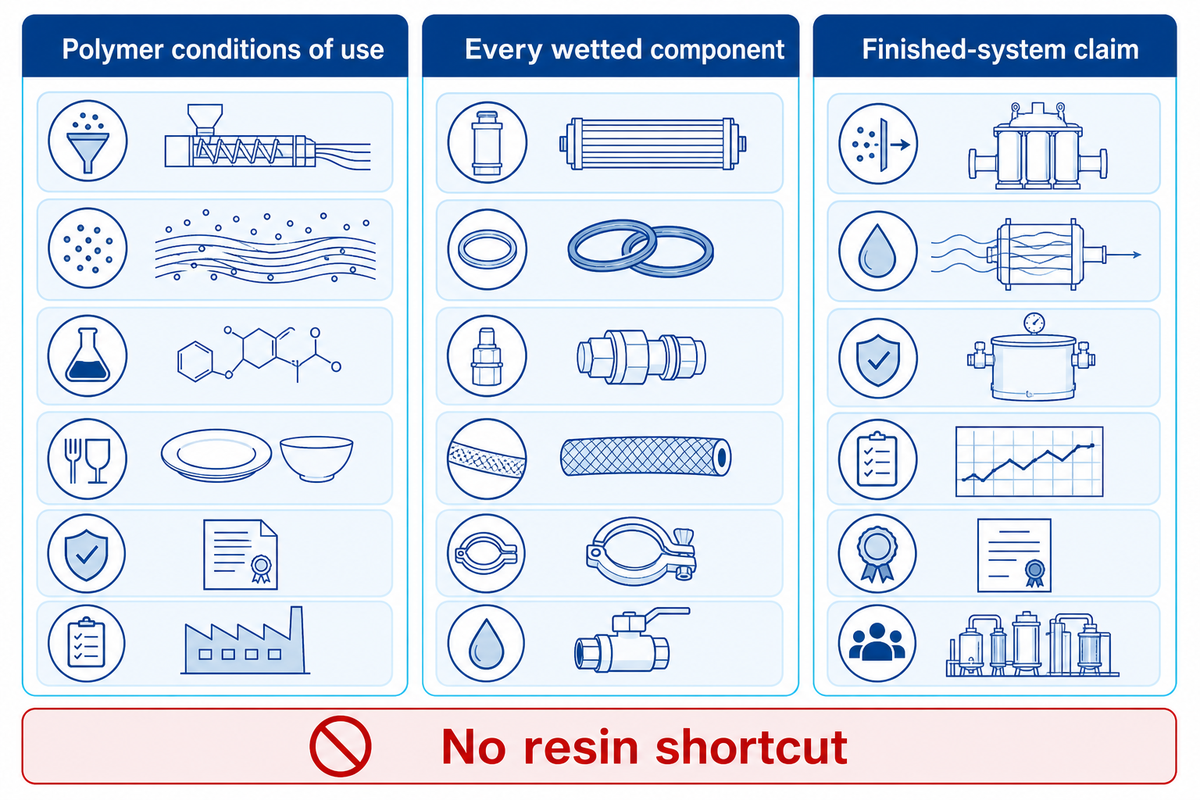
Potable water, process ingredients and beverages can benefit from a polypropylene melt-blown cartridge serving as a candidate particle prefilter. The usual qualifiers still apply: cartridge construction materials, extractables, operating pressures and temperatures, cleaning and sanitation practices, and the exact claim needed for the beverage or water application.
United States Title 21 food-contact language is easy to overstate. 21 CFR 177.1520 sets conditions for qualifying olefin polymers used as basic components of food-contact surfaces. It does not certify a complete cartridge, approve every additive, or demonstrate contaminant reduction by a finished filtration system. The FDA inventory likewise points polypropylene to multiple regulations whose intended uses and conditions control.
Finished-system claims are a separate question. NSF explains that Standards 42, 53 and 401 address different aesthetic, health-related and emerging-contaminant claims, with material safety, structural integrity and specific reduction testing. No resin declaration or component listing can establish a finished-system claim without the corresponding scope.
Procurement question: ask for the material declaration for every wetted component, the intended conditions of use, extractables or migration evidence where relevant, sanitation limits and the exact system or component certification listing. “Food grade PP” is not a complete answer.
For beverage clarification, syrup or ingredient-water protection, the cartridge should be a particle-control step unless the supplier provides separate evidence for adsorption, microbiological reduction or sterile service. High viscosity can also change the clean pressure drop dramatically. Confirm viscosity at operating temperature, because a water curve can’t be copied directly to a more viscous product.
Chemicals, Plating Baths, Amine Systems and Oils
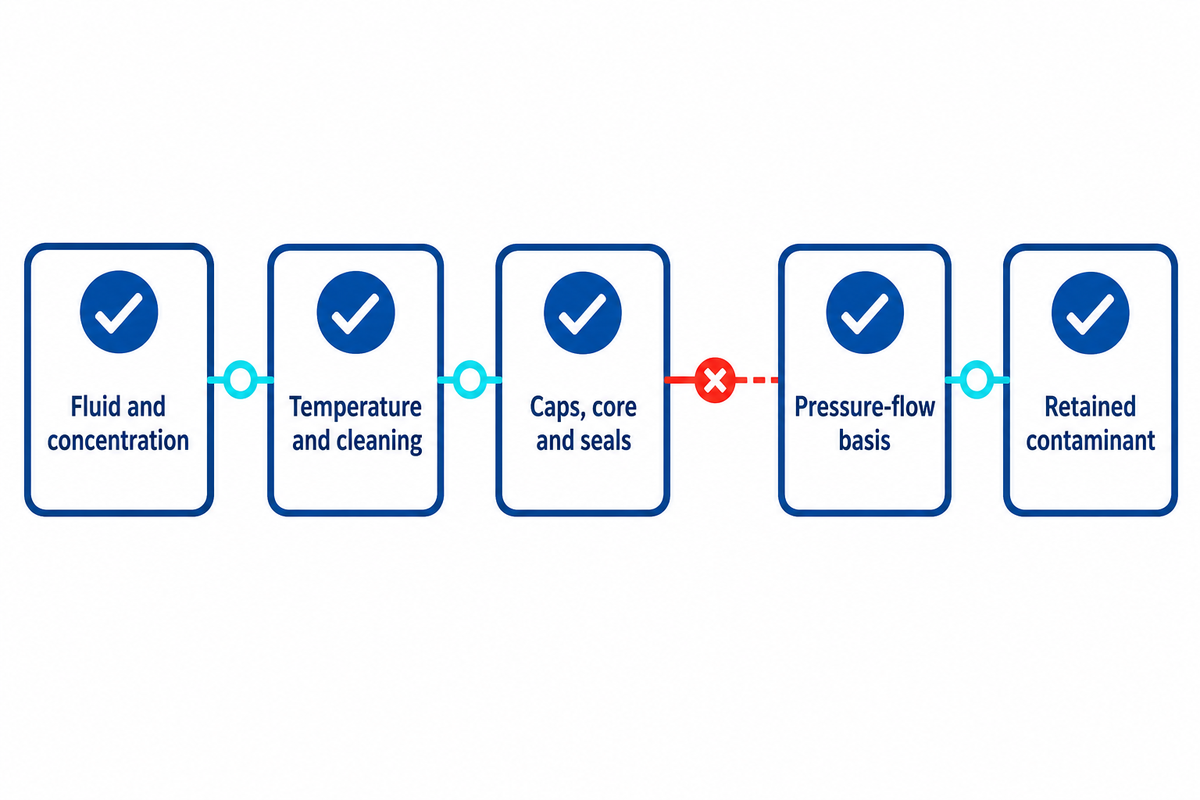
Melt-blown polypropylene cartridges may be evaluated for particulate control in compatible chemical liquids, plating baths, aqueous cleaners, amine systems and selected oils. The application is acceptable only after the complete cartridge, not just the PP media, has been checked against the exact chemistry and operating envelope; a melt-blown sediment label is not a compatibility test. A peer-reviewed review of functionalised polypropylene melt-blown media shows that adsorptive and other added functions require a different construction and evidence set from an ordinary particle cartridge.
Compatibility decisions need the chemical name, concentration, mixture composition, temperature, exposure time and cleaning cycle. End caps, cores, gaskets, O-rings and any support layer can fail before the melt-blown wall does, limiting cartridge durability. “Polypropylene has broad chemical resistance” is therefore a direction for screening, not a release decision.
Contaminant form matters just as much. Rigid fines can load a depth matrix predictably; deformable gels may smear over pores, cause rapid pressure rise or push through under higher differential pressure. High-viscosity oils can create a large clean pressure drop even when the particle load is modest. Ask for a pressure-flow curve at the relevant viscosity or correct the water curve using the manufacturer’s method.
Chemical service release checklist
- Full fluid name and concentration, including cleaners and upset mixtures
- Normal and maximum temperature
- Continuous or intermittent exposure time
- All wetted cartridge materials, seals and housing metallurgy
- Required retention basis and allowable differential pressure
- Disposal route for the retained contaminant
End-of-service handling and the receiving environment belong in the application decision. Spent polypropylene cartridges from plating baths, oil loops or chemical processes may carry the hazardous properties of the retained material. Do not assume a spent cartridge is benign or suitable for ordinary disposal merely because the clean cartridge began as polypropylene; waste status depends on the retained material and the applicable jurisdiction.
Coatings, Electronics, Cosmetics and Pharmaceutical Prefiltration
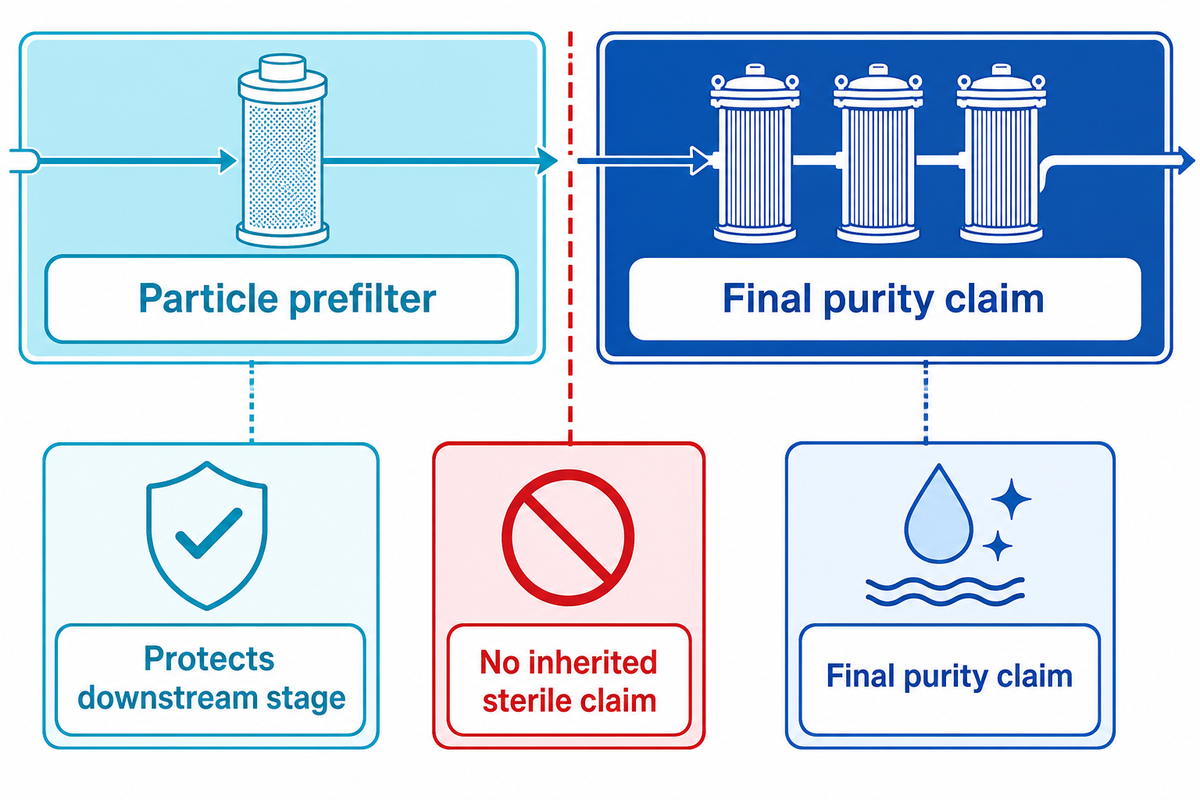
In coatings, electronics, cosmetics and pharmaceutical processes, an ordinary melt-blown cartridge is best treated as a particle prefilter. It may protect a nozzle, resin bed, membrane or final filter, but it doesn’t inherit that downstream step’s purity, microbial-retention or sterile claim.
Paints, inks and coatings can contain pigments, gels and valuable solids by design. Removing the wrong fraction changes the product, while a cartridge that’s too open may pass agglomerates that mark a film or block a spray tip. Define whether the unwanted material is hard particulate, soft gel or an out-of-spec agglomerate, then qualify the cartridge against product appearance and yield, not just against a micron number.
For electronics process water or chemical distribution, treat the cartridge as a candidate particle prefilter for high-purity polishing rather than the owner of the final purity claim, and include extractables and ionic cleanliness in qualification. Ask the supplier to identify every wetted material and provide traceability appropriate to the process. Request rinsing, extractables and lot-traceability evidence appropriate to the process, and make the final membrane or polishing stage responsible for the final quality claim.
Pharmaceutical water needs a still tighter boundary. An older FDA High Purity Water System inspection guide, used here as a risk-control example rather than a current regulation, says filters should have a stated purpose and a change procedure based on validation data. It also warns that point-of-use filters can mask microbiological contamination and do not necessarily reduce endotoxin. Current regulatory and validation requirements still govern. For that role, a melt-blown depth cartridge can be evaluated for particulate prefiltration, but it is not a shortcut around bioburden control, endotoxin monitoring, sanitation, system validation or sterilising-filter integrity testing.
Reject the umbrella claim: one cartridge specification cannot simultaneously prove cosmetic cleanliness, electronics-grade extractables, beverage food contact and pharmaceutical microbial control. Each is a separate qualification package.
The Fluid-Duty Release Envelope
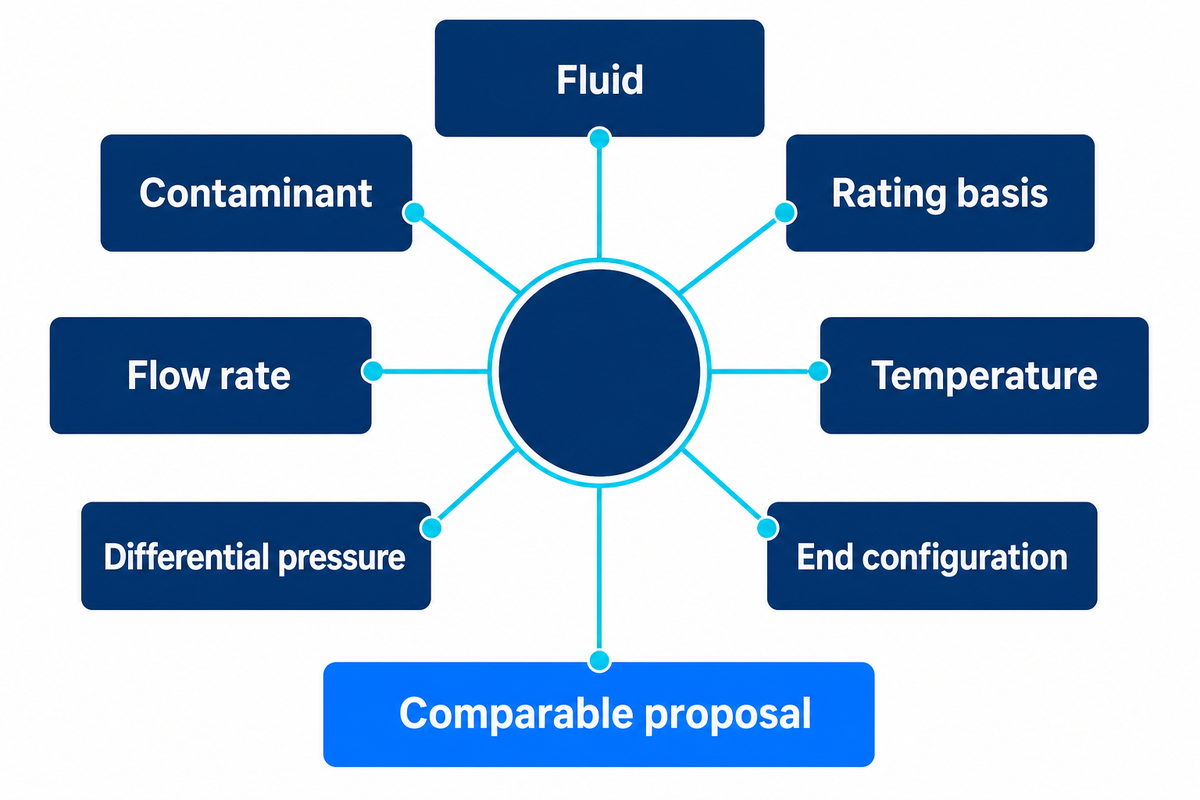
Melt-blown cartridge applications are ready to compare only after seven inputs are fixed: fluid, contaminant, rating basis, flow rate, temperature, differential pressure and end configuration. If any one is unknown, two proposals with the same length and micron label may solve different filtration needs.
7-Field Product-Data Normalization Rule
Keep supplier, series, grade, retention, test basis, fluid and operating condition in one record. In the reviewed Pall example, 1 µm, 3 µm, 6 µm, 12 µm and 20 µm grades are paired with 99.98% retention; 40 µm, 70 µm and 90 µm grades with 99.9%; and 100 µm, 150 µm and 200 µm grades with 90%. The same document’s Claris example pairs 3.45 bar with 20 °C and 1.72 bar with 60 °C. These are product-specific illustrations, not default values for another cartridge.
| Record field | Bound example | Control |
|---|---|---|
| Supplier | Pall | Do not transfer to another supplier |
| Product/series | Pall Melt Blown Filter Elements (PP); Claris DOE (PP) | Keep the series name with the data |
| Grade | 1 μm, 3 μm, 6 μm, 12 μm, 20 μm; 40 μm, 70 μm, 90 μm; 100 μm, 150 μm, 200 μm | Do not flatten grades into one generic micron claim |
| Retention | 99.98%, 99.9% and 90% for the listed groups | Keep each percentage with its grade group |
| Test basis | Supplier-published basis for the named product | Request the current method and document revision |
| Fluid | The fluid used for the supplier’s test or rating | Do not copy a water curve to another viscosity |
| Operating condition | 3.45 bar at 20 °C; 1.72 bar at 60 °C for the Claris example | Keep pressure paired with temperature |
| Release rule | Product-specific illustration only | Confirm the current supplier data before procurement |
| Input | What to provide | What goes wrong if omitted | Evidence to request |
|---|---|---|---|
| Fluid | Name, concentration, viscosity and mixture | Media or seal incompatibility; wrong flow curve | Complete-material compatibility review |
| Contaminant | Size distribution, concentration and form | Rapid blinding or unwanted product removal | Sample test or particle analysis |
| Rating basis | Nominal/absolute, efficiency and test method | Two “5 micron” offers are treated as equivalent | Efficiency curve or beta-ratio data |
| Flow | Normal, peak and batch volume | Excess clean pressure drop or too many housings | Pressure-flow curve at relevant viscosity |
| Temperature | Normal, maximum and sanitation cycle | Loss of strength, seal damage or chemistry change | Temperature-dependent operating limits |
| Differential pressure | Clean value and terminal limit | Short life, deformation, bypass or unloading | Cartridge and housing limits by temperature |
| End configuration | Length, diameter, core, end caps, gasket and seal | Poor seating, bypass or physical incompatibility | Drawing, tolerance and housing interface |
The check is deliberately simple, but it changes the buying conversation. Instead of asking, “Do you make a 5-micron PP cartridge?”, the buyer asks for a cartridge that reaches a stated removal efficiency at a stated flow in a named fluid, stays inside a defined pressure and temperature envelope, and fits a known housing. That request can be tested.
Trial data should record at least clean pressure drop, flow, filtrate quality, throughput to the terminal condition and any visible media or seal change. If the application has a compliance claim, add the sampling plan and acceptance method before the trial begins. Visual inspection alone isn’t a substitute for the measurement the process actually needs.
When a Melt-Blown Cartridge Is the Wrong Choice
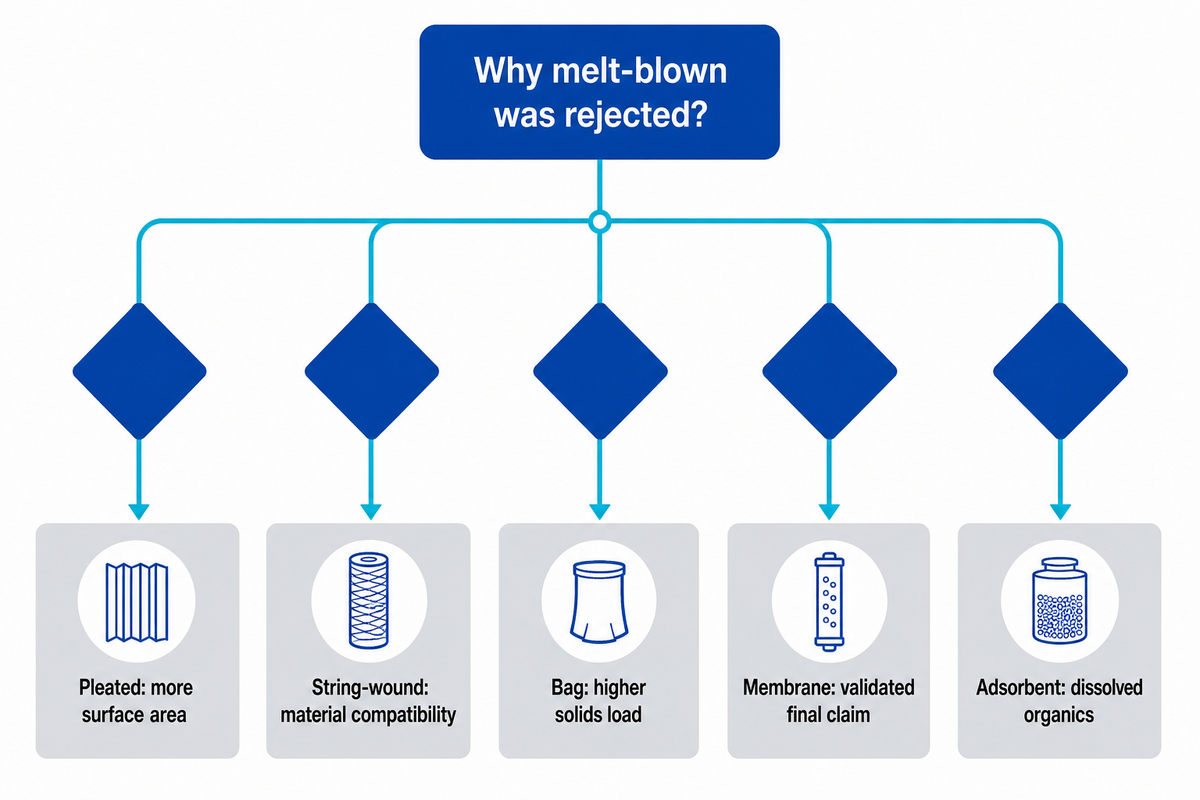
An ordinary nominally rated melt-blown cartridge may be the wrong choice when the job needs very high solids capacity, a washable surface, a tightly validated absolute rating, high-temperature resistance beyond the product limit, or removal by adsorption or membrane separation. The alternative depends on the reason for rejection rather than on a generic quality hierarchy.
| Filter type | Where it may win | Trade-off to check |
|---|---|---|
| Pleated cartridge | Large pleated surface area with low initial pressure drop and high flow capacity | Verify fluid-specific flow, viscosity, rating and collapse limit; also compare unit cost and surface-blinding risk under the actual gel or solids load |
| String-wound cartridge | Wide media, core and sealing options for varied chemical and temperature compatibility, including polyester media | Verify rating, winding construction and any required fibre-migration controls |
| Filter bag | Higher solids load, larger flow and faster changeout | Housing size, seal design and very fine filtration limits |
| Membrane or validated final filter | Defined microbial, fine-particle or separation claim | Cost, fouling sensitivity, integrity testing and pretreatment |
| Activated carbon or specialty adsorbent | Dissolved organics, chlorine, taste or odour where validated | Capacity, contact time, microbial control and media release |
The economic advantage is conditional. A Water Tech Online comparison used a 90 gpm cooling-water example to show how bag area, filter count, seals, shipping and changeout labour can favour a bag. The same article notes exceptions for low flow, limited installation space and very fine filtration. The useful lesson isn’t that bags always win; it’s that unit price alone is the wrong denominator.
Compare cost per accepted batch or cost per volume filtered to the terminal condition. Document cartridge count, downtime, waste handling, housing footprint, lost product and subsequent process-upset cost. An inexpensive cartridge which blinds early or allows passage of the critical contaminant simply isn’t economic.
How Application Requirements Change a PP Melt-Blown Production Line
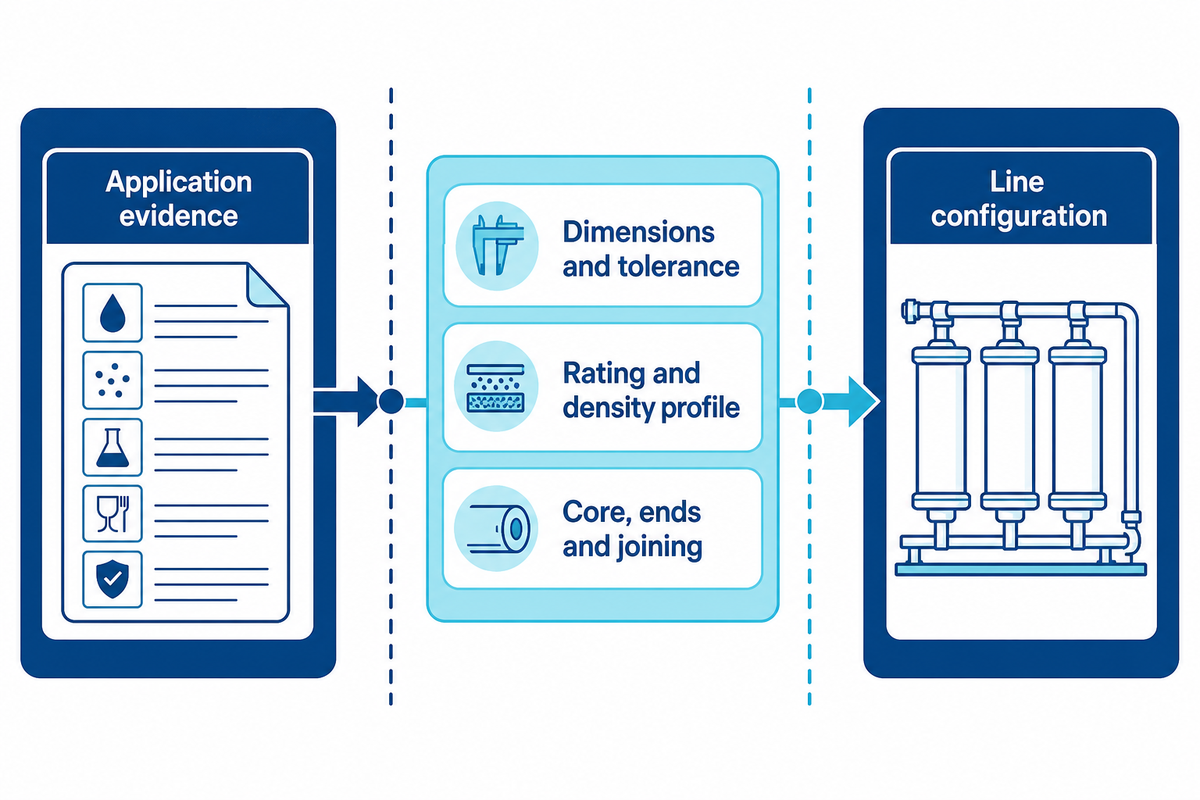
The application label alone won’t specify a manufacturing line; across the filtration industry, the intended cartridge geometry, rating basis, density profile, surface condition and core/end type must be defined before outlining necessary production modules, controls and downstream process support for the quote.
Water sediment cartridges may prioritise a broad rating range and economical open-end formats. Cartridges aimed at food-contact or high-purity prefiltration may add tighter control of the materials used, traceability, controlled end joining and validation documentation. Grooved or patterned surfaces change the forming and finishing requirement. Cored and coreless construction change the internal support strategy. Adapter ends, gaskets and welded caps introduce operations that a plain double-open-end element doesn’t need.
The current UDTECH page intentionally asks for the application before promising a machine configuration. Its PP melt-blown filter cartridge production line brief collects cartridge length and diameters, micron and rating intent, gradient-density target, surface, core/end condition, utilities and plant constraints. It doesn’t publish one universal capacity, power or footprint figure, so none is invented here.
Application-to-Line Freeze Point
Send a representative approved cartridge or drawing with these fields:
- Finished length, inside diameter, outside diameter and tolerance
- Nominal or absolute rating claim, efficiency basis and rating range
- Target mass, density profile and plain, grooved or patterned surface
- Core or coreless construction
- Open ends, caps, adapters, gaskets and joining method
- Resin and additive restrictions, traceability and intended compliance route
- Required output basis, electrical supply, compressed air, water, exhaust and available floor envelope
Suzhou UDTECH Technology Co., Ltd. provides equipment and lines for producing PP melt-blown, activated-carbon and wire-wound filter cartridges; a measurable product boundary is still needed. Define the product from the application before process design; do not define it merely to match an existing equipment specification.
Frequently Asked Questions
What is a melt blown filter cartridge?
A melt-blown filter cartridge is a cylindrical depth filter made from thermoplastic fiber, usually polypropylene. Fluid travels through its porous wall, retaining suspended particles along a tortuous path. Gradient structures place larger pores outside and finer pores inside. The printed micron value still needs an efficiency and test basis.
A commodity liquid prefilter cartridge is often disposable and used for sediment control or clarification. Performance across particles of different sizes still depends on the rating basis, density profile, flow, fluid properties and terminal differential pressure. The name describes a production process and construction family; it is not a complete application specification. An ordinary unmodified cartridge removes suspended solids through depth filtration, while adsorption, dissolved-ion removal or sterile service needs a different functional medium or validated final stage. Buyers should therefore ask for the material, efficiency curve, test method and pressure-flow data instead of treating one micron label as the whole specification.
When should a melt-blown cartridge be rejected for an application?
Reject an ordinary melt-blown cartridge when solids loading makes disposable depth media uneconomic, the fluid exceeds the complete cartridge’s chemical or temperature limits, or the required claim is adsorption, sterile filtration or a validated absolute rating the product does not carry. A string-wound, pleated, bag, membrane or adsorptive alternative should be chosen for the specific rejection reason, not by a generic hierarchy.
Use the fluid-duty release envelope to identify the failed boundary before comparing alternatives. A pure polypropylene media label does not qualify the end caps, seals, housing fit or all materials used in the complete cartridge. Compare the replacement at the same fluid, flow, temperature, pressure and retention basis, then document the reason for the change. This keeps the decision inside the application guide without turning it into a broad cartridge-construction comparison.
What are the key differences between melt-blown and string-wound filters?
Melt-blown cartridges form a continuous fiber matrix directly from molten polymer, while string-wound cartridges wrap yarn around a core. Melt-blown construction can provide a bonded gradient wall and uniform single-polymer structure. String-wound designs offer different yarn and core materials and can suit selected viscous or variable-load services. The useful comparison is not the construction name alone: match the rating basis, media stability, chemistry, clean pressure drop and throughput to changeout.
Neither is automatically better. Compare the actual removal-efficiency basis, media stability under rising differential pressure, chemical compatibility of every component, clean pressure drop and throughput to changeout. Two products with the same nominal micron value may deliver different filtrate quality and service life. String-wound construction can offer alternate yarn or core materials, while pure polypropylene melt-blown media may simplify a compatible aqueous duty. The reliable choice is the one whose test data and materials used match the fluid, temperature and housing, not the one with the more familiar name.
What are the disadvantages of cartridge filters?
Disposable cartridges have limited solids capacity, create recurring changeout waste and can impose high pressure drop when undersized or selected too fine. Multiple elements also mean multiple seals, which increases potential bypass points in a large housing. Dense depth walls may be inefficient for high-solids streams, while nominal cartridges may be unsuitable where validated absolute performance is required. Low purchase price can therefore hide labor, downtime and disposal costs.
For high flow or heavy solids, a bag, cleanable strainer or another bulk-separation step may lower operating cost. For high filtration efficiency or a tightly defined final-removal claim, a validated pleated or membrane element may be more appropriate. Cartridge count also changes housing size, seal count and changeout labor, while retained chemicals may make disposal more complex. The disadvantage is application-dependent, so compare accepted throughput, downtime, waste handling and downstream risk rather than cartridge price alone. Durable, efficient alternatives can cost more per element and still cost less per accepted batch.
Can melt-blown polypropylene be used for food and beverage filtration?
Melt-blown polypropylene can be evaluated for particle prefiltration in food and beverage service, but polypropylene identity alone is not approval. The finished cartridge’s resin, additives, end caps, seals, extractables, sanitation limits and intended conditions of use all need supporting documentation.
Food-contact regulations address material and conditions-of-use questions; contaminant-reduction standards address finished-system performance. Ask the supplier to name the exact listing or regulation, provide the applicable declaration, and explain whether it covers a component, a complete cartridge or the full filtration system.
Is a melt-blown cartridge suitable as a final sterile filter?
Generic melt-blown cartridges should not be assumed to be final sterile filters. Ordinary depth cartridges are commonly nominally rated and used to reduce particulate or bioburden load before a validated final step, but that role does not create a microbial-retention or sterility claim.
Sterile processing requires the specified filter, validated retention performance, integrity testing, controlled installation and a process that manages upstream bioburden and endotoxin. In pharmaceutical water systems, a final point-of-use filter can even hide a contaminated system if monitoring and sanitation are weak.
What should a buyer send before requesting a production-line quote?
Send the intended application, an approved cartridge sample or drawing, finished dimensions and tolerances, rating range and efficiency basis, surface and density profile, core/end configuration, target output basis, utility supply and available floor space.
Also identify material restrictions, documentation needs, packaging and downstream joining or testing operations. A line speed by itself is not a useful requirement because resin, fibre, density, diameter, mass, cooling and finishing choices interact. A measurable finished-product specification gives the equipment supplier a reliable basis to configure and verify.
How to Use This Guide in a Real Qualification
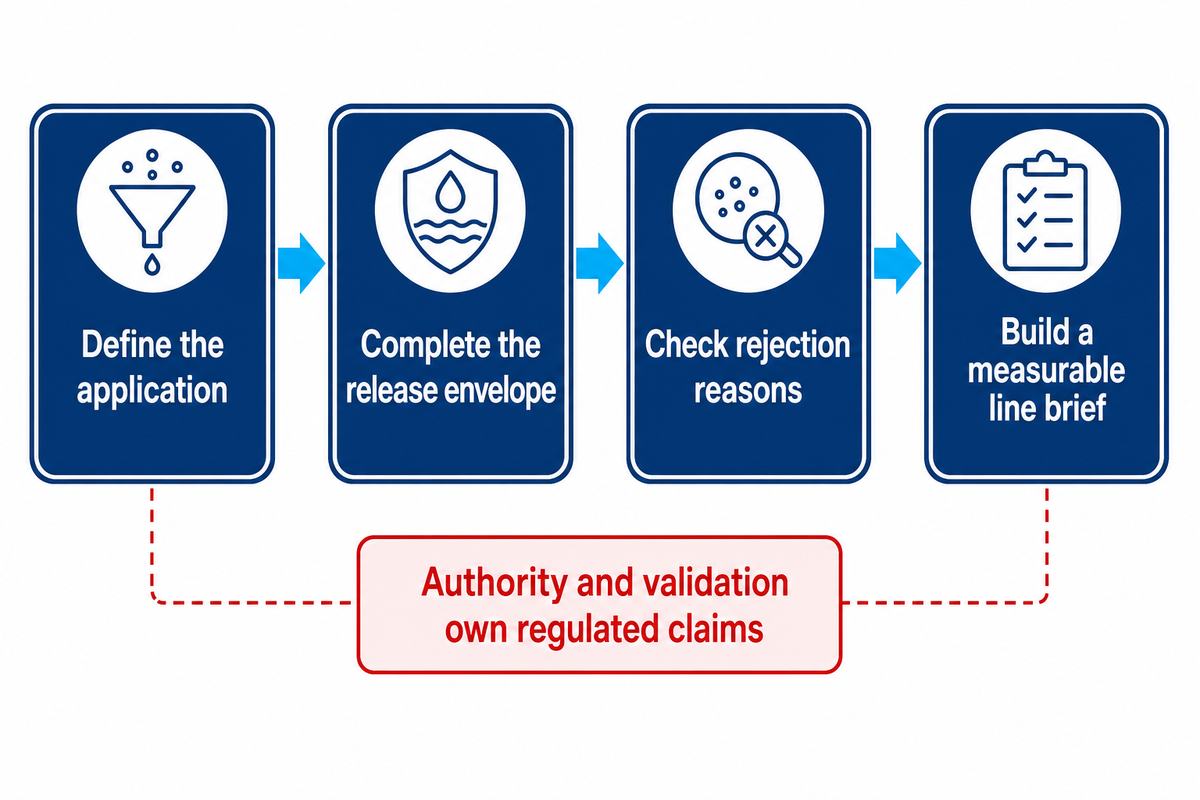
Begin by delineating the candidate process or application, working sequentially through seven input fit criteria, and then identifying items for rejection on the “rejection” column. Product-specific data must remain linked to the related product and test method. Where the process is regulated, let the applicable authority, validation plan and finished-system listing define the claim rather than turning a polymer name into a shortcut. UDTECH identity and product scope are based on first-party materials; no facility, patent, certification or export-reach claim is made here.
Claimed filtration applications and material properties were kept separate and checked against public and technical references; treat the list as a guideline, not an affirmation that one polymer suits all these markets.
Turn the application into a measurable cartridge brief
Bring the fluid, contaminant, rating basis, flow, temperature, pressure limit and finished geometry. UDTECH can use that field set to discuss a PP melt-blown cartridge line without replacing your process qualification or compliance review.
References & Sources
- 21 CFR 177.1520, Olefin Polymers Electronic Code of Federal Regulations
- Inventory of Food Contact Substances: Polypropylene U.S. Food and Drug Administration
- NSF/ANSI 42, 53 and 401 Filtration System Standards NSF
- Performance of a Depth Fibrous Filter at Particulate Loading Conditions Chemical Engineering Research and Design
- Advancements in PP-Based Materials Using Melt-Blown Nonwoven Technology Polymers / PubMed Central
- High Purity Water System Inspection Guide U.S. Food and Drug Administration
- Certification Action Line: Questions About Filtration Water Quality Association / Water Tech Online
- Filter Bags, an Alternative to Filter Cartridges Water Tech Online
- 3M Betapure NT-T Series Technical Document 3M
- Pall Melt-Blown Filter Cartridge Brochure Pall Corporation
- Systems for Industrial Filtration: Pleated Media Filter Cartridges Parker Hannifin
- DFT Classic Series String-Wound Filter Cartridges Pall Corporation