Get in touch with Suzhou UDTECH Technology Co., Ltd. Company

CTO Activated Carbon Filter Cartridge Machine
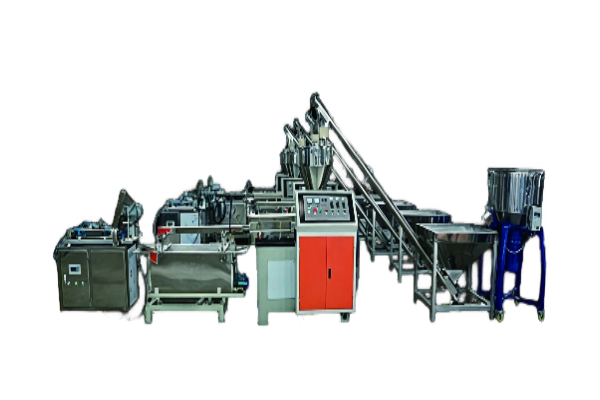
A CTO line takes granular activated carbon and a PE binder powder, heats the blend, forces it through a die, cools it and cuts it into solid carbon block cartridges. CTO stands for chlorine, taste and odor, the three things the finished cartridge is bought to reduce. The CTO activated carbon filter cartridge machine we supply is a six-station line that runs those steps continuously across six stations, and it will run 24 hours without a break.
This page is intended to aid an individual deciding whether to manufacture carbon block cartridges instead of purchasing them. It includes the bore envelope, the cycle time with the length it was measured at, the equipment for a complete plant beyond the extrusion line, and how a certification can be attached. Most supplier pages do not provide this information.
Formulation Privacy Policy
Your carbon grade, mesh, and binder ratio comprise your formulation. We do not disclose these numbers and we do not require them to configure a machine for you.
9 mm to 100 mm inner diameter, 29 mm to 150 mm outer diameter
One 10-inch cartridge every 50 to 60 seconds
20-30 working days from deposit
Minimum order one complete line
Technical Specifications & Capabilities
Comprehensive data regarding bore envelope, cycle metrics, and plant equipment layout.
Bore envelope
Inner diameter 9 mm to 100 mm, outer diameter 29 mm to 150 mm
Default build
38 mm inner diameter, 63 mm outer diameter
Cartridge lengths
5, 10, 20 and 30 inch
Cycle time
One cartridge every 50 to 60 seconds at 10 inch
Power
16.45 kW rated per set, 8 kW drawn while running
Duty
Runs 24 hours without a break
Lead time
20-30 working days after the deposit clears
Minimum order
One complete line
Two of these numbers are conditional and affect how many machines a product range requires.
Extruded Carbon Block Production: Six Stations, One Continuous Line
Carbon block exists because of contact time. Water passing through a cartridge under a sink touches the carbon for roughly 3 to 12 seconds; a municipal bed of granular activated carbon gets 1,000 to 4,000 seconds. Compacting powdered carbon into a solid wall does not make the carbon adsorb more, it makes the adsorption happen fast enough to matter in those few seconds [1].
Extrusion is how that wall gets made in volume. Compression molding presses each block individually in a heated mold. Alternatively, extrusion pushes a heated carbon and binder mixture through a die and cuts it to the desired length. This process was first reported in 1988 and 1989, and prior to this carbon blocks were molded slowly and in small batches at a high cost [1].
There are trade-offs with both manufacturing options, and this is where comparisons of the activated carbon block manufacturing process go off track. With throughput and cost per block, extrusion clearly has the advantage. In contrast, compression needs less binder, has more consistent filtration properties, and offers a wider range of porous binders in addition to the ability to make shapes that extrusion cannot [3]. They cannot be substituted for one another. Neither is the wrong answer in general, only for a given product plan.
The equipment goes by several names here. A carbon block making machine, a CTO filter cartridge making machine and a carbon block filter production line all describe the same filter machine: a fully automatic filter making machine with one control system driving all six stations, so a single operator runs the line.
The six stations, and what each one decides
01
Automatic mixer.
Blends activated carbon with the PE binder powder. This station sets how evenly the binder is distributed, which is what later decides whether the block wall is uniform or has soft spots.
02
Automatic feeder.
Meters the blend into the extruder at a constant rate. Variability in the feed rate causes density to vary longitudinally along the length of the rod.
03
Extruder and workbench.
The blend is heated above the binder’s melting point but below the temperature at which the carbon itself begins to change. This blend is then pushed through the die. Screw speed and barrel temperature are the two settings an operator adjusts here. The die and the center rod, both hardened steel, set the outer and inner diameter of all the components produced in this build [4].
04
Cooling machine.
Freezes the binder phase before the rod leaves the die. Cooling that is too slow lets the extruded profile relax; the product holds the tolerances of the die only if it hardens inside it.
05
Automatic cutting machine.
Cuts the long continuous rod to cartridge length. Cured carbon block is like very hard rubber or brittle ceramic so it is easily cut using a heated blade.
06
Dust collecting equipment.
Captures airborne carbon fines at transfer points. This is a station, not an accessory, and the reason is in the site readiness section below.
The Single-Bore Lock: One Extruder Build, One Diameter Pair
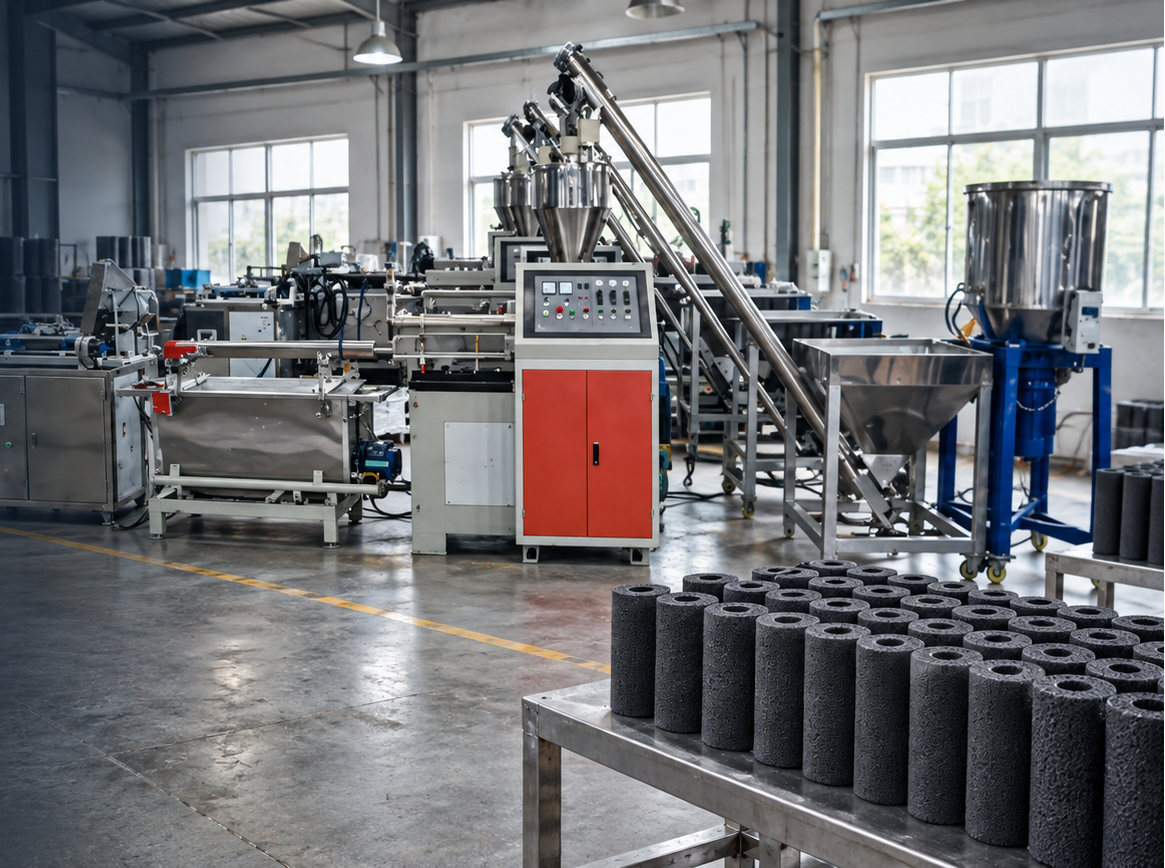
Extrusion Hardware & Tooling
An extruder configured for a given cartridge produces one inner and outer diameter. Producing a different pair means changing the screw and the barrel: not a setting, hardware. The mistake buyers make is costing one machine for a range that structurally needs two, and the structural reason is below.
This mechanism is described in the foundational extrusion patent for carbon blocks [4]. The extrusion die is used in combination with a smoothly finished stainless steel center rod that is screwed into the tip of the screw and passes through the center of the die.
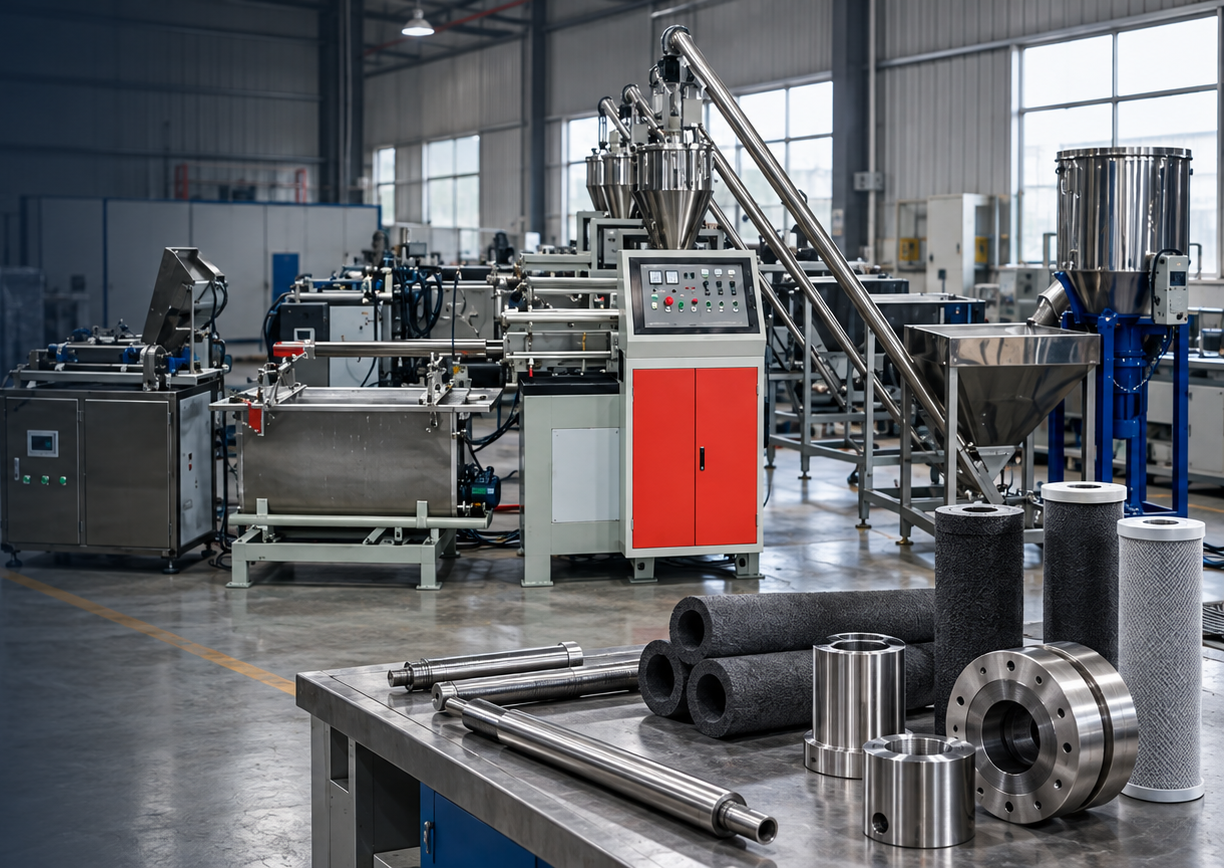
Equipment Limits & Process
A die of a given size and a rod of a given size extrude a tube of that size. A 2.0 inch rod in a 2.8 inch die yields a 2.8 inch outer diameter, 2.0 inch inner diameter tube; a 1.25 inch rod in a 2.5 inch die yields 2.5 by 1.25. Change either dimension and you change tooling.
This applies to all builders. An engineering director writing in the trade press puts it more simply: the limits of carbon block manufacture are caused by the equipment used to produce blocks of a given size, the size of molds and extrusion dies is constrained and the use of existing molds and dies is one of the ways to minimize cost and time [2]. The Single-Bore Lock is a characteristic of a process and not a shortcoming of a machine.
Cartridge Format Capabilities
This means that in practice, the range of products is a machine decision. Below, the bore each of the cartridge formats buyers usually ask for needs is set against the bore envelope of this line.
| Cartridge format | Nominal outer diameter | Inner diameter needed | Inside this line’s envelope |
|---|---|---|---|
| 10 inch standard (9 3/4 in long) | 63 mm (2.5 in) | 28 mm to 38 mm depending on core | Yes, and it is the default build |
| 20 inch standard | 63 mm (2.5 in) | 28 mm to 38 mm | Yes, same bore, longer cut |
| 30 inch standard | 63 mm (2.5 in) | 28 mm to 38 mm | Yes, same bore, longer cut |
| 10 inch Big Blue | 114 mm (4.5 in) | 28 mm to 30 mm | Yes, but a second bore pair |
| 20 inch Big Blue | 114 mm (4.5 in) | 28 mm to 30 mm | Yes, same second bore pair |
| Inline and point-of-use blocks | 29 mm to 55 mm | 9 mm to 20 mm | Yes, a third bore pair |
The arithmetic is in the last column. All lengths are customizable since these are cuts, so standard cartridges in three lengths are one bore pair and one machine. Adding Big Blue makes two. Adding small inline blocks makes three. Published block sizes in this category range from about 1 inch to 4.25 inch in diameter and 2.5 inch to 40 inch in length. Most product plans are either two or three bore pairs.
Paste your own format list into the Bore-Pair Build Counter and it will tell you how many extruder builds the range needs.
The Question to Put in Your Enquiry
Please send us cartridge formats that you plan on selling, along with outside diameter, inside diameter and length. We will provide the number of extruders based on the range you submitted along with the specific differences in the parts.
Maximize Your Extrusion ROI
This value is free. It has the largest impact on the quote compared to any other value you might submit.
Request a Quotation for Your Cartridge RangeActivated Carbon Grades, PE Binder and What You Supply
The line runs on two powders you buy: activated carbon and a food-grade polyethylene binder. Carbon is the performance and most of the cost. Binder is a small fraction by weight and most of the process risk.
Carbon
Two main carbon sources are in use in drinking water systems. Coconut shell carbon has approximately 50 percent more micropores than bituminous coal based carbon with lower ash and less dust, [3]. Coal based carbon is less expensive and more abundant. Both can be extruded. The choice belongs to your product claim, not to the machine.
Particle size is where carbon for a block differs from carbon for a loose bed. Grades vary by supplier and application, so treat any single range as illustrative: one carbon block manufacturer’s buyer guide puts bed carbon at 0.30 mm to 0.84 mm against block carbon at a fine mesh of 0.045 mm to 0.18 mm, seven to nineteen times smaller [3]. The direction is what matters: block carbon is ground far finer, which is what produces a continuous pore structure instead of channels between granules, and it is also what produces the dust the sixth station exists to capture.
PE binder
The binder is not a line item where you can make a cost saving substitution. The extrusion patent requires binder particles between 0.1 micrometers and 250 micrometers, operated at 5 to 20 micrometers, against carbon particles that range from 0.1 micrometers to 3,000 micrometers, with the binder at least about 3 percent by weight. The blend is heated to at least 25 °C above the binder’s softening point, and in practice 25 °C to 100 °C above its melting point, while staying below the point where the carbon changes; back pressure in the die runs between about 5 and 400 psi, set high enough to consolidate the mixture and low enough not to crush the carbon particles.
Those four numbers represent an operating window: size of the binder particle, size of the carbon particle, temperature of the barrel, and back-pressure. Move one and they all move with it. Because of that, when a plant changes its source of carbon, it performs another trial rather than another order, and your ratio is a band instead of a fixed value.
What you supply, and what we need to know
You supply
Activated carbon of your chosen source and mesh; food-grade PE binder powder; three-phase power; cooling water; compressed air; and the floor space set out below.
We need before quotation
The cartridge formats you are considering, the supply voltage and frequency, the available floor space, and whether or not you plan to include the mixer and feeder in your order or if you would be feeding the extruder from machines you would provide are all relevant.
Melt-blown cartridges
Spun polypropylene depth cartridges are a different forming process and are done on a different line. PP melt-blown filter cartridge machines
String wound cartridges
Yarn wound around a porous core is a winding process, not extrusion. String wound filter cartridge machines
Cartridge Formats, Ratings and What Your Output Can Claim
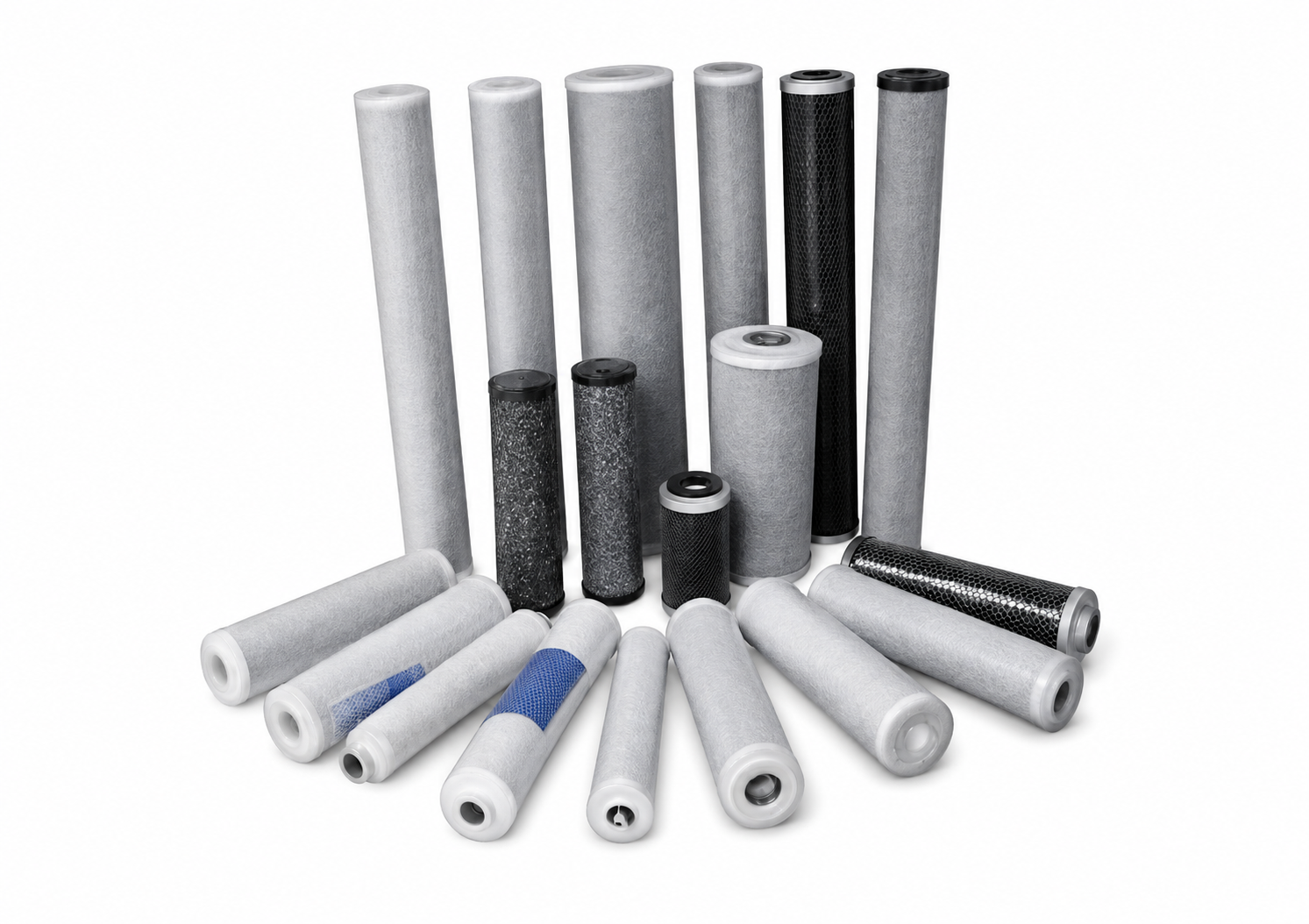
What comes off this line is a solid carbon cylinder with a bore through the middle. Water is pushed from the outside of the wall inward, so the wall thickness determines how long water is in contact with the carbon [3]. A thicker wall at the same flow rate means more contact time, more carbon per cartridge and a higher pressure drop.
What the cartridge removes
An activated carbon block works by three mechanisms at once. It strains particles larger than its pores, down to about half a micron. It adsorbs organic compounds onto the carbon surface. And where an outer wrap is fitted, it can hold charged particles electrokinetically [3]. In drinking water service that combination reduces chlorine, taste and odor, sediment and a range of organic compounds. It does not remove hardness, fluoride, dissolved salts or micro-organisms by default.
In this market, the volume is in three places. A CTO carbon block filter is the second or third stage in an RO system where its function is to remove chlorine prior to the contact with the membrane. The same water filter cartridge sold separately covers point-of-use water filtration. Large diameters become a whole house carbon block water filter, and food, beverage, and laboratory use the same industrial water filter cartridge in stainless steel housings.
Two adjacent products are important because customers always compare against them. For example, a UDF filter holds loose granular carbon rather than a block. Likewise, a PP water filter is spun polypropylene without carbon, and between a carbon block and activated carbon in granular form neither wins outright. The cost of replacement for carbon block filters is usually higher than GAC, and price and quality do not always move together. What a carbon block buys you is a known micron rating and no channelling. What it costs you is a greater pressure drop.
The rating basis, which matters more than the rating
Ratings for blocks published by other sources show clusters around 0.5, 5, and 10 micron. There are in fact two different thresholds below those numbers, and they should be shown separately. As a trade practice, a block that is rated to one of those sizes removes at least 85 percent of particles at the rated size; that is a nominal rating convention, not a standard. Cyst reduction claims are a certification threshold under NSF/ANSI 53 instead. The trade press has cited this as 99.95 percent of particles at 3 micron [2] and the binding standard is in the text itself rather than in any article about it [5]. That threshold is also applicable to a finished treatment unit that has been submitted for certification. It is not applicable to bare block that has been produced. The first describes how the trade labels a product; the second is the standard the certifier will test against.
Dense blocks that filter finer incur a higher pressure drop at the same flow rate, and overall performance is influenced by the type of carbon, the kinetics, the flow rate through the wall, and the amount of carbon in the block [2].
This is what your own customers care about. A distributor comparing two cartridges is going to care about whether the rating is nominal or absolute, before they care about who made the machine. Only a line that holds wall geometry and density consistently lets you answer that the same way twice.
Formats
| Format | Outer diameter | Length | Where it sells |
|---|---|---|---|
| 10 inch standard | 63 mm | 254 mm (9 3/4 in) | The volume format for under-sink and reverse osmosis pre-filtration |
| 20 inch standard | 63 mm | 508 mm | Twin housings and light commercial duty |
| 30 inch standard | 63 mm | 762 mm | Commercial skids and higher flow |
| 10 inch Big Blue | 114 mm | 254 mm | Whole house, where flow rate governs |
| 20 inch Big Blue | 114 mm | 508 mm | Whole house and well water at higher flow |
| 5 inch and inline | 29 mm to 55 mm | 127 mm and shorter | Appliance, coffee, dispenser and point-of-use assemblies |
Length is a trivial cost, but diameter is a true build. That is the reason the Single-Bore Lock is worth understanding before you pick a product range.
The Three-Machine Bill: What a Complete Cartridge Plant Needs
The extrusion line makes carbon rod that is then cut to length [4]. Bare carbon rod is not a commercial cartridge. Making a cartridge involves two other operations, both of which are separate machines.
This is not a peculiarity of one supplier. In the largest activated carbon filter plant described in the public record, extrusion feeds a separate bank of robotic assembly units that apply the prefilter, netting and end caps, and shrink wrap and bagging [1]. The boundary remains constant at all scales, with only the level of automation changing.
01
1. Extrusion line
Six stations, 16.45 kW rated, one inner and outer diameter per build. Output is bare carbon rod cut to cartridge length.
02
2. Wrapping machine
Wraps the rod in non-woven fabric. The wrap provides the block with its prefilter layer and, in some designs, its electrokinetic behavior. Full-automatic carbon block wrapping machines perform this task.
03
3. Gluing and capping machine
Bonds end caps to both ends so water is forced through the wall instead of around it. The fully automatic version runs on 220 V at 50 Hz, draws 2,000 W and is controlled by PLC and HMI, ejecting rods automatically, wrapping non-woven fabric and heat welding the joint. A semi-automatic gluing and capping machine covers lower volumes.
Quotation Drivers, Lead Time and Payment Structure
We do not publish a price for this line and no supplier in this category does. What we can post is what the number is made of. That way, you can compare two quotes on the same basis.
When you search for a carbon block filter machine manufacturer, headline figures appear that aren't related to each other because each one covers a different group of stations.
Variables impacting machine pricing
- How many bore pairs your product range requires. This is the most significant factor and it is determined by the format list you send us.
- The range of cartridge lengths, which determines the length to be cut and handled.
- Whether the mixer and feeder are included or if you are feeding from your own equipment.
- Whether a chiller is required. Cooling capacity is a separate line and in this category, stated power figures do not always include a chiller.
- How many of the three machines you are buying now.
- Supply voltage and frequency at your site.
- Destination port and trade term.
Steps to produce a quotation
-
1You send the cartridge formats, target output and site conditions.
-
2An engineer decides the number of extruder builds and what differentiates them.
-
3You are given a configuration and a quotation that specifies what is included and what is quoted separately.
-
4Anything outside scope is named rather than left out.
Lead time and payment
Production is scheduled at 20-30 working days after the deposit clears. Minimum order is one complete line. Payment is a deposit before the build starts and the balance before the machine leaves the factory, by bank transfer or letter of credit.
The points are logical. What is worth adding is what published data says about built-to-order machinery generally, since lead times are a shared responsibility and not just a supplier promise. In 2026, a Georgia Institute of Technology industrial engineering capstone researched weekly data for 264 built-to-order machines produced since late 2022 by one manufacturer, and reported 45 percent delivered late with an average delay of 25 days. The highlights from that report are what should be covered here. The report separates the causes of the delays twice, and the two separations conflict: one gives manufacturing time underestimation 25 percent, software development 19 percent, customer payment delays 19 percent and parts procurement 16 percent, while the other gives underestimated production time 25 percent, software development and testing 25 percent, waiting on customer payments 20 percent and purchasing and inventory 15 percent. Take the separations as an ordering of causes rather than a measurement. These machines were tube and cable fabricating equipment rather than cartridge lines. As such, this is evidence for the type of purchase that we are talking about, and not evidence for this line.
Something like one delay in five in this population started on the buying side. On schedule payments, final specifications fixed, and a single person designated to provide the required approvals will improve the commitment on the delivery date.
On payment structure there is no single correct split. Export payment methods run from cash in advance through letters of credit, documentary collections, open account and consignment, ordered by how much risk each transfers to which side. The United States International Trade Administration sets those five out in its Trade Finance Guide and states no universal deposit percentage. Any supplier quoting a fixed percentage as though it were a rule is quoting a preference. Ours is stated above and it is negotiable against a letter of credit.
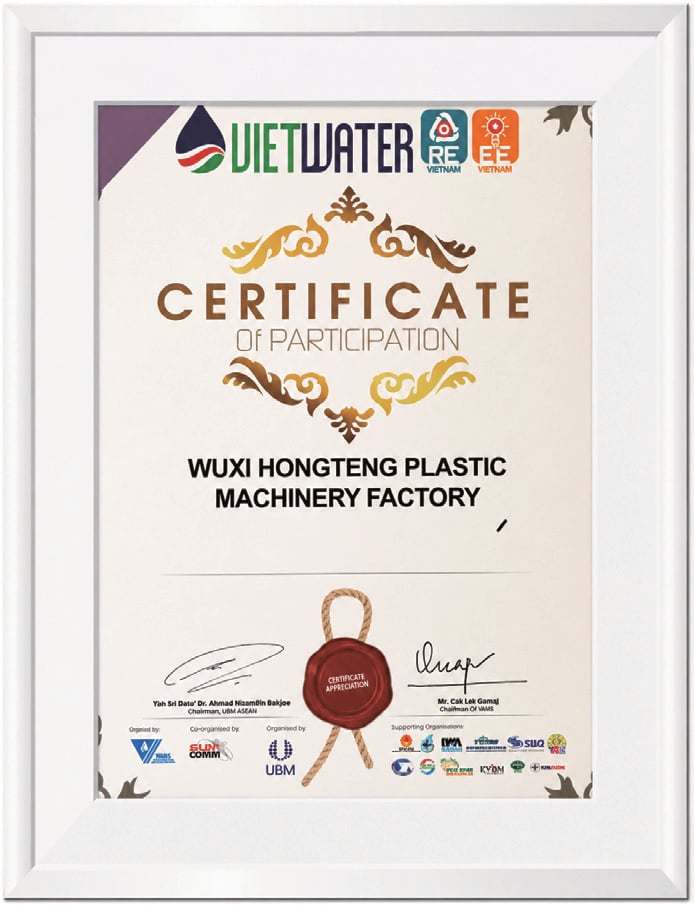
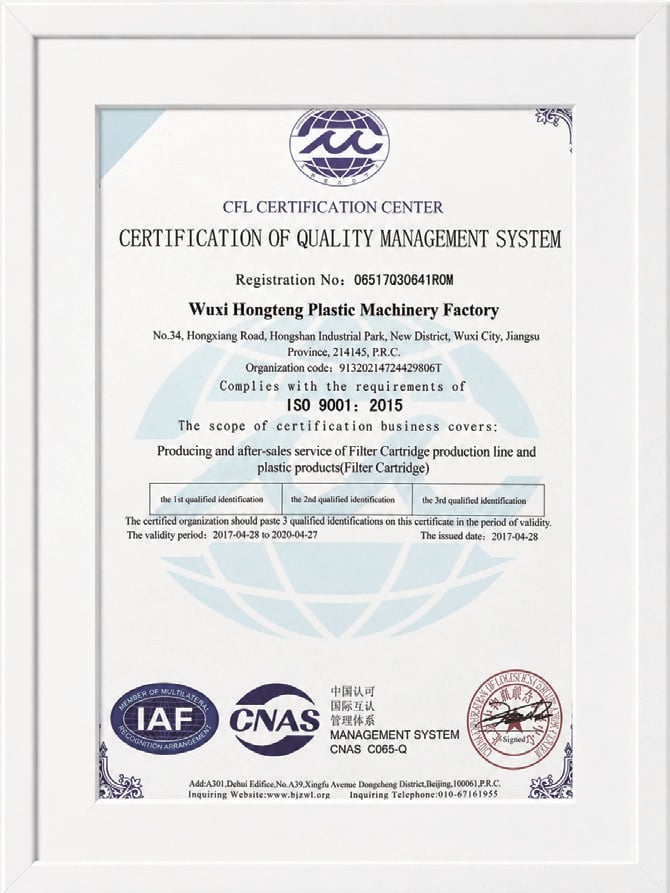

×
![Zoomed View]()
Click image to toggle zoom
Where a CTO Extrusion Line Is the Wrong Choice
Three instances of this procedure where it is inappropriate, and where to look instead.
Process Analysis
Evaluating alternatives to traditional extrusion methods for optimal production yield.
Evaluating alternatives to traditional extrusion methods for optimal production yield.
01
You require an absolute rating
A carbon block carries a nominal rating, which means a stated percentage of particles removed at the rated size rather than a guaranteed cut-off [2]. A nominal block cannot take the place of an absolute cartridge, and a finer micron rating will not solve this problem.
Where to look instead: a pleated membrane cartridge.
02
At low volume per size
You have a wide range spanning many diameters. Every bore pair is a build [4], so a dozen diameters in small quantities equates to more tooling cost than savings from equipment. A small filter cartridge making machine will not change the equation.
Where to look instead: compression molding [3].
03
You need spun or wound cartridges
Melt-blown polypropylene and yarn winding are different forming processes and are used on different machines. They are not different modes of the one used here. Each is covered on its own page, linked in the materials section above.
CTO Carbon Filter Extrusion Calculation Tools
Bore-Pair Build Counter
One extruder build produces one inner and outer diameter pair. Length is a cut, so it is free; a different diameter pair is a different build. Paste your cartridge range and this tool calculates the specific extruder builds required.
Extrusion Output Planner
A pieces-per-day headline is not comparable between two machines unless the cartridge length is attached to it. Enter seconds per piece at a stated length and this turns it into a practical planning number, with the standard deductions that a ceiling figure leaves out.
Carbon Cost per Cartridge
This is a materials figure and nothing else. It takes the wall geometry, a finished block density, a binder ratio, and your carbon price, and returns the strict carbon cost per cartridge. Every input is adjustable, as formulation densities vary based on specific extrusion methods.
Frequently Asked Questions
Comprehensive insights into the CTO Activated Carbon Filter Cartridge Machine, including manufacturing methods, outputs, operational costs, and machine specifications.
Industrial Grade
Engineered for continuous extrusion, optimizing throughput and lowering overall production costs for high-capacity filter manufacturing.
What is a CTO activated carbon filter cartridge machine used for?
A CTO activated carbon filter cartridge machine produces solid carbon block cartridges. Activated carbon and a PE binder are blended, heated, extruded through a die as a continuous tube, cooled and cut to cartridge length. The cartridges are used in under-sink filters, reverse osmosis pre-filtration, whole-house housings and appliance filters.
What are the manufacturing methods for CTO filter cartridges?
Two. Extrusion forces material through a die to produce a continuous block that is then cut to desired length. Compression molding requires individual blocks and a heated mold. Extrusion allows for faster throughput and overall lower cost; compression uses less binder and allows more shape variability.
Can the cartridge dimensions be customized?
Length, yes, freely, because length is a cut. Diameter is different: one build produces one inner and outer diameter pair, and another pair means changing the screw and barrel. Send your format list and we will tell you how many builds it needs.
What materials does the line run on?
Granular activated carbon, coconut shell or coal based, ground to fine mesh, plus a food-grade polyethylene binder powder. You supply both. The carbon source is a product decision rather than a machine constraint.
What does a carbon block filter machine price depend on?
Mostly dependent on the number of bore pairs your range needs, along with whether mixer, feeder and chiller are included in the package and how many of the three you are buying. No one in this category puts a number out there, so compare quotes based on what is included in each, rather than on the price per unit.
How much does an activated carbon cartridge cost to make?
The carbon alone in a 10 inch cartridge works out at roughly US$0.56 to US$0.87 using the geometry, density and price index shown in the specification section. The cost of the binder, energy, labor, wrapping, end caps, packaging, and scrap is additional. The description of how the cost is calculated is provided for your use, feel free to change the inputs.
What output can the line produce in a day?
At the 50 to 60 second cycle time for a 10 inch cartridge, 24 hours of continuous extrusion is 1,440 to 1,728 pieces. That is a ceiling from arithmetic, not a measured plant figure. Deduct startup scrap, changeovers and rejects to get a planning number, and always compare seconds per piece at a stated length rather than pieces per day.
What else is needed besides the extrusion line?
For capping, a wrapping machine applies the non-woven outer layer and a gluing and capping machine bonds the end caps. The extrusion line produces bare cut rod. Both downstream machines are separate purchases, and a budget built on the extrusion line alone will move.
What is a CTO filter cartridge?
CTO is the name for chlorine, taste and odor. It is a solid carbon block that reduces those three plus sediment and a range of organic compounds when water passes radially through its wall.
What is the difference between a GAC carbon filter and a CTO carbon filter?
GAC is a loose bed of granular carbon; CTO is a solid block of much finer carbon held together by a binder. This block prevents the channelling that a loose bed allows and gives a defined micron rating. In return, the pressure drop is higher.
What contaminants do CTO filters remove from water?
Chlorine, taste and odor, sediment and some organic compounds, by straining, adsorption and, with the right outer wrap, electrokinetic capture. Not hardness, fluoride, dissolved salts or micro-organisms.
What are the limitations of an activated carbon filter?
Capacity diminishes when carbon is loaded and contact time in a point-of-use filter is only seconds, so wall thickness and flow rate dictate true performance. A block is not always better than granular carbon: size, micron rating and certification are paramount compared to the words carbon block.