Get in touch with Suzhou UDTECH Technology Co., Ltd. Company


Updated September 2026
Filter cartridge production planning is the sequence of decisions a buyer makes between forecast demand and full-rate output from a new line. These decisions aren’t made in isolation for the purchase of one piece of equipment. Some equipment discussions end here, after the specification sheet. This planning guide starts at this point because projects can stall on unchecked capacity math, an unscheduled utility survey, an unwritten staffing plan, and a factory acceptance test that everyone assumed meant more than it did.
Users can find our side-by-side specifications for machine families on UDTECH’s own production line solutions page. This guide shows each of the eight decision-making gates that a prospective buyer will visit prior to, during, and after equipment selection.
Illustrative Planning Timeline at a Glance
| Phase | Illustrative duration | Key deliverable | Common failure point | Owner |
|---|---|---|---|---|
| 1. Capacity sizing | 1-2 weeks | Required daily output figure | Using nameplate pcs/24h without a utilization discount | Buyer |
| 2. Line family selection | 1-3 weeks | Machine family shortlist | Re-researching specs already published | Buyer |
| 3. Site and utility readiness | 2-6 weeks | Utility survey sign-off | Late power/floor-space survey | Buyer |
| 4. Landed-cost budgeting | 1-2 weeks | Cash-flow timeline | Treating duty/fees as a single line item | Buyer/finance |
| 5-8. Staffing, vetting, commissioning, ramp-up | See Phases 5-8 below | Trained crew, verified line, buyer-defined ramp-up target | Treated as strictly sequential without mapping dependencies | Buyer |
What “Production Planning” Actually Means (and What It Doesn’t)
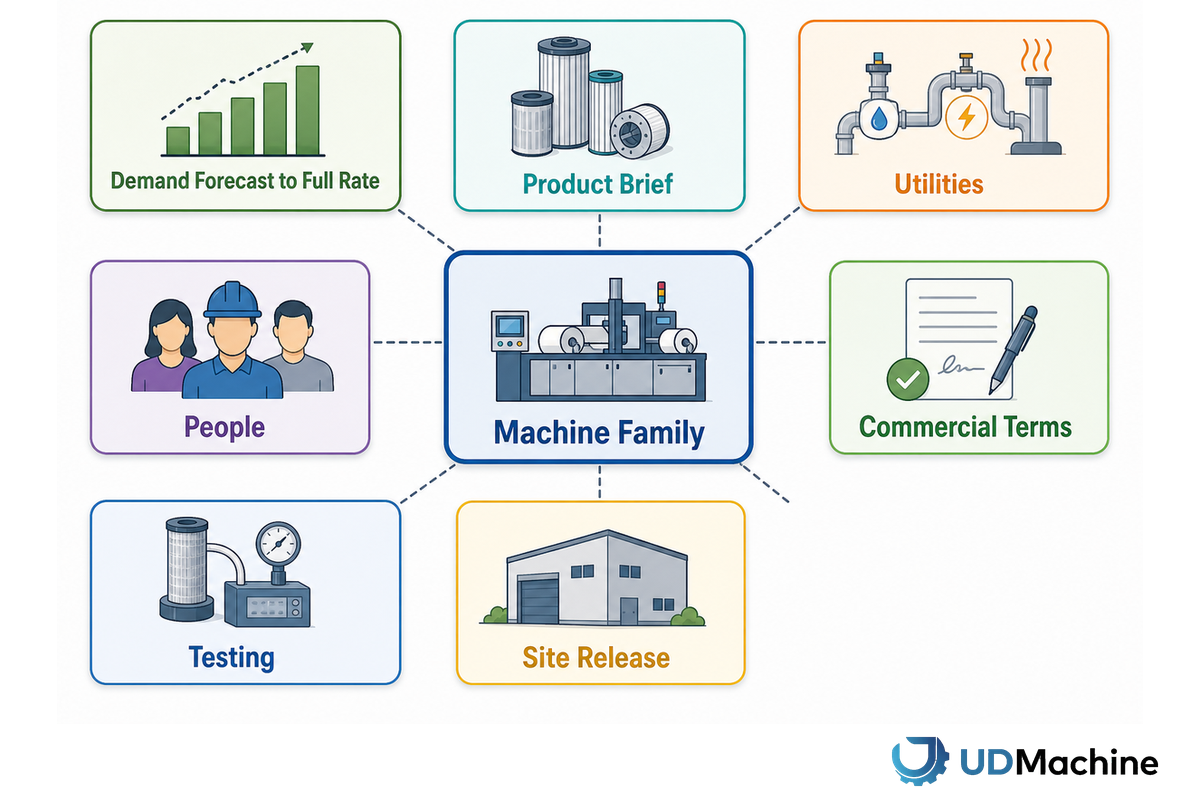
For this guide, production planning of the filter cartridge line is a series of eight buyer steps from demand forecast to full rate; it isn’t an industry standard or just the selection of a machine. Of the eight, selecting a PP melt-blown, string-wound, or CTO activated-carbon line is one step, while the other seven cover the product brief, utilities, people, commercial terms, testing, and site release.
According to US Patent 6,942,106 B1, the quantity of yarn, winding tension, lateral displacement per traverse, filament diameter, and loop structure are stated yarn-construction variables on a string-wound line that affect the size of a particle retained. A process that stops at “which machine” and never reaches “what product, settings, utility hookup, staff, and acceptance test” stops before those planning decisions are resolved.
UDTECH publishes three machine families for this guide: PP melt-blown, string-wound, and CTO activated-carbon. Each has a seller-stated micron range and output profile, and the full specification comparison — filtration accuracy, connected power, and cartridge length options — lives on UDTECH’s equipment pages; those figures require a product-specific quotation and test basis. What follows assumes that choice is either already made or running in parallel only where project dependencies permit, and focuses on the seven gates around it.
Phase 1: Turning a Sales Forecast Into a Capacity Number
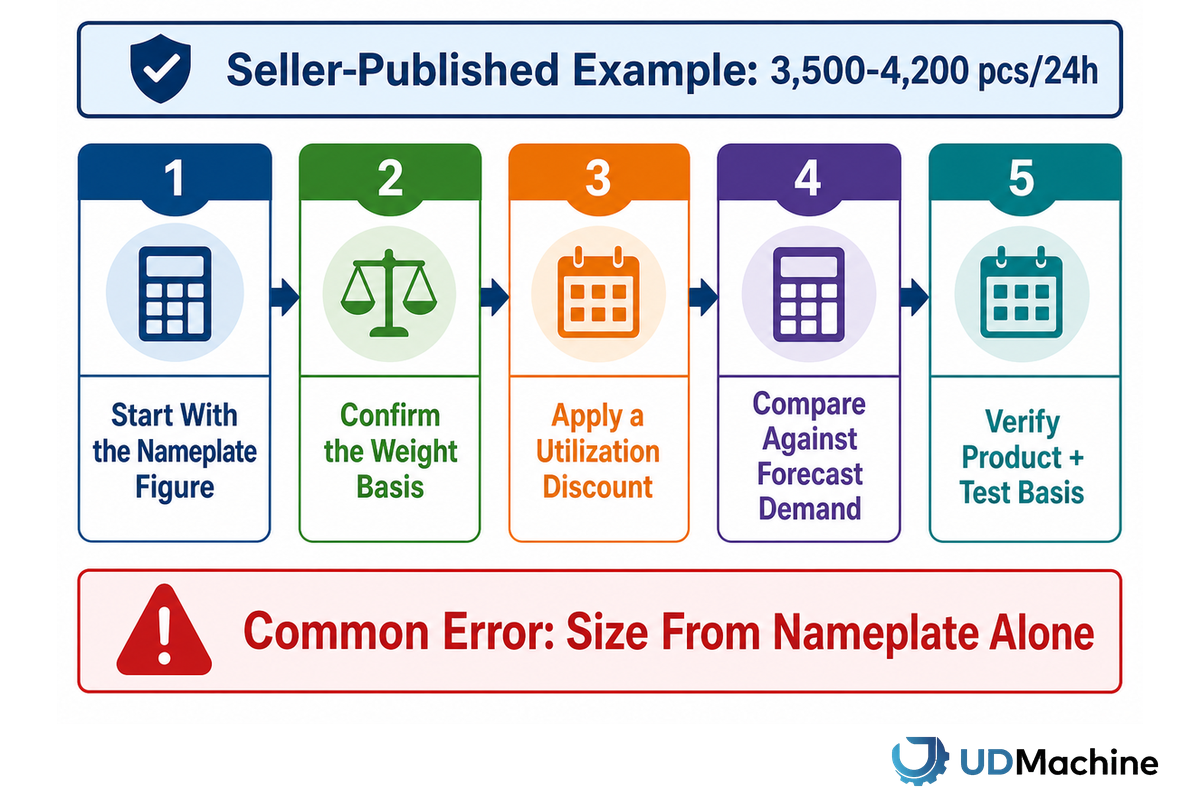
Capacity planning uses demand forecasts to identify the goal output for each day. It isn’t about putting the vendor’s ‘pcs/24h’ number on a spreadsheet. A nameplate rating is what a vendor states that a line gets done for a declared product and test condition, not what it always gets done with no issues. The planning number is what the line is expected to get done during a stated calendar after the buyer’s utilization, downtime, yield, and accepted-output assumptions.
The sample uses a real published line spec to provide a worked comparison instead of a generic formula.
| Step | What to do | Worked example |
|---|---|---|
| 1. Start with the nameplate figure | Take the vendor’s published pcs/24h rating | 3,500-4,200 pcs/24h, published by UDTECH for its 2E&2M model |
| 2. Confirm the weight basis | A pcs/24h number without its cartridge-weight basis is not usable for arithmetic; only if mass throughput stays constant would a heavier target weight reduce real piece output | Cartridge weight adjustable 70-200 g; confirm which weight the pcs/24h figure assumes before comparing it to another vendor’s number |
| 3. Apply a utilization discount | Multiply nameplate by an expected utilization rate, not 100% | Illustrative assumption: 3,850 pcs/24h midpoint × 0.65 planning utilization = 2,503 pcs/24h; replace it with the buyer’s evidenced assumption |
| 4. Compare against forecast demand | Divide required annual units by the planning-figure daily output | Illustrative assumption: 750,000 units/year forecast ÷ 2,503/day ÷ 300 planned production days = about 1.0 line needed with limited headroom |
| 5. Common error to avoid | Sizing off the nameplate number alone | Skipping this scenario’s 0.65 discount would understate its calculated line count; the actual discount must come from the buyer’s ramp-up, changeover, maintenance, and downtime assumptions |
Capacity-number takeaway:
A pcs/24h nameplate rating is a piece-rate statement and does not establish mass throughput, accepted output, or sustainable monthly output until the weight basis and test conditions are declared.
A pcs/24h nameplate rating is a piece-rate statement and does not establish mass throughput, accepted output, or sustainable monthly output until the weight basis and test conditions are declared.
Phase 2: Choosing a Line Family Without Re-Deriving the Specs
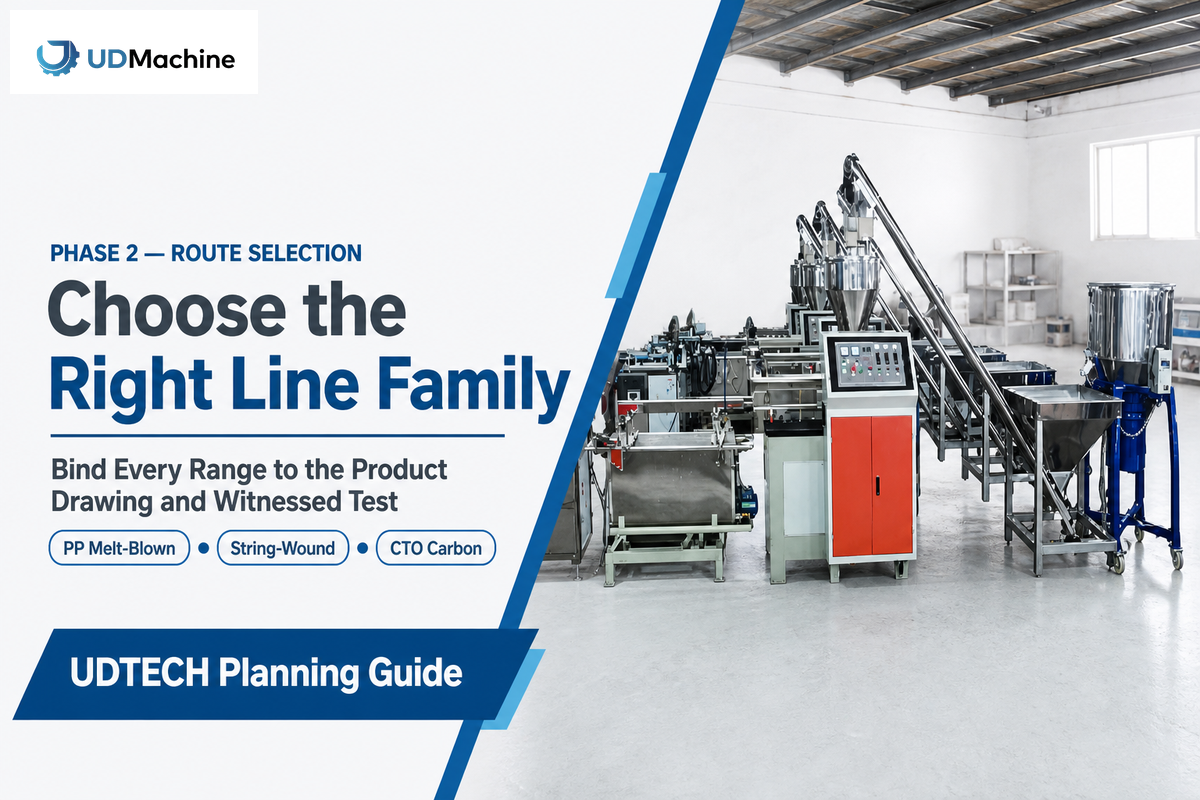
Having a capacity number makes finding the corresponding machine family a shortlist exercise, not a final product-engineering decision. UDTECH states that PP melt-blown lines cover roughly 1 to 100 micron filtration accuracy at outputs in the low thousands of pieces per 24 hours per line; that string-wound lines use winding geometry; and that CTO activated-carbon lines add bore-sizing and dust-handling steps, but these are seller statements requiring a product-specific quotation and test basis. The complete comparative data, power ratings, and option lengths for the three families are published on UDTECH’s production line solutions; buyers should bind each stated range to the product drawing and witnessed test conditions. What should be in the planning guide are the items the buyer must resolve around and after selection of the family: later site, commercial, staffing, testing, and release decisions.
Phase 3: Site and Utility Readiness Before the Line Arrives
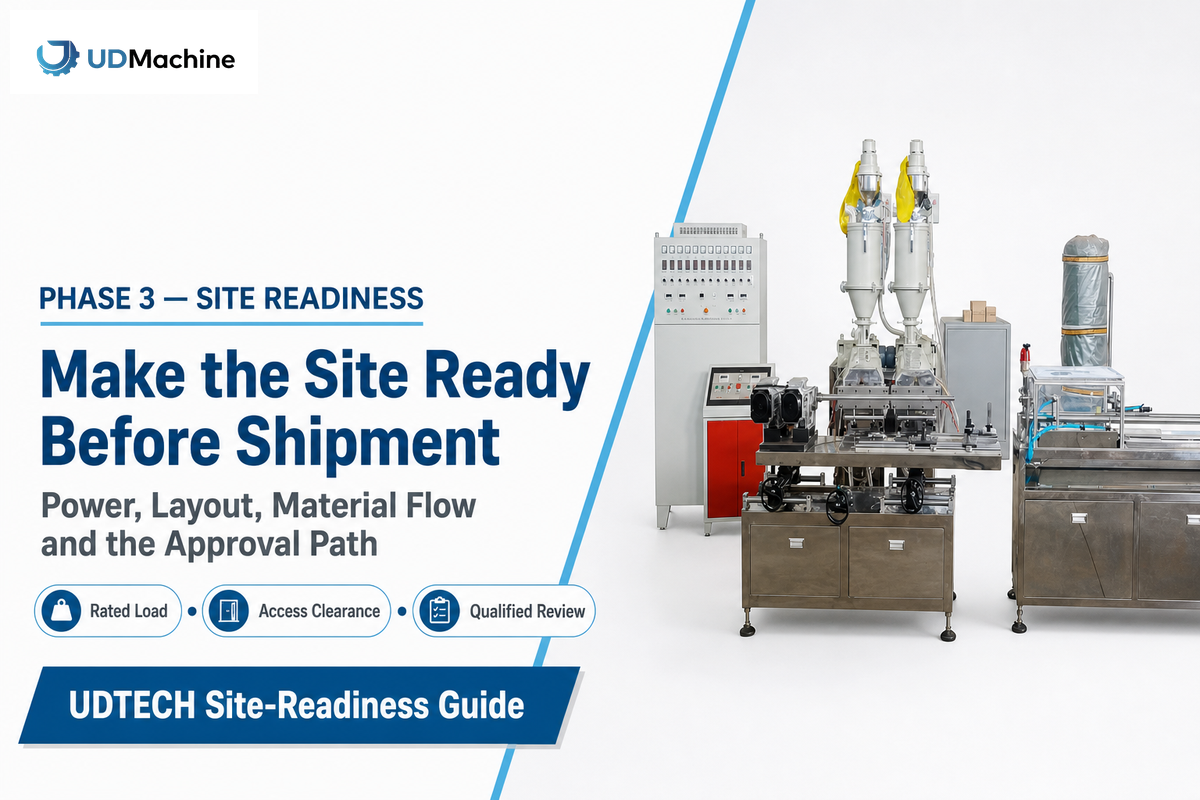
Utility readiness is the documented confirmation of power, floor space, material-flow paths, and access clearances by the buyer and qualified site professionals prior to a shipment. Without this readiness, a production line may not draw its required power or fit through the receiving door on the day of delivery, and the shipment can become a storage problem.
Four things must be present on the shipment checklist before a ship date is arranged:
- ✓ Connected power confirmed against the machine’s rated draw and exact site supply (UDTECH’s cited melt-blown line range publishes 70-100 kW connected power; running power, energy consumption, voltage, and frequency must be confirmed in the configured proposal)
- The complete floor space envelope includes service clearances for all sides of the machine, not just the footprint.
- ✓ The speed of the downstream and upstream processes should be checked for synchronization. Therefore, the buyer must test whether the packing step blocks the new line or the feeding step slows accepted output.
- Separating permitting and inspection lead time from transport lead time keeps both clocks visible before shipment scheduling. In some cases, these activities may not overlap; the project must decide from its jurisdiction and sequence.
For covered US installations, 29 CFR 1910.303(a) requires electrical equipment to be approved; that rule does not establish that a particular imported line or site installation is compliant. The gap should be identified during the site survey rather than delivery, including the applicable approval path, voltage, frequency, load, disconnect, and contractor scope. At delivery, unresolved electrical requirements become an electrical-contractor and scheduling problem, so qualified local professionals should verify them.
Phase 4: Budgeting for When the Money Actually Moves
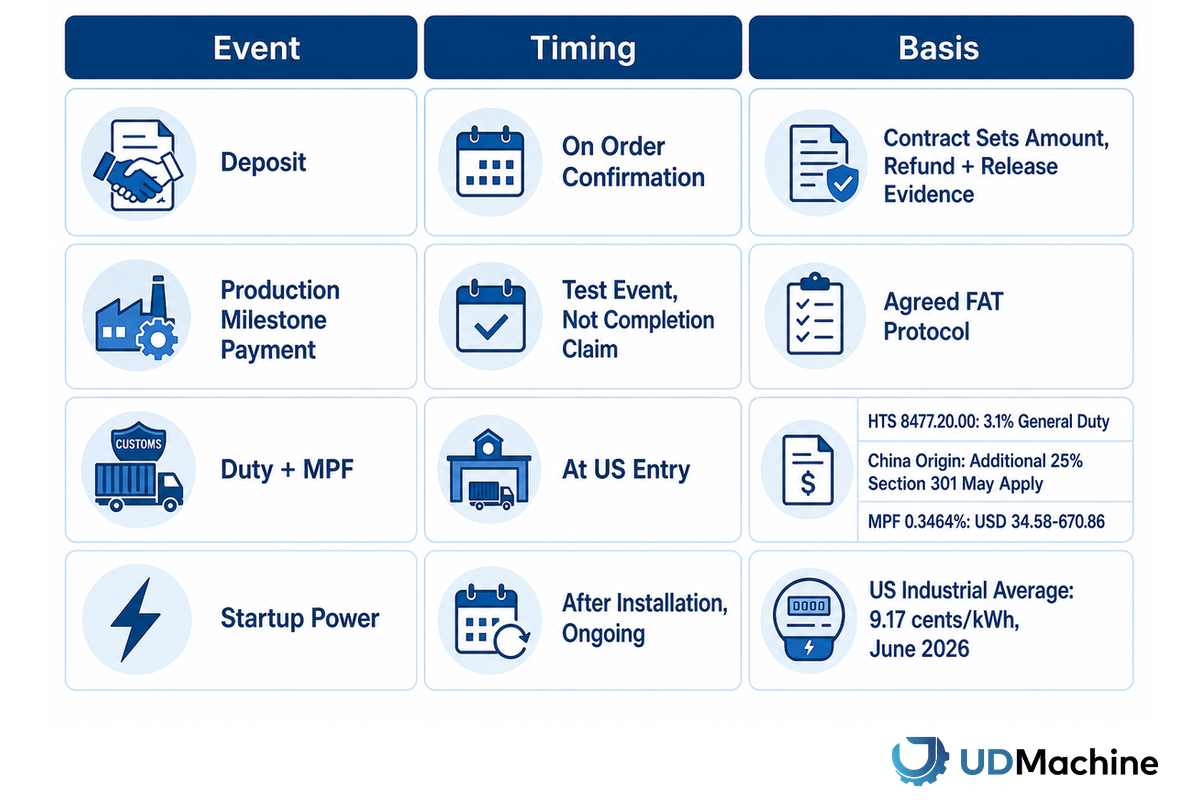
A production-line budget may have at least four separate payment events on different dates, not one lump equipment cost. Treating it as a single capex line can cause landed-cost surprises; the exact payment structure and remedies come from the contract and destination-country rules.
The 3.1% is only the general rate: for China-origin goods classified at 8477.20.00, USTR lists 84772000 in List 1 and an additional 25% Section 301 duty may apply, subject to the exact 10-digit classification, origin, exclusions, and other current measures; verify the current treatment with a customs broker (USTR product search; USTR List 1; USTR fact sheet).
| Event | When it lands | Cost basis |
|---|---|---|
| Deposit | On order confirmation | Negotiated as a share of equipment price; the contract should record the amount, refund conditions, and evidence required before release |
| Production milestone payment | Tied to a test event, not a completion claim | Negotiated; consider tying release to the agreed factory acceptance protocol rather than a supplier’s unsupported “production complete” statement |
| Duty and merchandise processing fee | At US entry, before the line clears customs, or after release where the entry and payment method permit it | If the imported equipment is correctly classified under HTS 8477.20.00 “Extruders,” the listed general duty is 3.1%; the published merchandise processing fee is 0.3464% ad valorem, with an FY2027 band of USD 34.58-670.86 effective October 1, 2026 (USITC HTS; CBP Dec. 26-14) |
| Commissioning and startup power | After installation, ongoing | US average industrial electricity 9.17 cents/kWh, June 2026, up 3.0% year over year (EIA) |
Of the four example events, some may be provided in the sales discussion and the others may not be. An estimate of landed cost can be low when the budget includes only the provided events; mark each row supplier-included, buyer-paid, estimated, or open.
Phase 5: Staffing and Training, the Step Most Timelines Skip
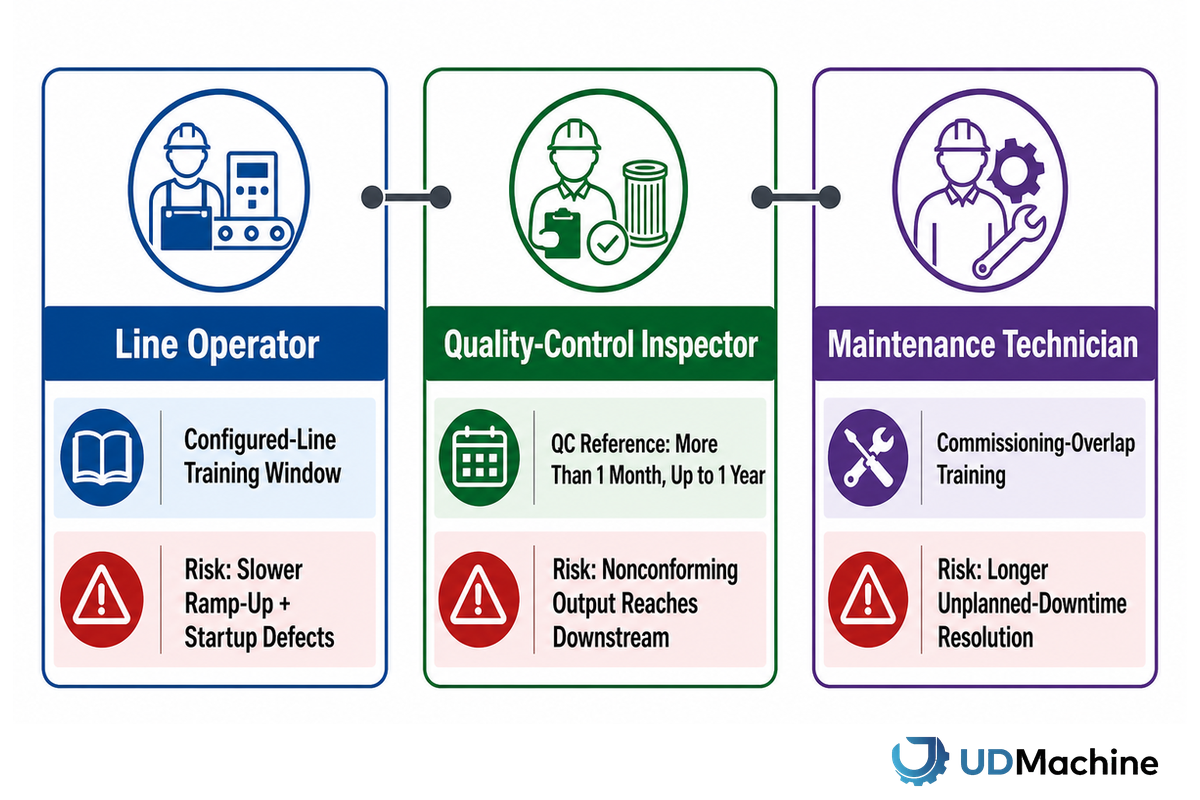
A new production line requires relevant staff competence and sign-off to be in place prior to each activity. Quality-control staffing and operator training lead times should be planned in project timelines built around equipment delivery dates.
The cited production-ramp-up study reports earlier cross-enterprise research that estimated direct ramp-up costs at about 20 percent of building-and-equipment investment, including training for new employees. In the study’s own case, worker qualification began during commissioning and process analysis and was followed by a lower later error rate, but the study did not isolate a shorter-ramp cause or establish a universal filter-line ratio. The same case records supplier-part unavailability as one cause of delay, so training belongs in the project estimate without being described as the single biggest risk on every filter-line project.
Quality-control staffing has its own lead time separate from operator training. In the United States, quality-control inspectors typically receive more than 1 month and up to 1 year of on-the-job training, while manufacturing accounted for 64 percent of their jobs in the cited period, according to the US Bureau of Labor Statistics. A project timeline that assumes QC coverage appears the day the line is installed is assuming away an occupational training window, but this data is not a filter-line proficiency guarantee and does not set the buyer’s competence date.
| Role | Training lead time | What happens if skipped |
|---|---|---|
| Line operator | Configured-line training window, overlapping commissioning only when the training plan, safety controls, and dependencies permit | Risk to track: a slower ramp-up curve and startup defects during the first production weeks |
| Quality-control inspector | US occupational reference: more than 1 month and up to 1 year of on-the-job training, not a filter-line proficiency promise | Risk to track: nonconforming output may reach downstream stages before it is caught |
| Maintenance technician | Training overlapping commissioning, where possible under the training plan, safety controls, and project dependencies | Risk to track: longer unplanned-downtime resolution after the vendor’s commissioning support ends |
Phase 6: Vetting the Supplier and Defining What FAT Actually Proves
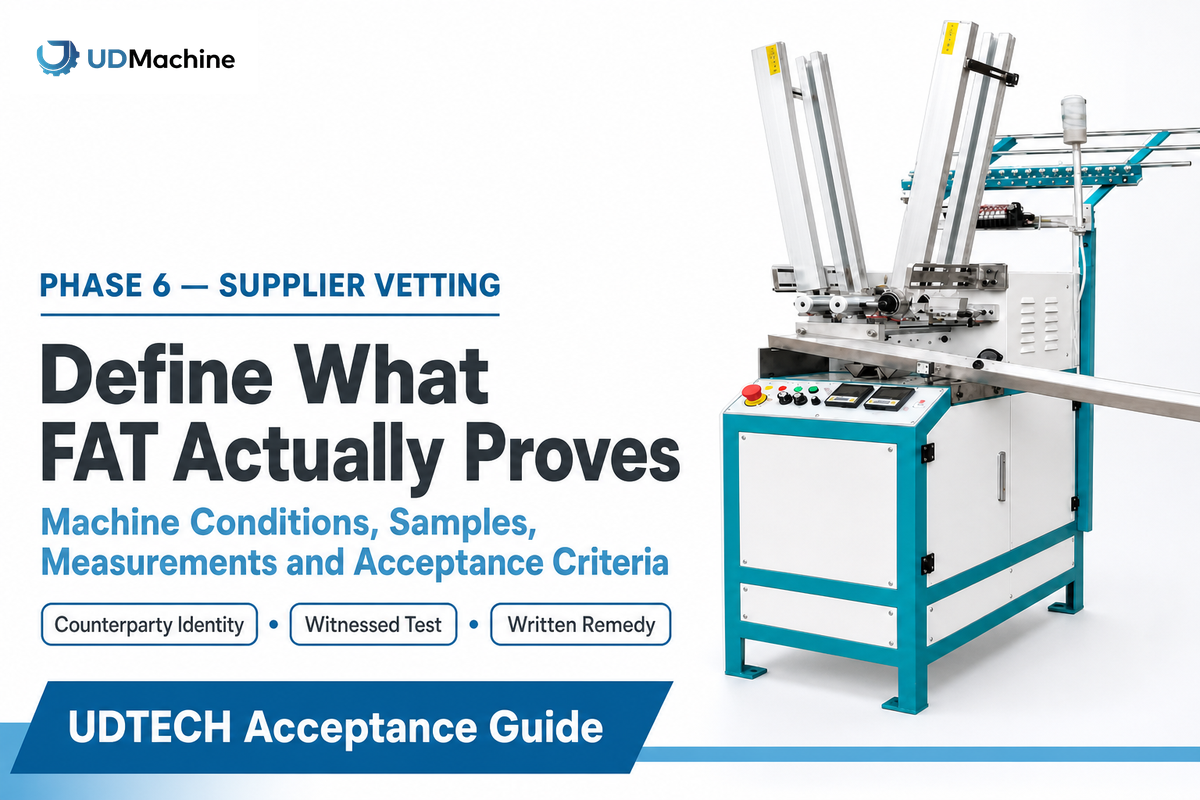
A Factory Acceptance Test confirms only the machine items, conditions, samples, measurements, and acceptance criteria written into the agreed test protocol, not automatically every published specification. It doesn’t by itself confirm the finished product or system’s certification status or performance claims. This is a scope question.
The cited standard in United States drinking-water practice has a scope that does not reach production machinery. Certification evidence attaches to the finished product or system covered by the applicable standard and claim, not automatically to the line that made it. NSF/ANSI 53-2025, with an official July 2026 errata notice, is scoped to point-of-use and point-of-entry finished treatment systems, not to the equipment that manufactures the cartridge inside them. A machine can be sold as capable of producing cartridges for a certification route, but that claim is not proof that a finished treatment system holds the certification.
A due-diligence checklist for the purchase order, drawn from a published seven-question framework for sourcing capital equipment from China:
- ✓ Confirm the identity of the counterparty prior to any deposit, not afterwards.
- ✓ Associate the payment for production with a supplier-site acceptance test, independently witnessed where agreed, rather than with the seller’s statement of “production complete”.
- ✓ Confirm formally, in writing, what remedy is available in case the seller fails to perform, prior to deposit.
- ✓ Don’t treat a marketplace refund window as a substitute for FAT: platform coverage and deadlines may differ from the real installation and commissioning timeline, so verify the current terms directly and define the factory test and contract remedy separately.
Phase 7: Commissioning and Pilot Run, the Safety and Quality Checks FAT Doesn’t Cover
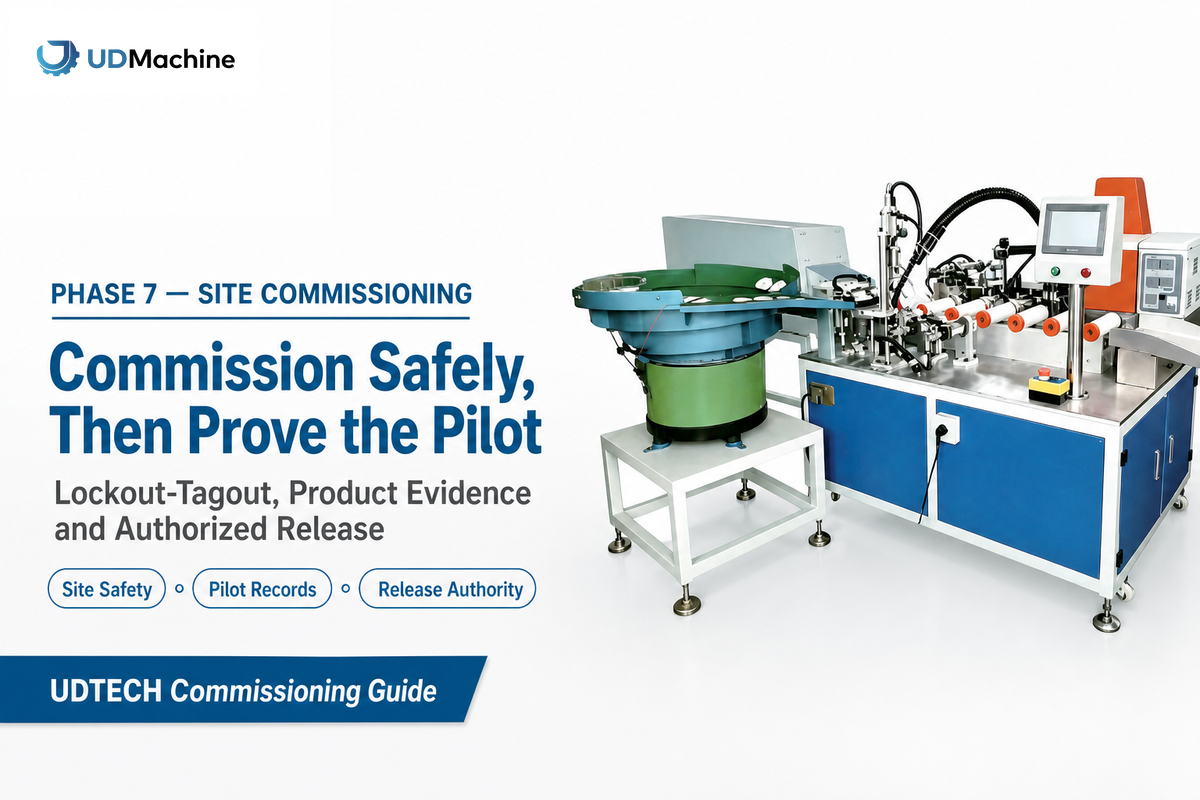
A pilot-run quality plan turns the approved product brief into release controls for the actual build. The same framework can cover PP melt-blown depth filters, string-wound cartridges, pleated PES (polyethersulfone) membrane filters, high-flow surface filters, or another approved cartridge type; if bag filters provide pre-filtration, that interface belongs in the brief. It does not choose a filter for the end user or supply universal acceptance values.
Where relevant, the approved brief should state whether a cylindrical polypropylene build is the selected type of filter, how its filter type interfaces with the filtration system, the liquid process duty, and the pressure differential used for the recorded test.
Choosing the right filter for a specific process remains an application-design decision; this matrix starts only after that choice. When a buyer compares types of filter cartridges for water applications or other process environments, evidence from different industries is not automatically transferable.
Hazardous-energy controls and training are employer-side obligations for covered US servicing and maintenance, separate from the supplier’s factory acceptance test (FAT). When a new line is installed, the employer must determine the applicable lockout-tagout procedure, employee training, and contractor coordination for electrical and utility tie-ins before covered servicing or maintenance; a passed supplier-site FAT does not complete those site obligations.
After the buyer-authorized return-to-service process, and not while the line is locked out, the pilot run raises a second question a FAT can’t address: does output meet the buyer-approved release basis, not just quantity? All metrics, including overall equipment effectiveness and piece counts, could appear healthy while inspection bias or an unvalidated acceptance criterion lets nonconforming cartridges through. A pilot run must undergo its own quality and process capability check, meaning the pilot run cartridges must be inspected against the same acceptance criteria to which the final product is held before its output is considered released under the buyer’s product-release procedure.
Pilot-Run Quality Plan for Industrial Filter Cartridges
| Release-control item | Define before the run | Verify during the run | Release record |
|---|---|---|---|
| Product identity | Approved product brief naming the cartridge type, filter size, housing interface, intended filtration application, and drawing revision. | Confirm each pilot batch matches the approved configuration; identify any variant separately. | Work order, drawing revision, and configuration sign-off. |
| Materials and components | Approved filter media or media type, core, end cap, seals, adhesive or weld materials, supplier lots, and permitted substitutions. State surface area only if the product brief specifies it. | Check material identity and lot status before loading the line; record any approved substitution. | Incoming-inspection status, material records, and lot traceability. |
| Process recipe | Process requirements and operating conditions for extrusion, winding, pleating, bonding or welding, trimming, and applicable downstream steps. For the filtration process, record the cartridge’s intended duty, the approved production process, and the recipe used for the trial. | Record actual process parameters by trial batch and investigate deviations from the approved recipe. | Recipe revision, completed batch record, and deviation disposition. |
| Dimensions and construction | Required dimensions, pore size or micron rating where specified, measurement method, housing fit, filter-pack assembly, and bypass criterion. Record filter housing fit under the stated assembly conditions. | Measure the agreed sample under the stated conditions with the identified instrument. | Inspection results, instrument ID, and reviewer sign-off. |
| Hydraulic and filtration performance | Applicable flow rate, pressure drop or differential pressure, particulate-retention or filtration-efficiency method, and acceptance basis. Define the contaminant identity, the target level of contaminants, and any cumulative contamination load under the named test method; measure pressure drop across the agreed assembly; compare filtration efficiency over time only at consistent conditions; do not infer performance at higher flow rates from one point. | Run the named test at documented process conditions and retain the raw result; add contaminant, microbial, or water-quality challenges only when the product brief requires them. | Test method, conditions, raw data, result, and approval. |
| Sampling and nonconformance | Sampling plan, inspection frequency, contamination controls, segregation rule, retest rule, and nonconformance authority. | Inspect the prescribed units and keep nonconforming cartridges outside released output. | Sampling sheet, nonconformance record, and final disposition. |
| Application-specific controls | Process fluid and process-filtration duty; where applicable, food and beverage, water filtration, water-treatment, service-life, replacement, or validated-reuse requirements. Define evidence for when media begins to clog and when to replace filter elements; record the approved basis for cleaning or replacing cartridges. | Confirm that product-specific evidence matches the intended duty without extending one pilot result to other applications. | Application review, validated use limits, and service-life or replacement basis. |
| Traceability and change control | Required material lot, recipe revision, batch ID, operator, instrument, process-data, deviation, and change-history fields. | Reconcile the identifiers and records across each pilot batch. | Traceability record and approved change history. |
| Production release | Named release authority, required dossier, open-deviation rule, and conditions for moving from pilot runs to routine production. | Review the complete evidence set and unresolved items before release. | Signed production-release authorization or documented hold decision. |
The matrix doesn’t choose the right cartridge filter for an end user, rank filtration solutions, or prescribe a universal water-quality or microbiological limit. It serves a more limited purpose: convert the selected product design into a repeatable, buyer-approved pilot-run test plan before the line is treated as production-ready.
As a within-operation diagnostic, overall equipment effectiveness (OEE) should compare a line against its own earlier weeks and a buyer-defined ramp-up target, not treat a universal 85 percent “world-class” headline as a contractual acceptance benchmark.
In its automotive case, the study used overall equipment effectiveness as a monitoring metric, observed many process errors during pre-acceptance, and reported a lower later error rate after early worker qualification.
Automation decisions in this phase also require caution. Assuming dedicated automation is always the lowest-cost option for cartridge assembly and finishing is not supported as a universal rule in high-mix, low-volume production. The real economics are configuration-specific and not fixed by production volume alone, according to peer-reviewed research on high-mix low-volume manufacturing and a separate academic review of the same manufacturing category ; neither source is a filter-cartridge cost model. Automating a production line for multiple cartridge formats using a low-volume, high-mix approach is very different from automating a production line for cartridge formats at high volume a year later.
Phases 5 through 7 need not run one after the other in the order described in every real project. Staffing, supplier acceptance testing, and commissioning may overlap and iterate where safety, the contract, and project sequencing permit — an operator hired during Phase 5 may finish training during Phase 7’s commissioning window, and a FAT deficiency found in Phase 6 can send the project back to a supplier conversation while safely independent site work continues.
Commissioning takeaway
Passing a factory acceptance test confirms only the machine items, conditions, samples, measurements, and criteria agreed in the recorded supplier-site test protocol. It indicates nothing about the employer’s completion of applicable lockout-tagout controls and staff training for covered servicing, or whether trial-run output meets the buyer’s recorded product-release criteria.
Passing a factory acceptance test confirms only the machine items, conditions, samples, measurements, and criteria agreed in the recorded supplier-site test protocol. It indicates nothing about the employer’s completion of applicable lockout-tagout controls and staff training for covered servicing, or whether trial-run output meets the buyer’s recorded product-release criteria.
The Utilization Paradox: Why Growing Demand Doesn’t Mean You Should Over-Build Capacity
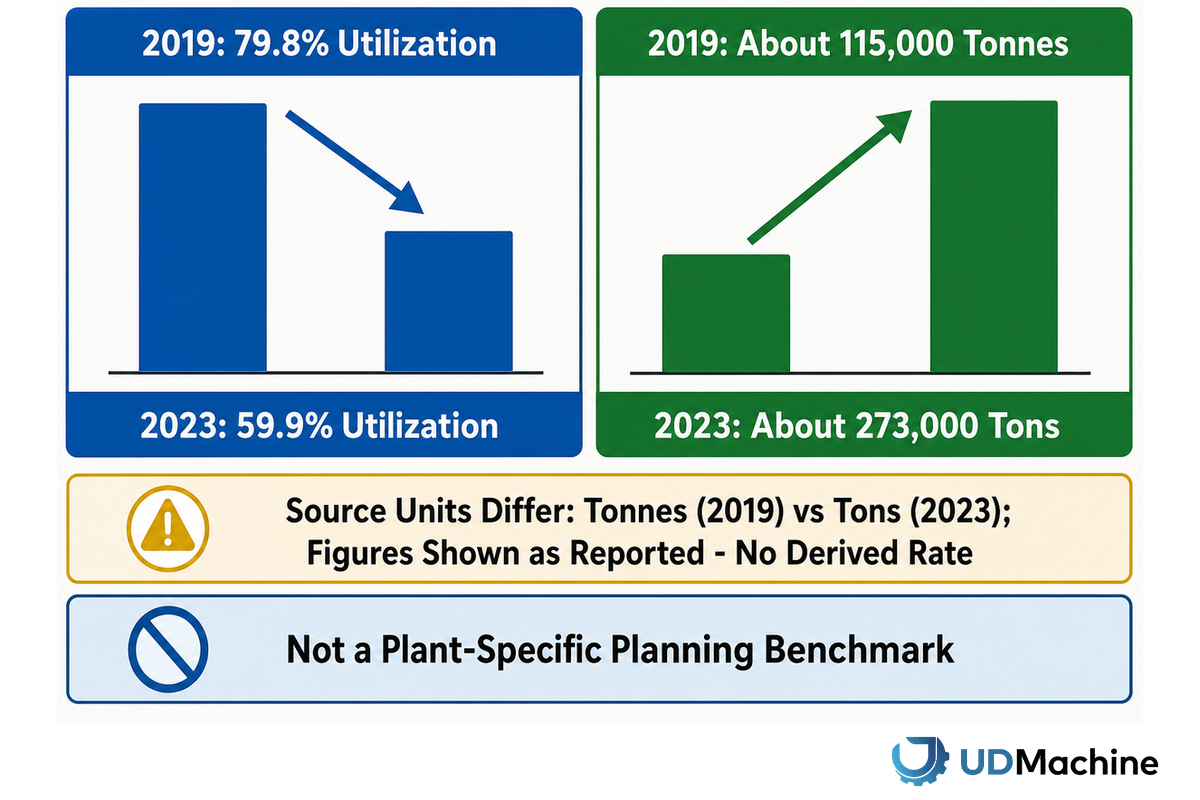
A trade-press analysis estimated that global stand-alone meltblown nonwoven capacity utilization fell from 79.8 percent in 2019 to 59.9 percent in 2023. Concurrently, capacity and dollar value growth can occur within the industry at the same time as unused capacity, which is why a headline market growth percentage is not a plant-specific planning benchmark.
Global nameplate capacity for stand-alone meltblown production grew from about 115,000 tonnes in 2019 to about 273,000 tons in 2023, with full utilization of that global capacity not expected until 2031 on the same data set. One point is worth noting rather than smoothing over: the source’s tonnage and utilization figures don’t reconcile into a single clean calculation. Therefore, the data is reported as provided rather than synthesized to create a derived figure that the data wouldn’t support.
The overall industrial filtration market is expected to grow from approximately USD 43.38 billion in 2025 to USD 45.64 billion in 2026, according to market-research estimates. While these numbers provide background context, they aren’t the planning basis. The planning basis is the buyer’s own demand forecast, product mix, accepted output, current capacity, and utilization assumptions. It’s possible to expand a market in terms of dollars while having unused capacity. Therefore, a potential buyer making a line size calculation based solely on the market growth percentage is making a planning mistake.
| Scenario type | Signal to review | Decision question | Evidence to bring |
|---|---|---|---|
| Forecast not yet evidenced | Demand rests mainly on market forecasts, enquiries, or unconfirmed opportunities. | What demand is committed, probable, or still speculative? | Order history, signed contracts, probability-weighted pipeline, and forecast owner. |
| Stable demand with spare capacity | Forecast demand is steady while the current process still has unused planned time. | Is the gap caused by scheduling, changeovers, maintenance, yield, staffing, or actual capacity? | Shift calendar, downtime and changeover logs, yield, and accepted-output history. |
| Stable demand with a recurring bottleneck | Accepted orders repeatedly queue at one constrained operation. | Which operation sets throughput, and is that operation inside the proposed line scope? | Route map, work-in-process queues, cycle observations, and bottleneck log. |
| Seasonal or campaign demand | Short peaks are separated by quieter periods or product campaigns. | Can scheduling, inventory, overtime, or qualified outside capacity cover the peak? | Monthly demand profile, inventory policy, labor plan, and supplier-capacity evidence. |
| Product-mix or changeover pressure | Multiple cartridge formats reduce available run time. | Which product families, changeovers, or cleaning steps consume the planning window? | Product-mix forecast, sequence plan, changeover records, and cleaning requirements. |
| New product or unproven process | Demand may exist, but recipe, yield, or acceptance performance is not established. | What must the pilot run prove before capacity can be sized? | Approved product brief, pilot data, yield and rejection record, and test method. |
| Committed demand with a site constraint | Demand is evidenced, but floor space, utilities, permits, or access remain open. | Which site dependency controls the earliest usable-capacity date? | Layout, utility survey, permits, receiving and service clearances, and named owner. |
| Committed demand with a people or quality constraint | Equipment time may be available, but trained operators, maintenance, or quality coverage is limited. | Which competence or shift gap caps accepted output? | Staffing roster, competence matrix, training plan, and inspection coverage. |
| Current line near its planned load | Forecast and accepted-output history indicate limited operating cushion. | Which risk-control option fits the evidence without assuming a universal trigger? | Forecast scenarios, utilization basis, downtime and yield history, and staged or external-capacity options. |
Utilization-paradox takeaway
Growing markets and unused capacity can exist simultaneously within an industry. Size a new line against your own capacity and a realistic level of assumed utilization, not against growing market estimates for someone else’s capacity.
Common Planning Mistakes and When to Delay Your Purchase
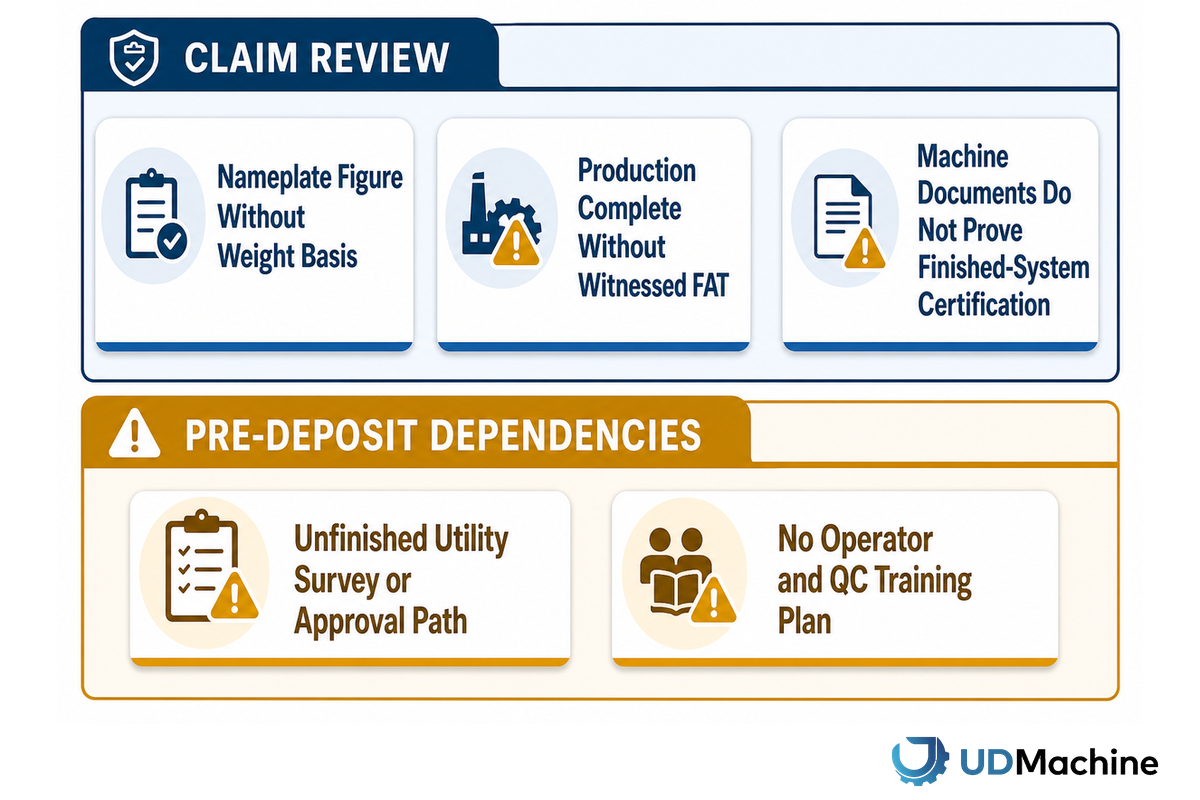
Failures in planning on a filter cartridge line can be timing and scope errors, not equipment failures. The machine may do what it should per the written spec while a failure remains in one of the decisions surrounding the machine; this guide does not claim that pattern is the most frequent.
What to discount from a vendor’s claims:
- ⚠️ A nameplate pcs/24h figure quoted without its cartridge-weight basis
- An offer of “production complete” in lieu of a supplier-site acceptance test, independently witnessed where agreed.
- Any statement that a machine certificate or document proves the finished cartridge or treatment system meets its drinking-water certification standard.
When to ask the commercial and legal team whether to withhold a deposit rather than commit to a date:
- The indicated lead time is being fixed while the site utility survey, access route, or locally required approval path remains unfinished.
- No staffing or training plan is in place for operators and QC prior to commissioning.
Common-mistakes takeaway
Treat an incomplete utility survey, missing staffing plan, or missing FAT protocol as an open commercial risk to address in the contract with qualified legal and commercial advice, not as a universal reason to hold the deposit or something to defer until after the line ships.
Treat an incomplete utility survey, missing staffing plan, or missing FAT protocol as an open commercial risk to address in the contract with qualified legal and commercial advice, not as a universal reason to hold the deposit or something to defer until after the line ships.
The Eight-Phase Planning Clock
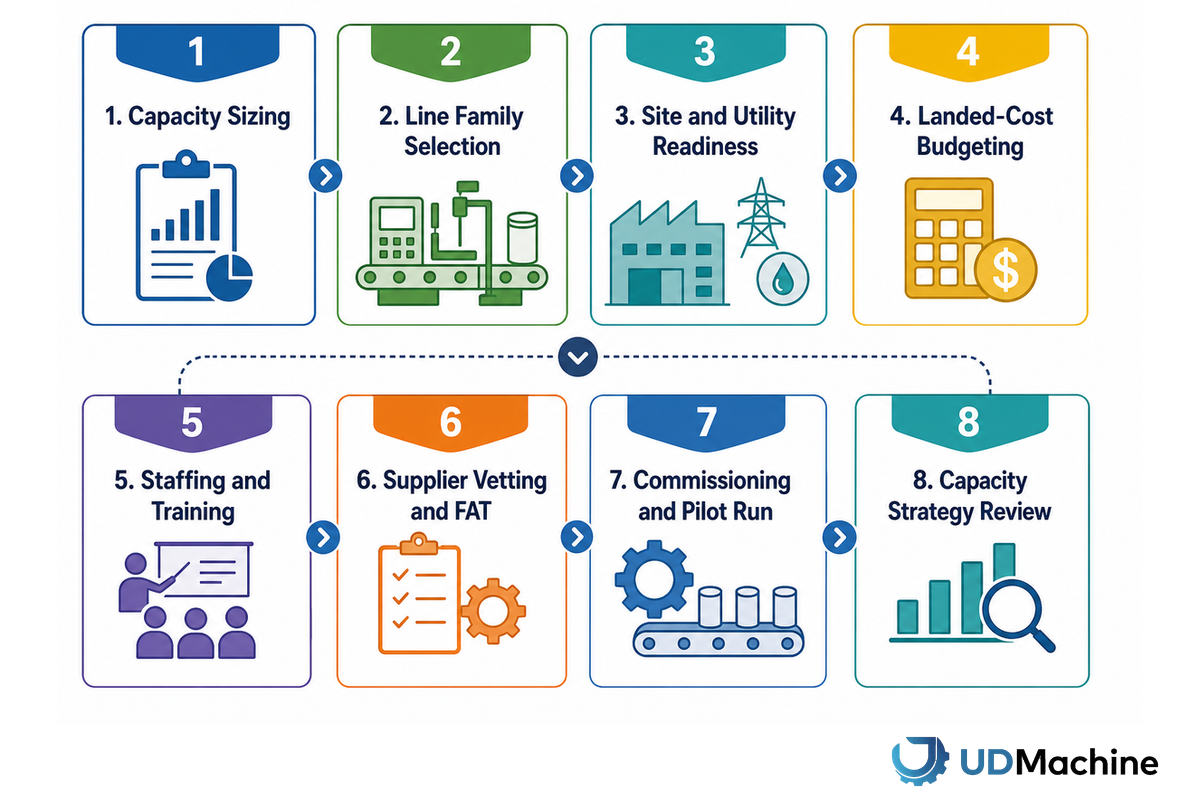
One page to update throughout the whole project, from the capacity worksheet in Phase 1 to the ramp-up review in Phase 7 before any example window becomes a schedule:
| Planning phase | Illustrative duration | Key deliverable | Common failure point | Owner |
|---|---|---|---|---|
| 1. Capacity sizing | 1-2 weeks | Required daily output figure | No utilization discount applied | Buyer |
| 2. Line family selection | 1-3 weeks | Machine family shortlist | Re-researching published specs | Buyer |
| 3. Site and utility readiness | 2-6 weeks | Utility survey sign-off | Power/space survey done late | Buyer |
| 4. Landed-cost budgeting | 1-2 weeks | Four-event cash-flow timeline | Duty/fees treated as one line item | Buyer/finance |
| 5. Staffing and training | 4-12 weeks, overlapping | Trained operator and QC crew | No training line item on the timeline | Buyer/HR |
| 6. Supplier vetting and FAT | 2-4 weeks | Supplier-site acceptance test, independently witnessed where agreed | FAT mistaken for product certification | Buyer |
| 7. Commissioning and pilot run | 2-8 weeks | Verified LOTO procedure, validated pilot quality, ramp-up plan | Expecting full-rate output in week one | Buyer |
| 8. Capacity strategy review | Ongoing | Utilization-based expansion trigger | Sizing the next line off market headlines | Buyer |
Frequently Asked Questions
Q: How Much Does a Filter Making Machine Cost?
Filter making machine prices cannot be reduced to one defensible range: a simple single-step machine and a fully automatic industrial line differ by product type, automation level, capacity, line boundary, test protocol, delivery term, and buyer-supplied work.
Market price comparisons should differ by machine class: small pleating or bonding equipment, oil-filter production lines, PP spun or meltblown cartridge lines, and fully automatic industrial air-filter lines are not interchangeable scopes. Automation level, production capacity, and configuration (control system, glue system, testing equipment) affect the price and must be normalized before offers are compared. Any stated number is an equipment quote, and Phase 4 outlines the other charges that may come along with it.
Q: What Core Filter Making Machines Are Needed in a New Plant?
A new plant may need equipment for media feeding, forming or pleating, bonding or sealing, and assembly, while the exact list depends on the specific filter product and approved route.
For a filter cartridge line, candidate forming and assembly steps may include extrusion or winding to form the media, bonding or welding end caps, and cutting or trimming to final length, but the approved product drawing and route control the actual list. Auxiliary equipment such as compressed air and material handling may be included, optional, or buyer-supplied. Phase 2 outlines where to find the seller’s specification comparison for each machine family and use it as a shortlist rather than a universal scope.
Q: How Do You Determine How Many Filters Are Needed in Your Process?
Determining filter quantity for a finished-product process starts with an application-specific method and operating data, then works forward under acceptance criteria and a qualified reviewer — a different calculation from sizing a production line’s capacity.
This question addresses a customer adding filters to a fluid process, which belongs to application engineering rather than the planning used to size a production line that makes cartridges. If your question focuses on the finished product, the capacity planning worksheet in Phase 1 applies only to production demand: do not start filter selection with a demand number, discount factor, or single best-case production-line number; use the governing application method, operating data, acceptance criteria, and qualified reviewer for that separate task.
Q: What Auxiliary Machines Support Filter Production?
Beyond the core forming and assembly equipment, a filter cartridge line may need compressed air, material handling and conveying, marking or labeling, and packaging equipment to support daily production.
When these supporting systems do not appear on a first quote of the main equipment, put them on the same site-readiness and budgeting lists and ask whether each interface is included, optional, buyer-supplied, or out of scope. Where applicable, packaging and labeling affect the landed-cost budget in Phase 4, while compressed air belongs on the utility survey in Phase 3.
Q: How Long Does It Take to Train Operators on a New Filter Cartridge Line?
Operator training on a new line follows a configured curriculum and competence test rather than a promised few weeks overlapping commissioning, while quality-control inspectors typically need more than 1 month and up to 1 year of on-the-job training in the cited US occupational data; that range is not an operator-training promise or a configured-line competence schedule.
Separating operator and QC training in Phase 5 reflects a real distinction between roles, while the actual timescales and experience required must be defined for the configured line. An operator’s line competence cannot be promised in weeks from this evidence, even when training overlaps the commissioning window in Phase 7; a QC inspector uses a separate buyer-defined proficiency and sign-off basis for spotting nonconforming output. A published ramp-up study found that direct ramp-up costs, including training, ran to roughly a fifth of combined building-and-equipment investment in its studied context — a project allowance to replace with buyer evidence, not a universal filter-line ratio. In that study, beginning worker qualification during commissioning was followed by a lower later error rate, and no control that waited for completion of a fully installed line was reported. In equipment purchases, inadequate planning for staff capabilities can remain a gap, but this guide’s research does not establish that it is the most common or cheapest gap to fix. The practical response is a line on the project plan for roles, competence, trainers, and sign-off dates, followed by confirmation of whether equipment-supplier support or a change order is required.
Related Articles
- Filter Cartridge Production Planning Solutions — UDTECH’s equipment and services page for this exact planning stage
- Filter Cartridge Production Line Solutions — full specification comparison across PP melt-blown, string-wound, and CTO activated-carbon lines
- Filter Cartridge Making Machines — equipment hub with individual machine family pages
Why We Write This
Suzhou UDTECH Technology Co., Ltd. publishes pages covering PP melt-blown, CTO activated-carbon, and string-wound filter cartridge production lines; unverified workshop size, management-system certification, conformity markings, and shipment counts are not used here as purchase evidence. The capacity worksheet in this guide is built from our own published line specifications, while the planning gaps are buyer checks rather than frequency claims about what customers ask most often once a quote is in hand.
References & Sources
- 29 CFR 1910.303 — Electrical equipment approval requirement — eCFR / OSHA
- 29 CFR 1910.399 — Definition of “approved” (NRTL) — eCFR / OSHA
- 29 CFR 1910.147 — Control of hazardous energy — US Occupational Safety and Health Administration
- Harmonized Tariff Schedule, HTS 8477.20.00 — US International Trade Commission
- Section 301 Product Search — Office of the United States Trade Representative
- Section 301 List 1 Product List — Office of the United States Trade Representative
- Section 301 Investigation Fact Sheet — Office of the United States Trade Representative
- CBP Dec. 26-14, Merchandise Processing Fee FY2027 — Federal Register / US Customs and Border Protection
- CBP Entry Summary and Post-Release Process — US Customs and Border Protection
- Electric Power Monthly, Table 5.6.A — US Energy Information Administration
- Supply-chain risk planning for small manufacturers — National Institute of Standards and Technology
- NSF/ANSI 53-2025 with July 2026 errata, Drinking Water Treatment Units — Health Effects — NSF
- Stand-alone meltblown capacity utilization data — Nonwovens Industry
- Industrial Filtration Market size and forecast — Precedence Research
- Seven questions before paying for China-sourced capital equipment — Harris Sliwoski (China Law Blog)
- Production ramp-up cost and workforce qualification study — Production Engineering (Springer)
- Quality Control Inspectors Occupational Outlook — US Bureau of Labor Statistics
- Lean Six Sigma in high-mix low-volume manufacturing — PLOS ONE
- A Review of the High-Mix, Low-Volume Manufacturing Industry — Applied Sciences (MDPI)
- US Patent 6,942,106 B1 — Google Patents