Get in touch with Suzhou UDTECH Technology Co., Ltd. Company

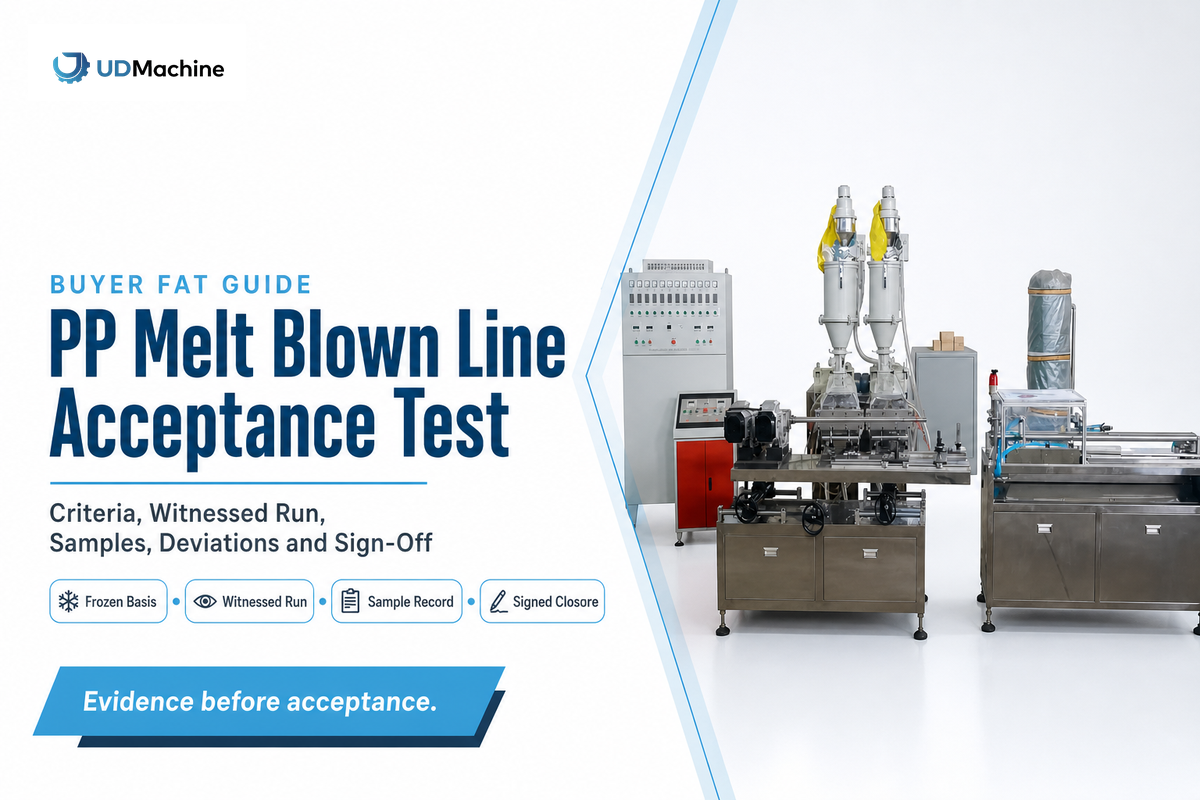
A PP melt blown filter cartridge production line acceptance test is a witnessed evaluation that must demonstrate equipment performance against a frozen purchase basis, not merely that the equipment can run. Acceptance evidence should be traceable to a defensible FAT basis rather than a bare run demonstration. A FAT must connect each requirement to a witnessed step, measured result, identified sample, deviation decision, and authorized sign-off.
Direct answer
Accept the line only when the agreed cartridge, material, utilities, run conditions, sample plan, pass criteria, evidence files, open items, and signatories all match the approved basis. Nameplate speed, a short demonstration, or one good cartridge cannot replace that chain of evidence.
Structure and processes described above are generic. This means that specific attributes including, for example, average speed or rate, yield, or acceptance level aren’t defined and must be agreed to by the buyer and seller.
Basis
Approved specification, product, material, utilities, methods, and revision.
Observation
Witnessed condition, instrument, sample identity, raw result, and exception.
Disposition
Pass, impact review, correction, retest decision, owner, and signature.
What does a production-line acceptance test actually prove?
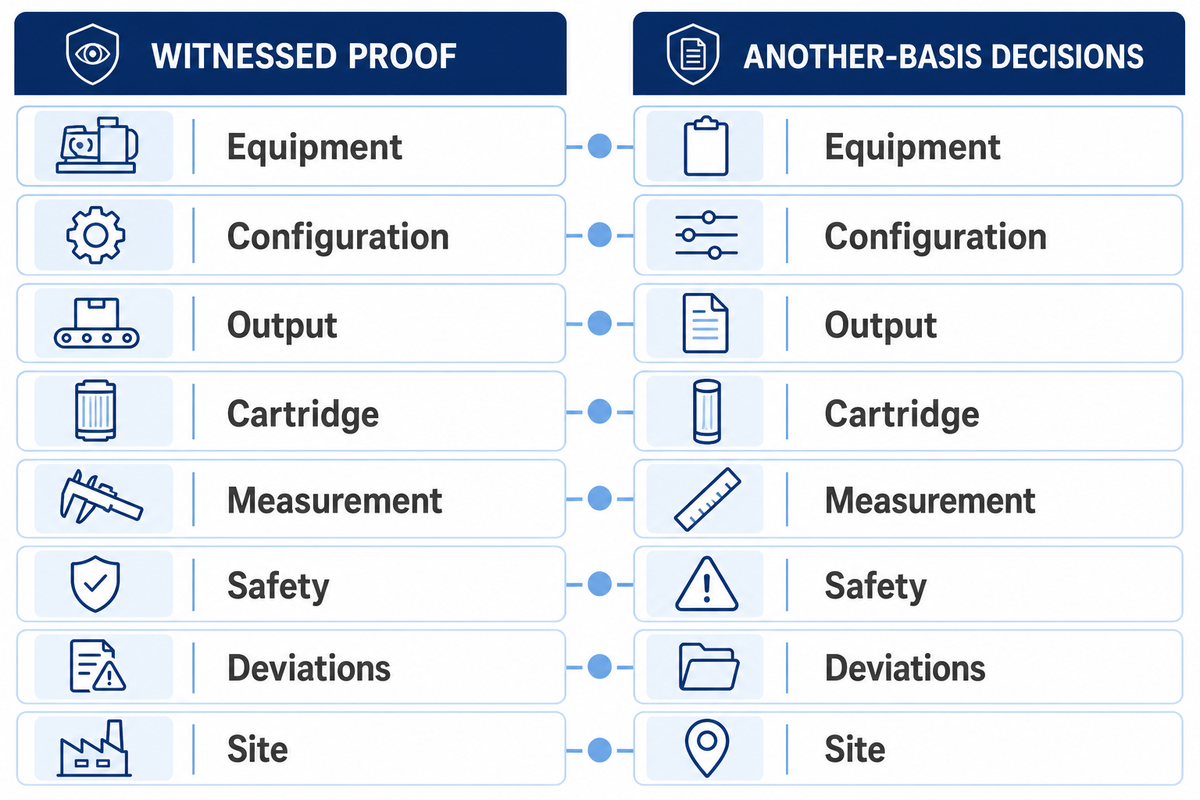
A Production-Line FAT can demonstrate that the witnessed equipment and agreed cartridge met contractual checks under recorded factory conditions during the defined run. A Production-Line FAT doesn’t warrant every future resin lot, operator, utility, micron claim, filtration-efficiency result, service-life result, or regulated-use approval.
| Evidence type | FAT can establish | Needs another basis |
|---|---|---|
| Equipment | Agreed functions observed on the witnessed configuration | Behavior after unrecorded changes |
| Configuration | Installed modules and recorded revisions | Future substitutions or upgrades |
| Output | Conforming units in the defined test window | Long-term capability across campaigns |
| Cartridge | Specified observations on identified FAT samples | Use-specific filtration and compliance claims |
| Measurement | Results from the listed method and instrument | Conclusions beyond method capability |
| Safety | Agreed factory observations and records | Every destination or workplace approval |
| Deviations | Impact review and recorded disposition | Unreviewed effects on other criteria |
| Site | Factory interfaces included in the test | Installed utilities, integration, and commissioning |
It’s acceptable to state that the observed configuration met listed criteria during the defined run. Equipment shouldn’t be considered acceptable for all future production.
Witnessed-lot boundary: one FAT lot is a bounded event. Evidence of repeatability across resin lots, operators, environments, maintenance states, and production campaigns belongs to a wider capability or continued-verification program.
Freeze ten acceptance inputs before the FAT date
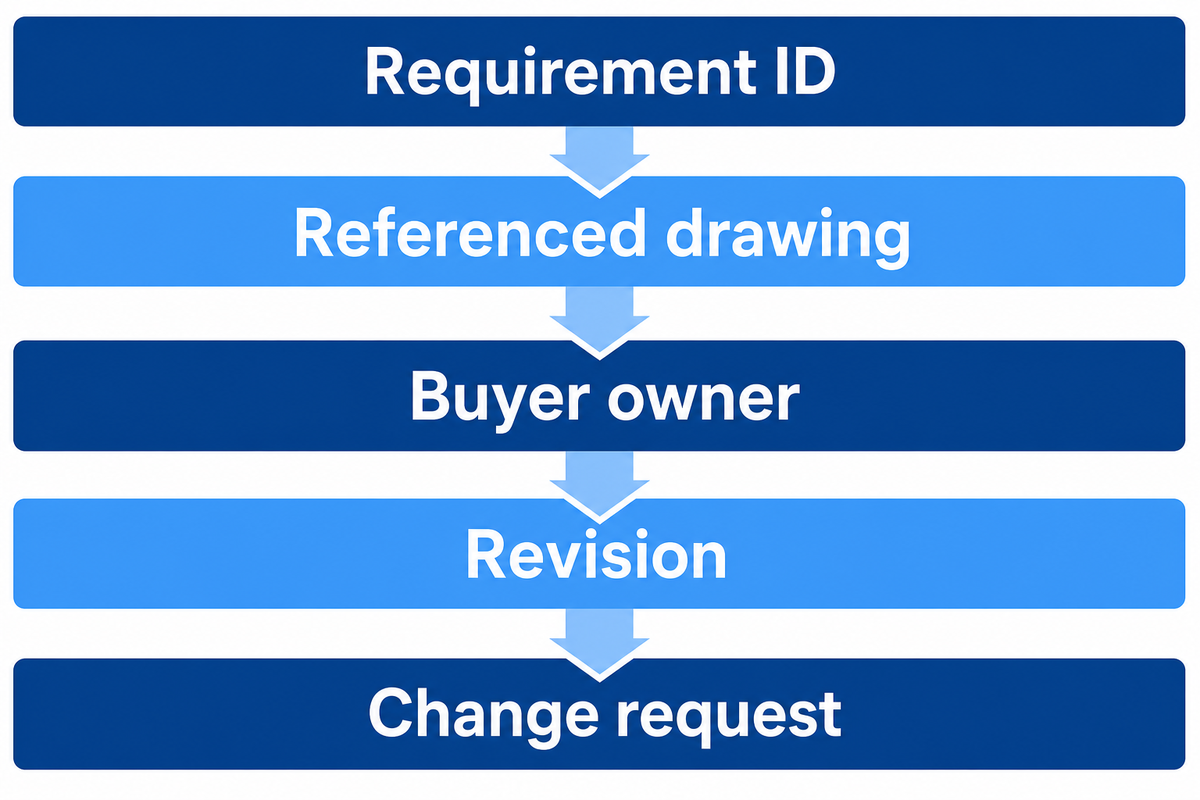
Prior to the FAT date, all acceptance inputs must be final, including product geometry, filtration designation, defined accepted output, PP material, electrical and utility bases, surfaces, cuts, floor conditions, interfaces, witnessed-run basis, and the document package.
Acceptance-Basis Freeze Card
- Requirement ID, exact wording, units, method, and pass rule
- Referenced drawing, recipe, purchase-order clause, or approved attachment
- Buyer owner, supplier owner, witness, and decision authority
- Revision, approval date, supplied test material, and allowed substitutions
- Change request, impact review, and disposition route
If conflicting documents indicate different controlling terms, review the purchase order, technical agreement, drawing, supplier proposal, and meeting notes, then resolve which document controls prior to starting the equipment.
Practical stop condition: if the trial cartridge, resin lot, utility basis, method, or pass criterion differs from the approved card, pause and authorize the change. A result from the wrong basis is not made comparable by adding a signature later.
The Five-Gate Witness Sequence: a buyer-created decision aid
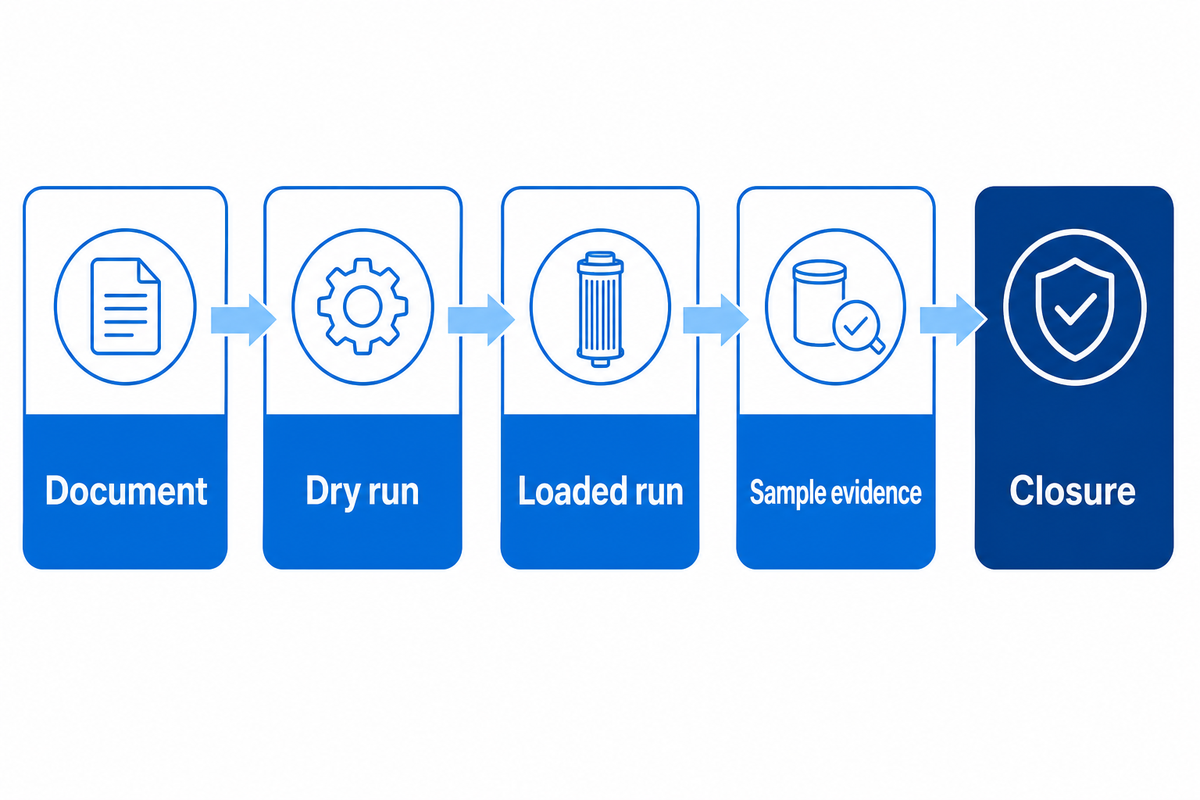
The Five-Gate Witness Sequence is a means of organizing data. This allows a client to resolve outstanding issues related to earlier results. This 5-Gate Witness Framework is a buyer-created decision aid, not an ISO, FDA, OSHA, or industry-association standard, and the signed contract remains the authority for the actual project. This document will not supersede contracts or other similar legal agreements. This document is intended to be used as a decision aid by the client.
| Gate | Decision | Retained record |
|---|---|---|
| Document | Is the basis approved and testable? | Frozen criteria and revision index |
| Dry run | Are functions and interfaces ready? | Function, alarm, utility, and safety log |
| Loaded run | Does the agreed cartridge run under the defined conditions? | Time-series settings, events, and output |
| Sample evidence | Do identified samples meet the agreed checks? | Sample register and raw measurements |
| Closure | Are results and deviations properly disposed? | Impact reviews, retests, open items, signatures |
When using this document, evidence should be provided to demonstrate compliance with the pass criteria at each gate. This helps to ensure that problems don’t go undocumented.
Verify dry-run readiness without overclaiming compliance
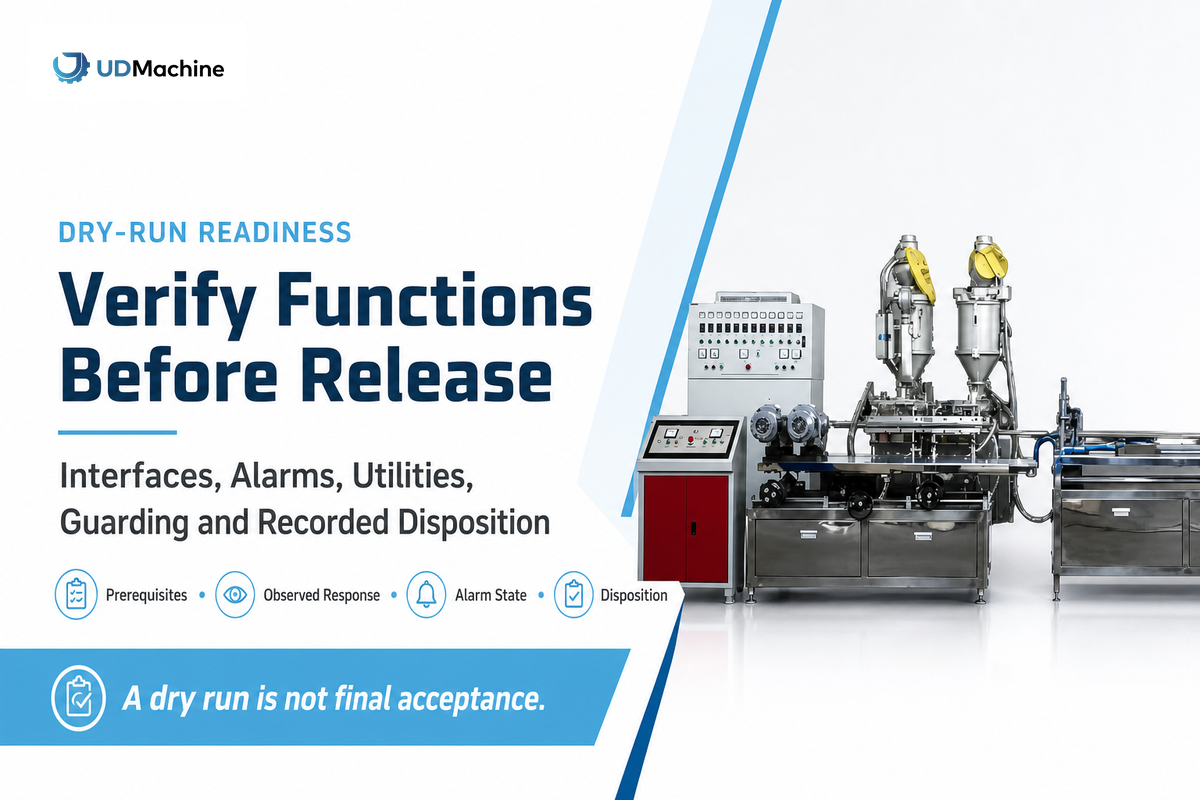
Prior to the release of production product, a dry run should be performed to determine if the equipment and the process will function as designed and if interfaces function as required. A dry run shouldn’t be construed as an acceptance or a release for service of the equipment.
“One or more methods of machine guarding shall be provided.” OSHA 1910.212, United States scope
There are a number of gaps in the process, including guarding, electrical, installation, and site responsibilities, that should be addressed prior to shipment. For example, prior to shipping a product, guarding evidence should demonstrate the destination and hazard basis, and the applicable tests should be performed and documented. Gaps may also exist when personnel lack the required training to operate equipment, but training does not replace the applicable risk, electrical, installation, and site-responsibility reviews.
Eight-field readiness record: function ID; prerequisite; command; expected response; observed response; alarm or interlock state; witness; disposition. Attach photos or video as indexed supplements, not as substitutes for signed results.
Run the agreed cartridge and measure accepted output
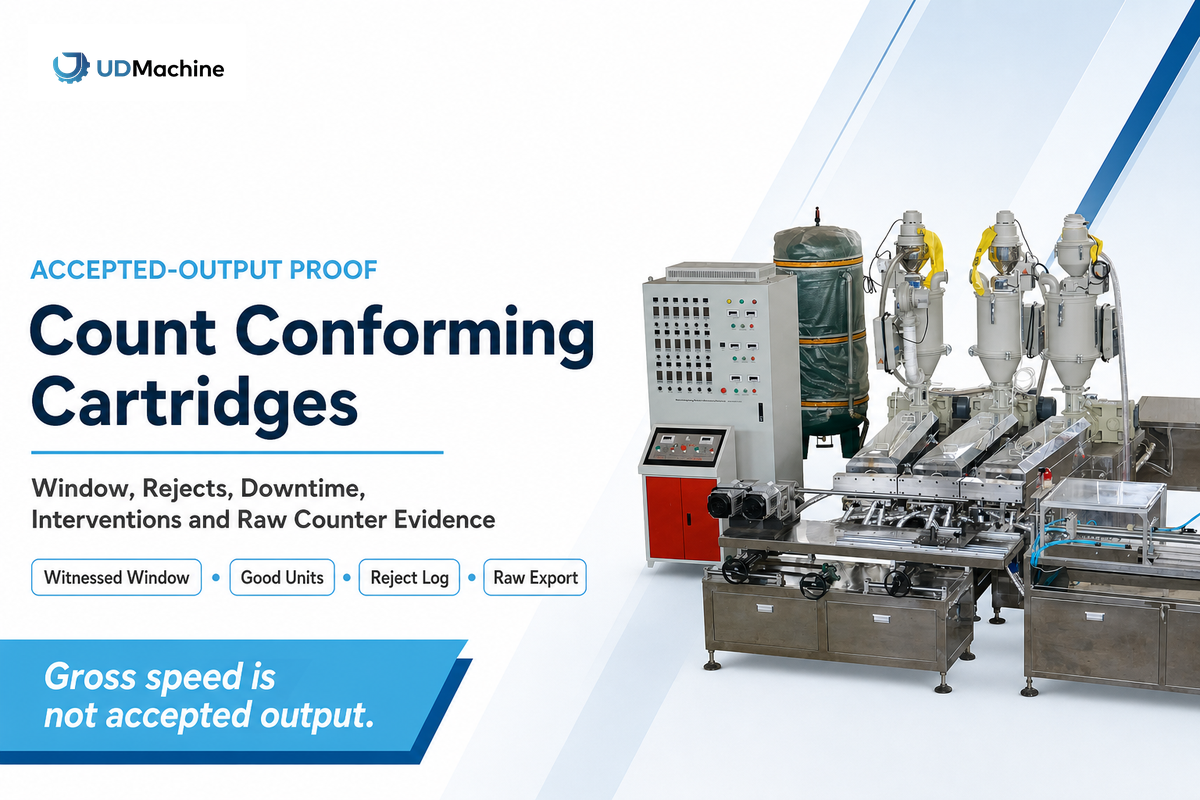
The product run should be evaluated against the stated requirements and retain the cartridge, PP lot, settings, witnessed window, operator, output, reject, downtime, and intervention records. Conforming product is considered accepted product, and nonconforming product is considered rejected product. There are a number of reasons why product may be rejected, for example, the product may be out of adjustment, and product is being produced too rapidly, and excess pieces may be produced. Routine interventions shouldn’t be excessive.
Accepted-Output Proof Sheet
- Start, stabilization, witnessed-window, stop, and restart timestamps
- Good units, rejected units, quarantined units, and stated counting method
- Downtime, exclusions, material replenishment, operator intervention, and reason
- Recipe revision, PP lot, cartridge drawing, and sampled-unit IDs
- Raw counter export, manual cross-check, witness, and disposition
Stable state evidence should be provided to demonstrate that the process is controlled without hiding agreed recovery or transient behavior outside stable state conditions. Stress testing shouldn’t be performed unless it has been reviewed and documented to be in conformance with the requirements of the contract.
Comparison rule: two output results are comparable only when the product, material, modules, utilities, settings, stabilization rule, included time, and reject definition are equivalent or their differences are disclosed.
Build an auditable cartridge sample and inspection plan
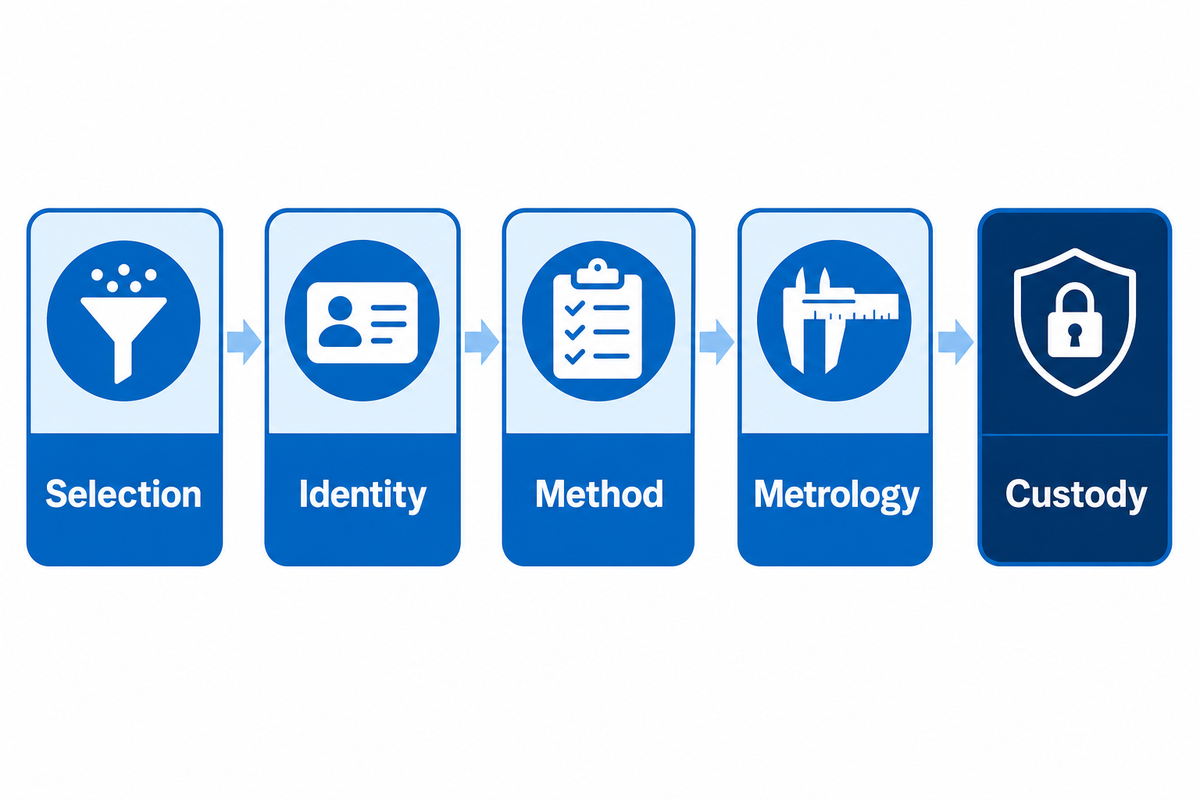
An auditable sample plan identifies the rationale for selection and binding of the sample ID to the measurement record. It explains why and where each sample is taken. Decisions about risk, run length, product variations, measurement burden, and contract requirements should determine the sample distribution instead of relying on an invented universal AQL.
| Field | Record | Decision risk controlled |
|---|---|---|
| Selection | Startup, stable run, end, and agreed disturbances | Convenience sampling |
| Identity | Sample ID, time, PP lot, recipe revision | Lost traceability |
| Method | Characteristic, datum, instrument, procedure | Non-comparable results |
| Metrology | Calibration status, resolution, repeatability, uncertainty | False pass or fail near a limit |
| Custody | Witness, result, retained location, disposition | Unreviewable evidence |
A calibration certificate will be included with the measurement plan and report, if necessary. However, other factors may also limit the measurement result.
How many cartridges? There is no defensible universal count for every FAT. Agree a risk-based distribution across the observed states and document why it can answer the listed acceptance questions.
Keep machine FAT distinct from filtration-performance qualification
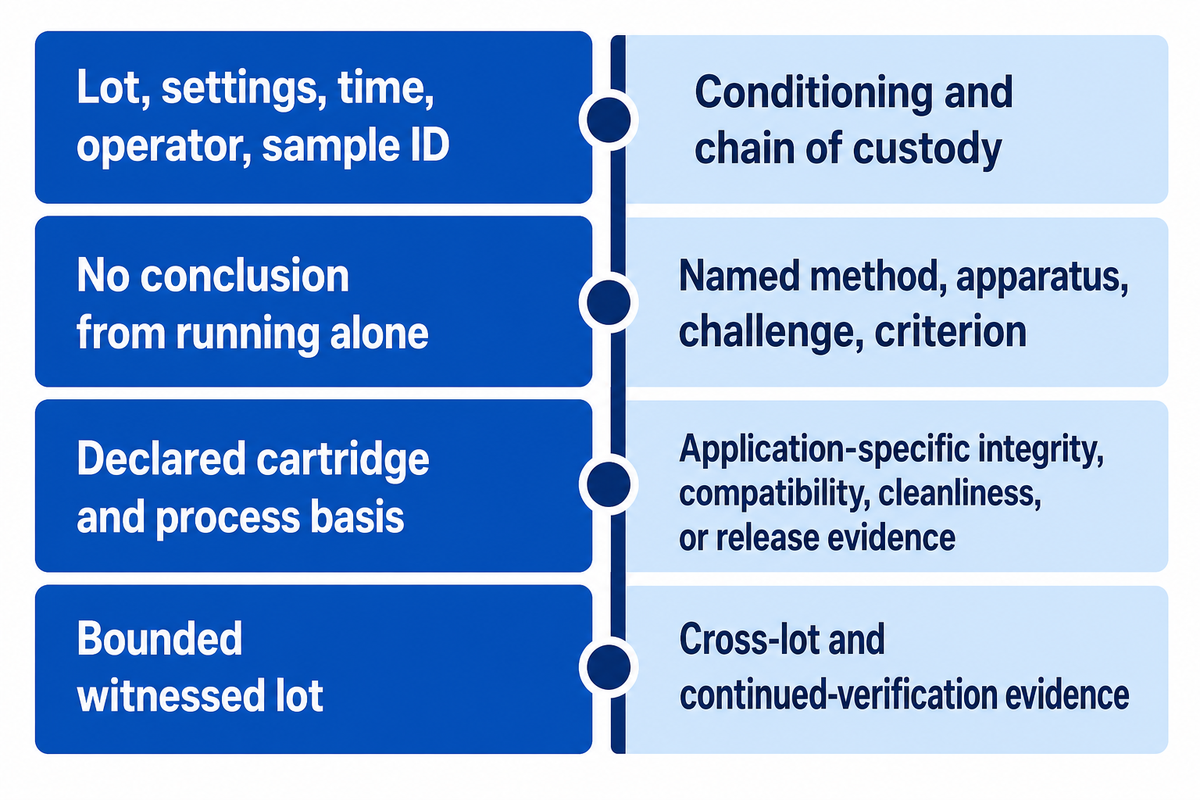
There are numerous types of documented process and product information that may support a broader qualification program, while machine FAT and cartridge-performance qualification remain distinct decisions. However, these samples of information may not prove, support or qualify the process and its output to meet the requirements for micron rating, efficiency, pressure drop or service life.
| Question | Machine FAT record | Product-qualification addition |
|---|---|---|
| Was the sample traceably produced? | Lot, settings, time, operator, sample ID | Conditioning and chain of custody |
| Does a filtration claim pass? | No conclusion from running alone | Named method, apparatus, challenge, criterion |
| Is evidence fit for the use? | Declared cartridge and process basis | Application-specific integrity, compatibility, cleanliness, or release evidence |
| Is the process sustained? | Bounded witnessed lot | Cross-lot and continued-verification evidence |
The production process for PP filtration media involves heating the polymer melt, extruding it, and drawing melt-blown fibers around a core. The process results in a meltblown filter cartridge whose gradient density, fiber diameter, pore size, porosity, surface area, structure and filtration performance can vary with raw material and production conditions; in melt blowing, the PP polymer melt is extruded into melt blown polypropylene fibers, but a PP melt-blown filter cartridge sold as a liquid filter still needs defined evidence for water purification, high-efficiency filtration, larger particles, higher filtration efficiency, or any claimed advantages of PP.
Terminology boundary: PP meltblown, polypropylene meltblown, a formed melt-blown filter, filter media, filtration media, a cartridge filter, a polypropylene filter, and a PP meltblown filter can describe related products or media. They do not make melt flow, continuous production, automatic production, high production, flow rate, low pressure, or low pressure drop an acceptance criterion without a method and limit.
There are various intended uses of PP, and these include liquid and gas purification, and other separation processes. Product filtration performance may vary with intended use, porosity, and density; a depth filter used for pre-filtration before a reverse osmosis membrane faces a different contaminant, solvent, or high flow duty from other liquid filtration, water treatment, and filtration applications.
Direct answer: types of filter and types of filter cartridges need specific filtration requirements, named filtration materials, and use-specific evidence. Terms such as melt-blown nonwovens, polymer fibers, filter elements, PP particles, low melt, melt-blown process, meltblown process, melt blown process, production technology, improved PP melt blown filter, melt blown filter cartridges designed, cartridges designed for specific applications, or surface area of the filter do not prove micron rating. Traceable FAT samples may enter a separate program with its own method, conditioning, equipment, laboratory, criterion, and approving authority.
Build a record pack that another reviewer can audit
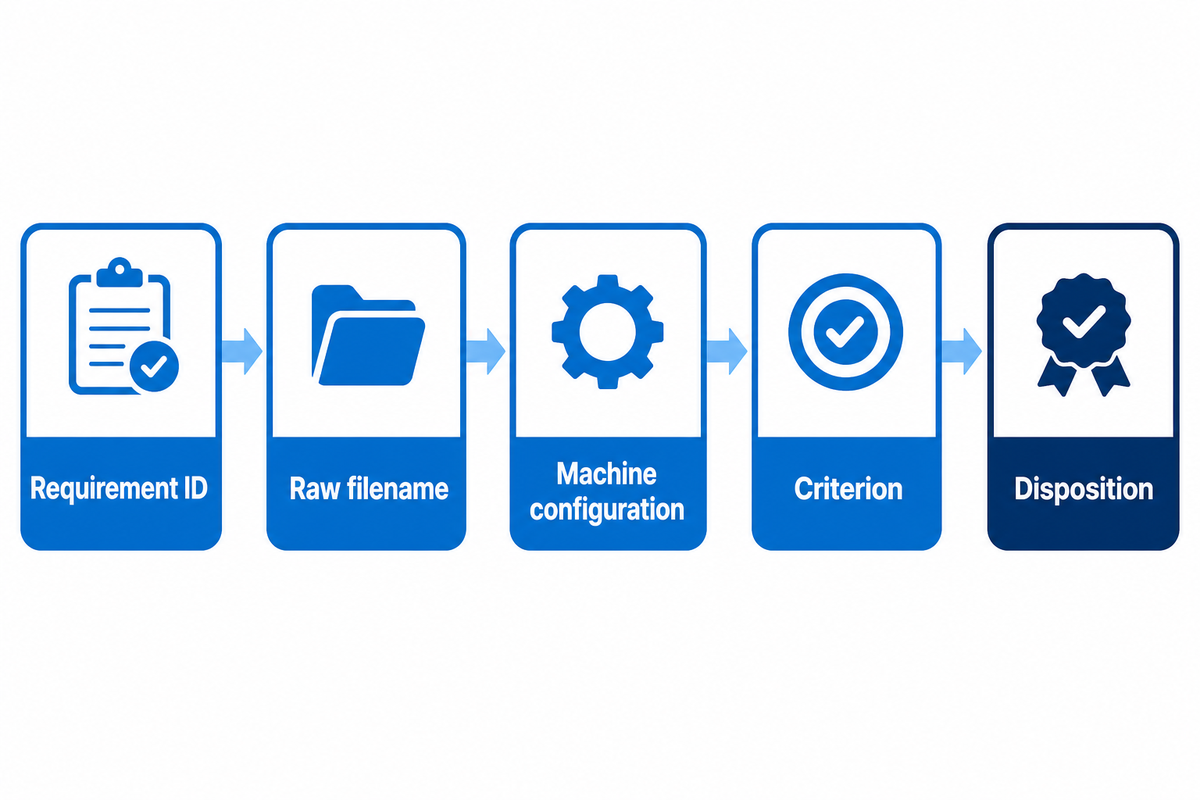
Auditable record packs let reviewers move, without memorization, from an acceptance input to related test steps, raw records, acceptance criteria, witness answers, results, and dispositions. The record packs preserve the integrity of the records, including the revision history, sample identification, instrument evidence, exceptions, approvals, and trial-lot record.
Evidence index fields
- Requirement ID and controlling document revision
- Test-step ID, raw filename, timestamp, custodian, and immutable original
- Machine configuration, software or recipe revision, material lot, and sample IDs
- Criterion, result, witness, exception, and linked deviation record
- Disposition, approving role, signature date, and FAT/SAT transfer status
Time-stamped photos and videos should also be included to document test steps and sample records. These should also be included along with signed decisions.
Document control: retain the original filename, revision, creation time, author, custodian, approval state, and any later superseding file. Mark the record as evidence from the witnessed trial lot, not a claim of future cross-lot capability.
Close failures with an impact-based Deviation-to-Signoff Loop
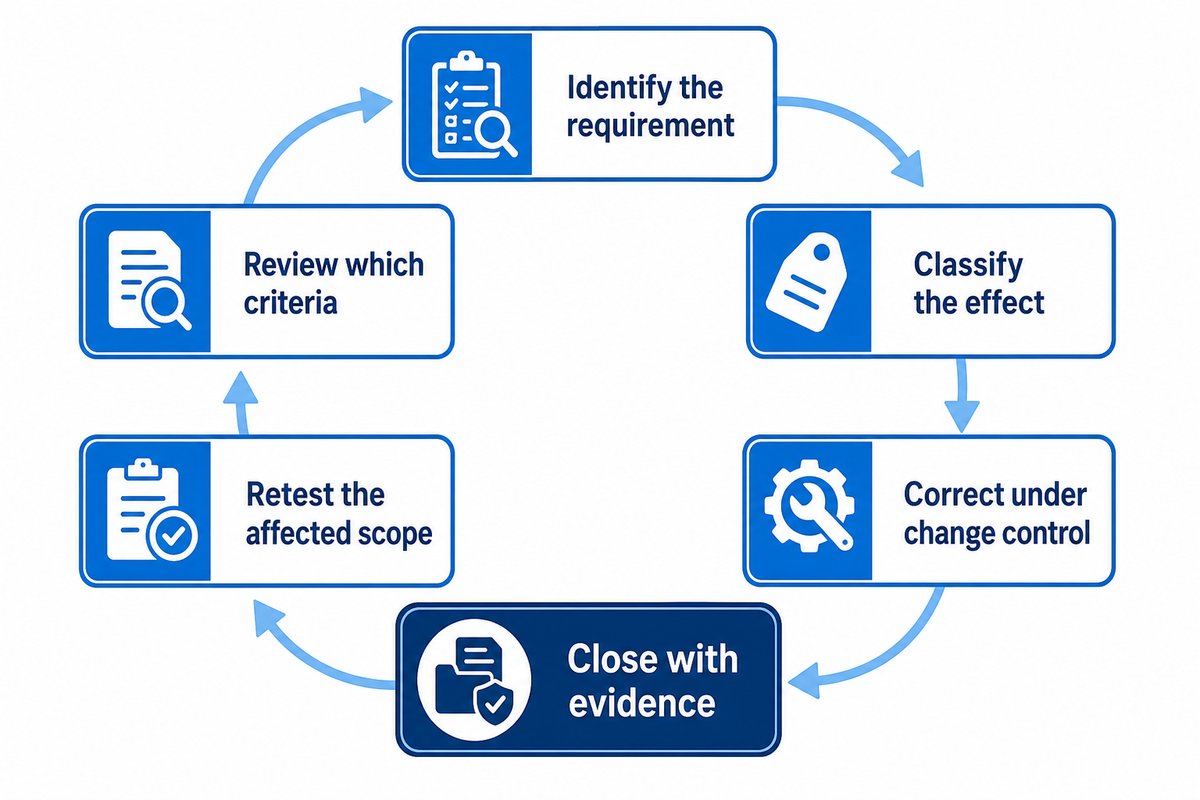
Deviations should be identified, classified, and closed through the appropriate review, and, if needed, a determination should be made to retest. The evidence should be provided along with the decision.
Deviation-to-Signoff Loop
- Identify the requirement, observed result, time, configuration, and sample.
- Classify the effect on safety, function, output, product evidence, documents, and schedule.
- Correct under change control and preserve the original failed evidence.
- Review which criteria, records, and prior results the change can affect.
- Retest the affected scope, or approve a documented no-retest rationale.
- Close with evidence, owner, buyer authority, date, and any SAT carryover.
A corrected filename typo may require controlled document replacement without requiring a machine re-run. Changes to a sensor or control parameter would also impact previous results and would therefore also warrant a repeat run. The impact review would convey the differences.
Contract boundary: informational observations, punch-list items, conditional acceptance, payment release, shipment permission, and final acceptance are not interchangeable. Define who can grant each status and what evidence must exist first.
Transfer evidence from FAT to SAT and commissioning
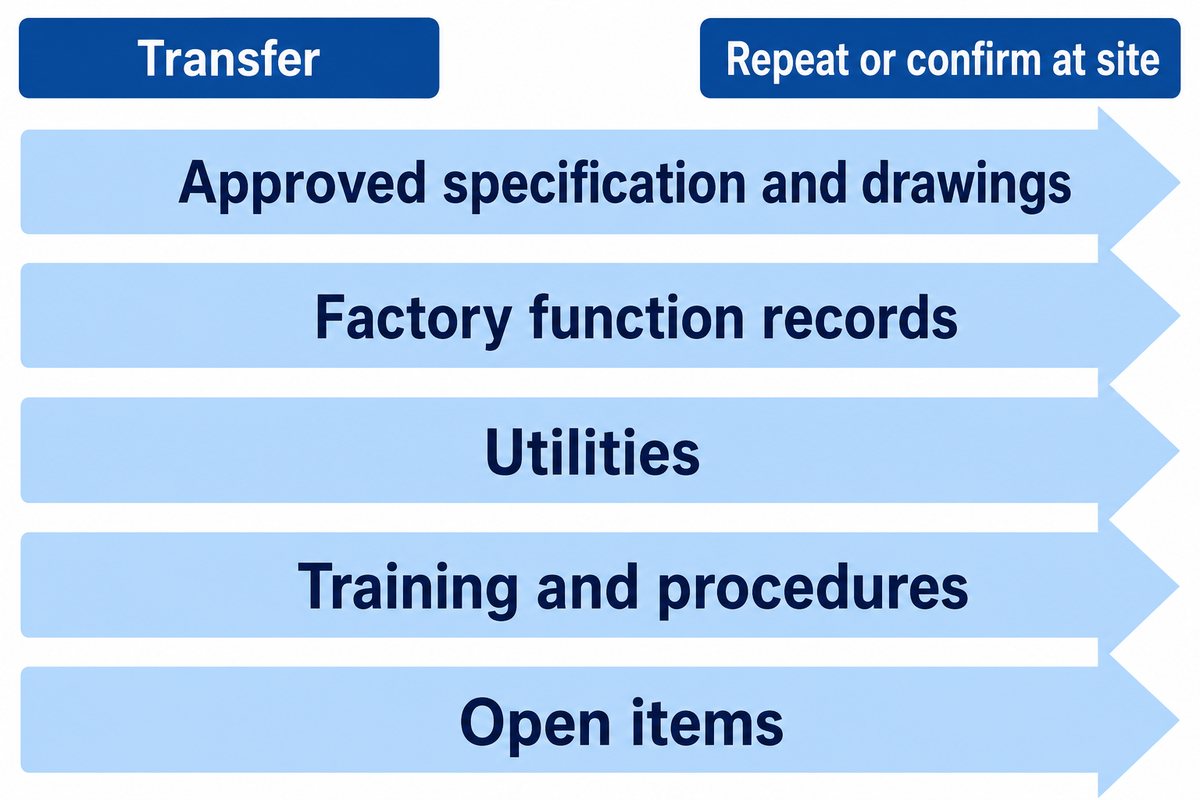
Evidence collected as part of a FAT should be clearly labeled as transfer, repeat, or open and sent to the customer site. Factory observations and documents may remain valid, but their transfer, repeat, and open status must be defined before site use. Other evidence should be verified during Site Acceptance Testing (SAT) or Commissioning.
| Item | Transfer | Repeat or confirm at site |
|---|---|---|
| Approved specification and drawings | Controlled copies | Installed-as-built match |
| Factory function records | Raw logs and signed results | Functions affected by installation or interfaces |
| Utilities | Factory test conditions | Actual site voltage and frequency, air, cooling, and stability |
| Training and procedures | Manuals and planned curriculum | Site personnel competence and routine execution |
| Open items | Owner, due date, acceptance effect | Closure evidence and final authority |
Evidence may need to be repeated due to shipping and/or installation. Label the results as accepted or reference only.
Put the acceptance package into the RFQ and purchase order
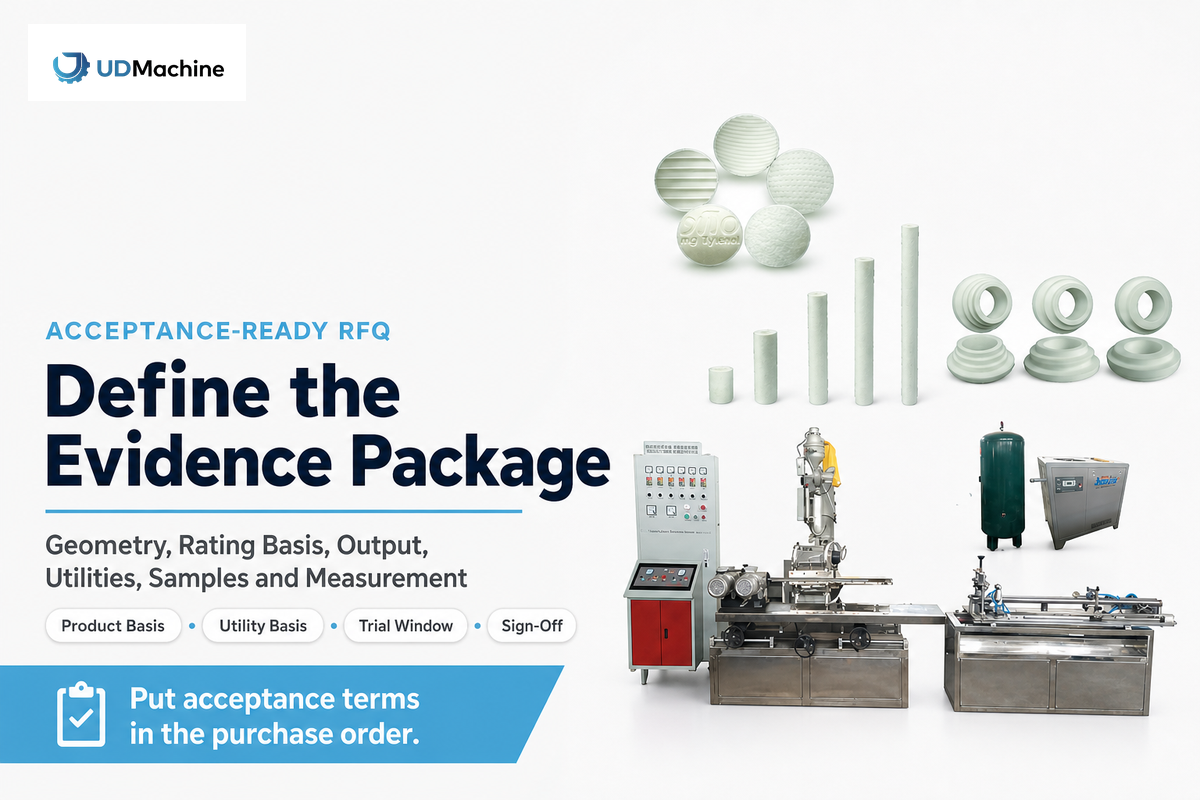
It’s ideal to perform a FAT before the equipment is procured, because much of the evidence can still be defined in supplier-selection and purchase-order documents. Products, services, and the means to achieve requirements should be tied to shipping, installation, connection, and software-restoration evidence.
Populate the RFQ with the information below, complete each “contract-defined” field with the approved project alternative, and use the broader filter cartridge production line solutions page to compare related equipment families. Discussions and clarifications regarding quotations are available in the melt-blown filter cartridge production line document.
RFQ checklist — copy these into your quote request:
| Parameter | Recommended range | Why it matters | How to verify |
|---|---|---|---|
| Cartridge geometry | Contract-defined length and diameters (mm) | Sets product and tooling basis | Drawing, datum, gauge, sample log |
| Filtration designation | Contract-defined rating (µm) with named basis | Prevents label-only acceptance | Named product-test method |
| Accepted output | Contract-defined conforming units/time | Separates gross speed from good product | Counter export plus reject log |
| Utilities | Destination-defined V, Hz, and kW, plus project-defined MPa | Makes factory and site conditions comparable | Instrumented utility record |
| Trial window | Contract-defined time or produced units | Defines included evidence | Timestamped run log |
| Sample distribution | Contract-defined units per observed state | Avoids convenience sampling | Preapproved sample register |
| Measurement capability | Stated resolution and uncertainty in mm, g, or Pa | Supports decisions near limits | Calibration and method review |
About Suzhou UDTECH Technology Co., Ltd.
UDTECH manufactures PP melt-blown, CTO activated-carbon, and wire-wound filter production equipment. The company reports a 6,000 m² standardized workshop, independent R&D and testing resources, ISO 9001:2015 and EU CE certification, and equipment exports to more than 55 countries; treat project-specific performance as subject to the signed configuration and acceptance evidence.
Need an acceptance-ready quotation package?
Send the cartridge, material, utility, test, evidence, and sign-off requirements before the FAT date is fixed.
Frequently asked questions
The following responses cover information typically deferred until test day: what constitutes FAT, how long the test should run, whether FAT proves filtration, how accepted output is counted, and what happens during SAT. The project documents will be the final determination.
What should be included in a PP melt blown filter cartridge production line FAT?
Include the approved specification hierarchy, document review, dry-run functions, utility conditions, a loaded run on the agreed cartridge and PP lot, accepted-output accounting, the sample and measurement plan, transient states that are in scope, raw evidence files, deviations, impact reviews, retest decisions, open items, FAT-to-SAT transfer, and authorized signatures. The purchase order and technical agreement should state the controlling list.
How long should the production trial run?
There’s no universal duration. The agreed window must be long enough to reach the defined stable condition, observe the included operating states, count accepted and rejected cartridges, collect the planned samples, and expose relevant interruptions; record excluded time separately. Product variants, changeovers, measurement burden, and the risk of a false pass should shape the written basis.
Is a successful machine FAT proof of micron rating or filtration efficiency?
No. A machine FAT can produce traceable samples and process records that support later evaluation, but it doesn’t replace a named filtration test method, sample conditioning, challenge conditions, apparatus, laboratory, acceptance criterion, intended-use review, and named decision owner. Keep the evidence connected without treating the machine and product decisions as equivalent.
What does accepted output mean?
Accepted output is the count of conforming cartridges produced during the agreed witnessed window under the frozen basis. The record identifies rejects, quarantined units, stoppages, excluded time, counting method, and any disturbance or intervention that changed the comparison.
Which checks should be repeated during SAT?
Repeat or confirm checks affected by shipping, unpacking, installation, alignment, destination power, frequency, compressed air, cooling, extraction, network, and upstream or downstream interfaces. Revisit guards, interlocks, alarms, emergency functions, representative running, material feeding, operator interventions, restart behavior, training, procedures, backups, restoration, and open-item closure under the applicable site basis. Compare the installed configuration and software or recipe revisions with the FAT index before relying on transferred results. Recheck any criterion touched by transport damage, installation work, a component substitution, a changed utility condition, or an unresolved deviation. Transfer controlled FAT records where the evidence remains valid, label factory-only observations and reference-only files, and retain the site result with its own witness and disposition. Don’t let a prior factory signature mask a changed condition or release final acceptance before the authorized site owner closes the listed dependencies.
References and scope notes
References & Sources: the sources below support FAT responsibility, process-variable traceability, United States guarding and electrical boundaries, statement-of-work planning, and scope-limited counter-evidence. The 1997 FDA device inspection guide is a historical impact-review example, not current QMSR compliance guidance or a machinery FAT rule.
This information was reviewed and provided by the Suzhou UDTECH Technology Co., Ltd. The article isn’t a project-specific acceptance certificate, laboratory report, or legal opinion, and it doesn’t mean UDTECH accepts project requirements outside a signed agreement. This provides guidance for procurement and planning purposes only.