Get in touch with Suzhou UDTECH Technology Co., Ltd. Company


Filter cartridge micron rating identifies a particle-size reference, but the number alone doesn’t prove efficiency, pressure performance, service life, or suitability for a fluid. Defensible specifications relate particle size to efficiency, a test method, and stated operating conditions.
Updated October 2026.
Direct answer
Filter cartridge micron rating tells you the referenced particle size. Specify size, efficiency or beta ratio, test method, fluid, flow, temperature, differential pressure, tested configuration, and loading stage before comparing products.
Selecting a filter begins with what you want to filter and the proof the outlet needs. The right filter is not automatically the lowest micron rated product. Choosing the right micron rating means matching the filter’s micron rating to the duty instead of treating different micron labels as a quality ladder.
A micron is a unit equal to 0.001 mm. The filter is rated by a supplier’s stated convention, and its micron rating indicates size rather than complete performance. Various micron bands can be useful, but the right micron filter depends on the feed, target, and test basis.
Each filter micron rating needs a stated basis to be able to support a purchasing decision.
1 µmone micrometre, or 0.001 mm
β20099.5% calculated efficiency at the stated size
5 fieldsminimum decision card before an RFQ handoff
Key points
- The lower micron number isn’t automatically a better filter.
- Nominal and absolute labels need a supplier definition and an efficiency value.
- Two products with the same label can behave differently under different flow, fluid, housing, and loading conditions.
- Machine acceptance and finished-cartridge performance validation are separate records.
What does a filter cartridge micron rating actually tell you?
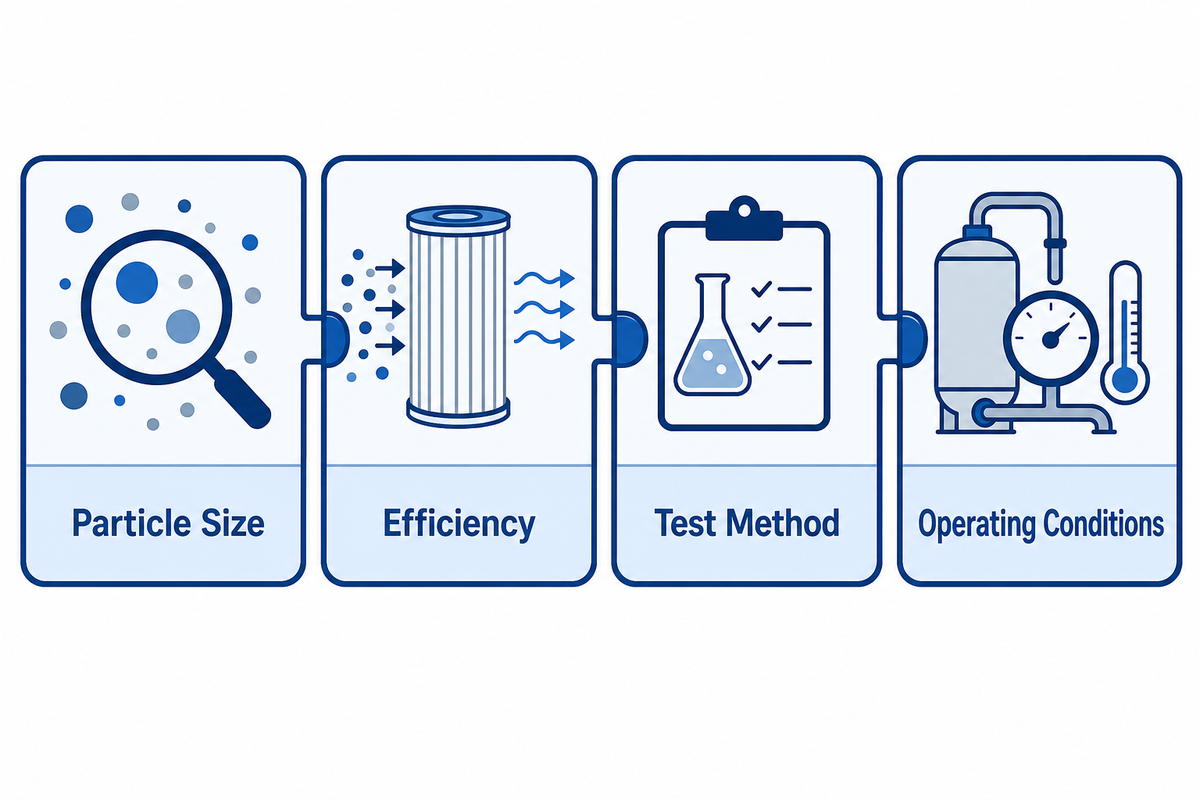
Filter cartridge micron rating refers to the particle size used in a retention statement. It doesn’t identify how many particles pass through the filter, how the particles were measured, or whether the cartridge can maintain that result at the required flow and terminal differential pressure.
Four-Part Micron Performance Statement
The Four-Part Micron Performance Statement joins particle size, efficiency, test method, and operating conditions in one claim. For example: “10 µm(c), β200 under ISO 16889 conditions at the documented flow and differential-pressure range.” Preserve notation such as µm(c) when the report uses it; plain µm is not automatically interchangeable. Reference the ISO 16889:2022 multi-pass method scope for hydraulic fluid power filter elements when that method is specified.
For a water duty, the rating refers to the size of particles a filter is built to retain. It doesn’t identify every class of particles from water, and it can’t state the final water quality without a measured outlet result.
Efficiency and test basis remain unknown when a water filter micron rating is written as microns in size.
Buyer objection: “The catalogue already says 5 micron.” That label is a starting point. Ask what percentage is retained at 5 µm, by which method, and in which tested assembly.
Nominal vs absolute micron rating: the efficiency is the missing number
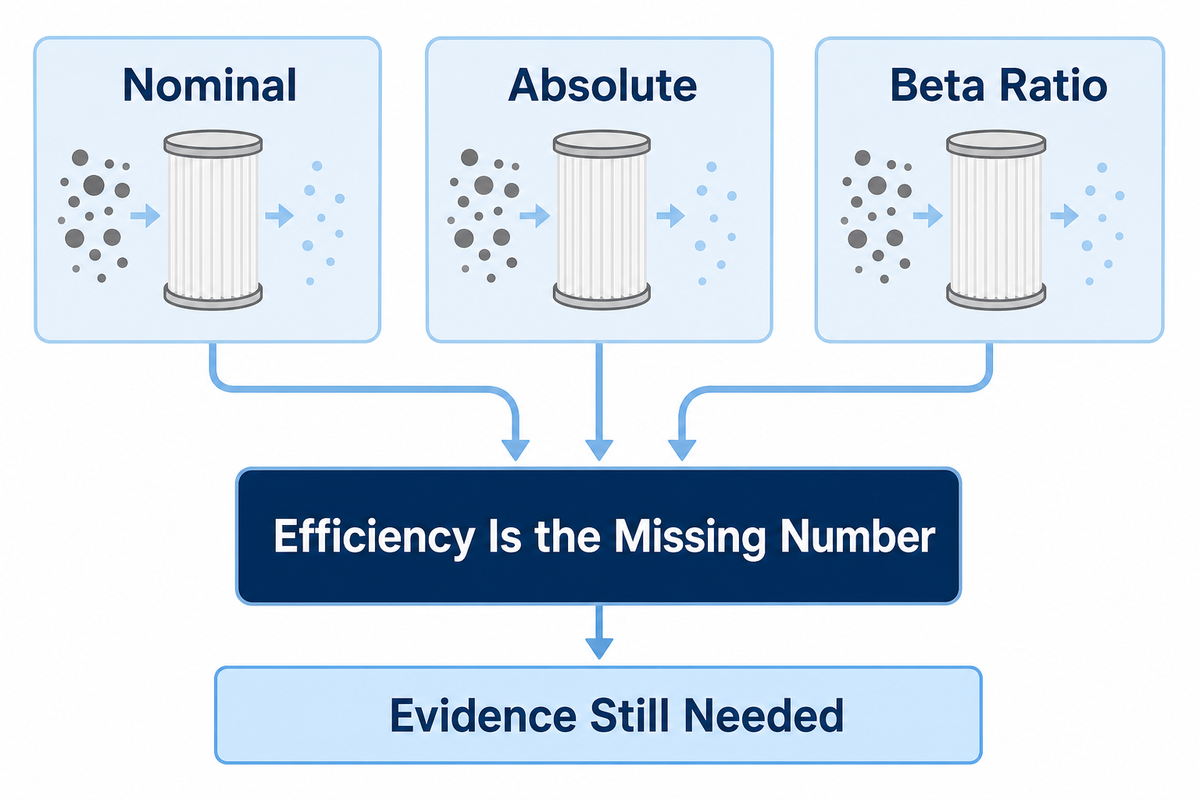
Nominal and absolute are rating conventions, as opposed to universal percentages. Suppliers should define both terms, while a beta ratio states an upstream-to-downstream particle-count relationship at a named size. The arithmetic is useful only when particle measurement, challenge concentration, detection capability, and test conditions are valid. The ISO 16889:2022 overview is an official example of a named multi-pass test basis for hydraulic fluid power filter elements.
Rating-Language Crosswalk
| Language | What it can state | Evidence still needed |
|---|---|---|
| Nominal | Supplier-defined partial retention | Exact percentage, method, conditions |
| Absolute | Supplier-defined high retention | Threshold, test, assembly, detection limit |
| Beta ratio | Count ratio at size x | Particle convention and test conditions |
Use βx = upstream count ÷ downstream count. Efficiency = (1 − 1/β) × 100%. A β10 result equals 90%; β100 equals 99%; β200 equals 99.5%; and β1000 equals 99.9%. If a valid test counts 20,000 particles upstream and 100 downstream at the stated size, β = 20,000 ÷ 100 = 200, so calculated efficiency is 99.5%.
The weak test isn’t repaired by a worked example. Low upstream challenge or a downstream counter that can’t detect the relevant concentration can make the provable result look stronger than the measurement supports.
An absolute filter claim still needs its percentage and method. The rating means little across suppliers until the same particle convention, assembly boundary, and operating window are used.
Is a smaller micron rating always better?
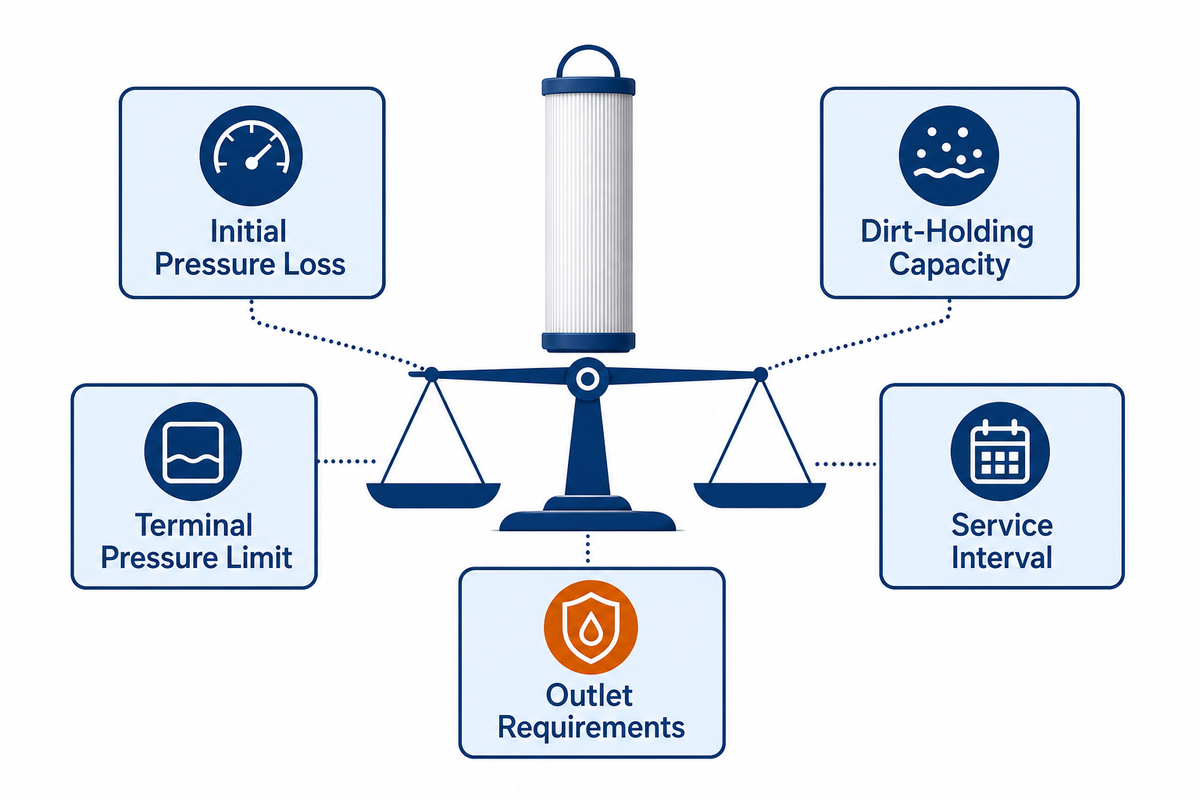
Smaller micron ratings are better only when the downstream protection target requires finer particulate control and the system can accept the resulting resistance, loading rate, and changeout burden. A finer cartridge that plugs early or adds excessive pressure loss can reduce useful flow without solving the actual quality problem. For the separate mechanical pressure-rating question, see the ISO 2941:2009 collapse/burst verification method.
Smaller-Is-Better Failure Test
The Smaller-Is-Better Failure Test asks what becomes unacceptable when the rating is tightened. Look at initial pressure loss, terminal pressure limit, dirt-holding capacity, service interval and outlet requirements. The AAQR study on loaded fibrous filters shows that pressure-drop behavior changes with particle loading and media conditions; its aerosol results are evidence of sensitivity, not a liquid-cartridge limit.
To choose the right filter, identify the required water quality or process outlet prior to decreasing the micron size. As a filter fills, water flow or process flow can fall, even when the media retains particles.
Hypothetical example: a process team replaces a 20 micron prefilter with a 5 micron filter because the smaller number feels safer. Flow then falls before the planned batch ends while the final stage outlet result remains the same. The correct next step isn’t to choose a 1 micron filter. Compare the contaminant distribution, clean pressure drop, terminal limit, and downstream acceptance result under the same flow and fluid conditions. Following a coarse stage with a validated fine filter may better control loading, but the sequence still needs testing.
How to compare 1, 5, 10, 20, 50 and 100 micron cartridges
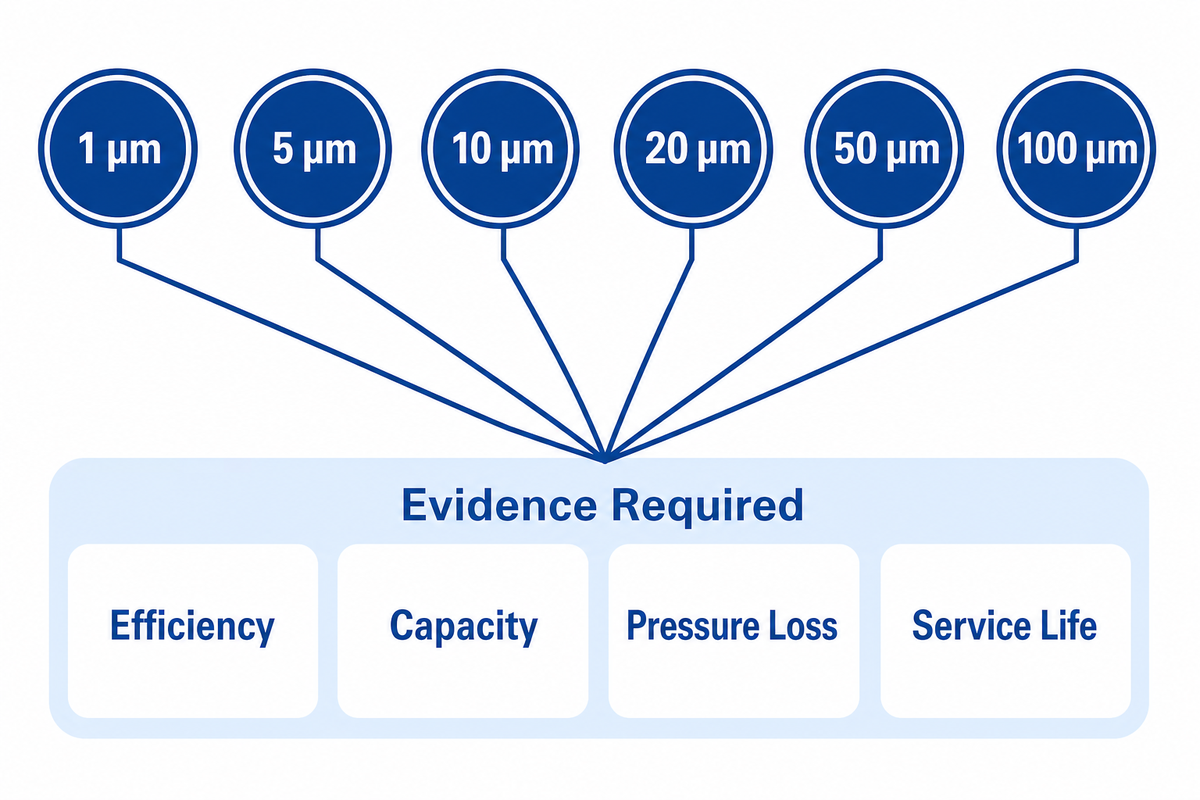
Consider micron bands as screening options, not contaminant guarantees. A 1 micron filter is finer than a 5-micron filter on the same rating basis, and 50 micron is finer than 100 micron, but the label can’t define efficiency, capacity, chemistry, pressure loss, or service life. An official example of a stated test basis for hydraulic fluid power filter elements is the ISO 16889:2022 multi-pass method.
Rating-Band Decision Table
The Rating-Band Decision Table turns common micron ratings into evidence requests rather than promises.
| Stated band | Possible duty to evaluate | What the number does not prove | Limitations / evidence request |
|---|---|---|---|
| 0.5 µm | Very fine polishing candidate | Microbial, chemical, or compatibility result | Request validated retention and clean-to-terminal pressure data |
| 1 µm | Fine particulate stage | Absolute retention | Confirm nominal/absolute definition and efficiency |
| 5 µm | Fine sediment or process protection candidate | Universal “sweet spot” | Match flow, fluid, loading, and outlet target |
| 10 µm | Intermediate particulate control | Equal performance between suppliers | Ask for same-basis count and pressure curves |
| 20 µm | Coarse loading control | Protection of every downstream asset | Tie selection to the protected clearance or outlet limit |
| 30 µm | Prefilter evaluation | Better service life than 20 µm | Compare dirt load and terminal differential pressure |
| 50 µm | Coarse particle capture candidate | Removal of named contaminants | Obtain the feed particle-size distribution |
| 100 µm | Very coarse protection | Capture of every particle ≥100 µm | Request efficiency and bypass boundary |
| 200 µm | Screening or upstream load reduction | Fine filtration | Use only when the downstream stage accepts the residual load |
Household water supplies create a different decision frame from industrial duty. Guidance on a micron water filter may address well water, municipal water, a water softener, or drinking water in one filtration system. Industrial buyers should not import those recommendations without a water test, particle distribution, and defined water treatment duty.
Micron ratings work only when the rating basis and service match. Specifically, to remove from your water a measured sediment load, identify the particles you expect to remove from water and the allowable pressure loss. The rating for your water filter then follows the evidence rather than a generic chart.
A 0.5 micron stage can occur in water filtration, but a finer number doesn’t make it the right micron for every feed. Water systems with different loads can require different staging, and micron filtration ratings still require efficiency and test conditions.
The micron rating for your water should reflect the measured feed and the required quality of the water at the outlet. City water with low visible solids and well water with a heavy sediment load can demand different sediment filter decisions.
Match five conditions before comparing two cartridge datasheets
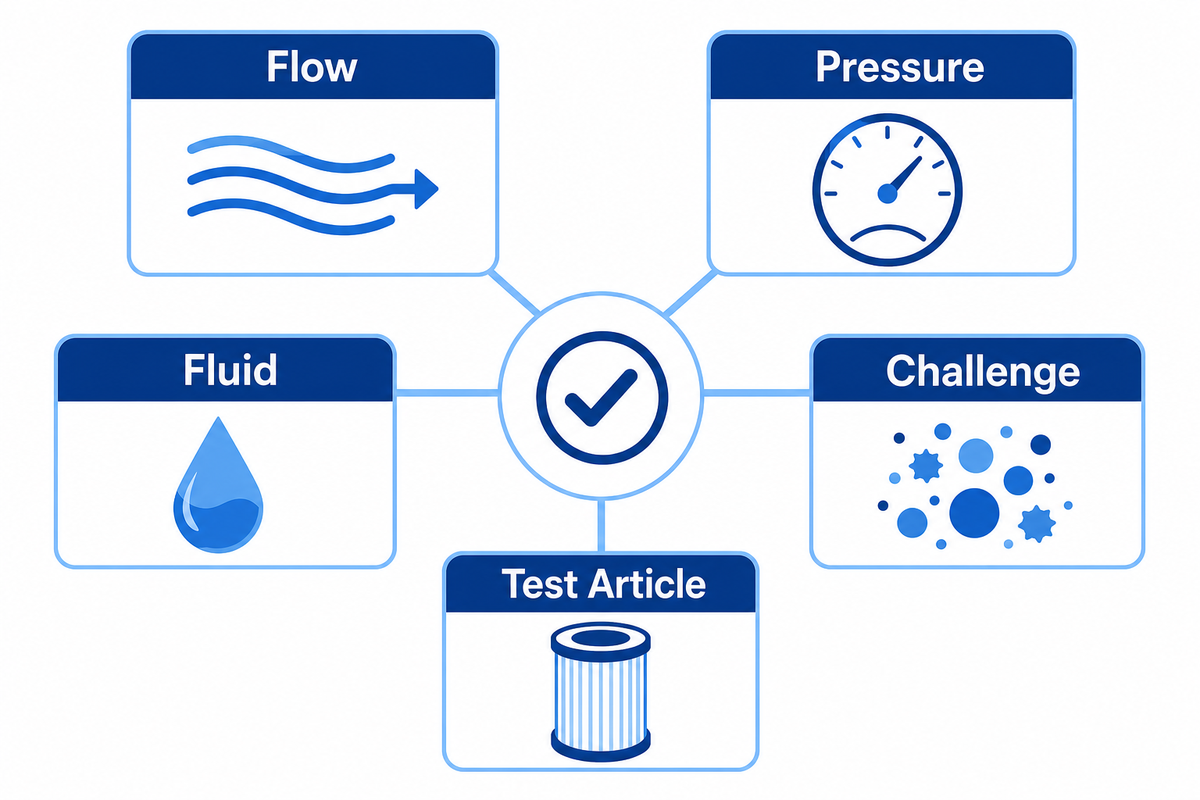
A valid cartridge datasheet comparison matches five condition groups: flow; initial and terminal differential pressure; viscosity and temperature; challenge distribution, concentration, and detection capability; and the complete tested component, media, method, seal or bypass boundary, and loading stage for reliable procurement decisions.
Matched-Condition Comparison Card
- Flow: state volumetric flow or face velocity.
- Pressure: record clean and terminal differential pressure.
- Fluid: identify viscosity, temperature, and relevant chemistry.
- Challenge: define particle distribution, concentration, and downstream detection limit.
- Test article: name media, geometry, housing, seals, bypass boundary, method, and clean/intermediate/terminal stage.
“ISO 2941:2009 specifies a method for verifying the collapse/burst pressure rating of a hydraulic fluid power filter element.”
Collapse or burst resistance addresses a mechanical survival question. It doesn’t define filter particle-removal efficiency. Treating a pressure rating as proof of filtration performance compares different evidence types.
How media construction changes a shared micron number
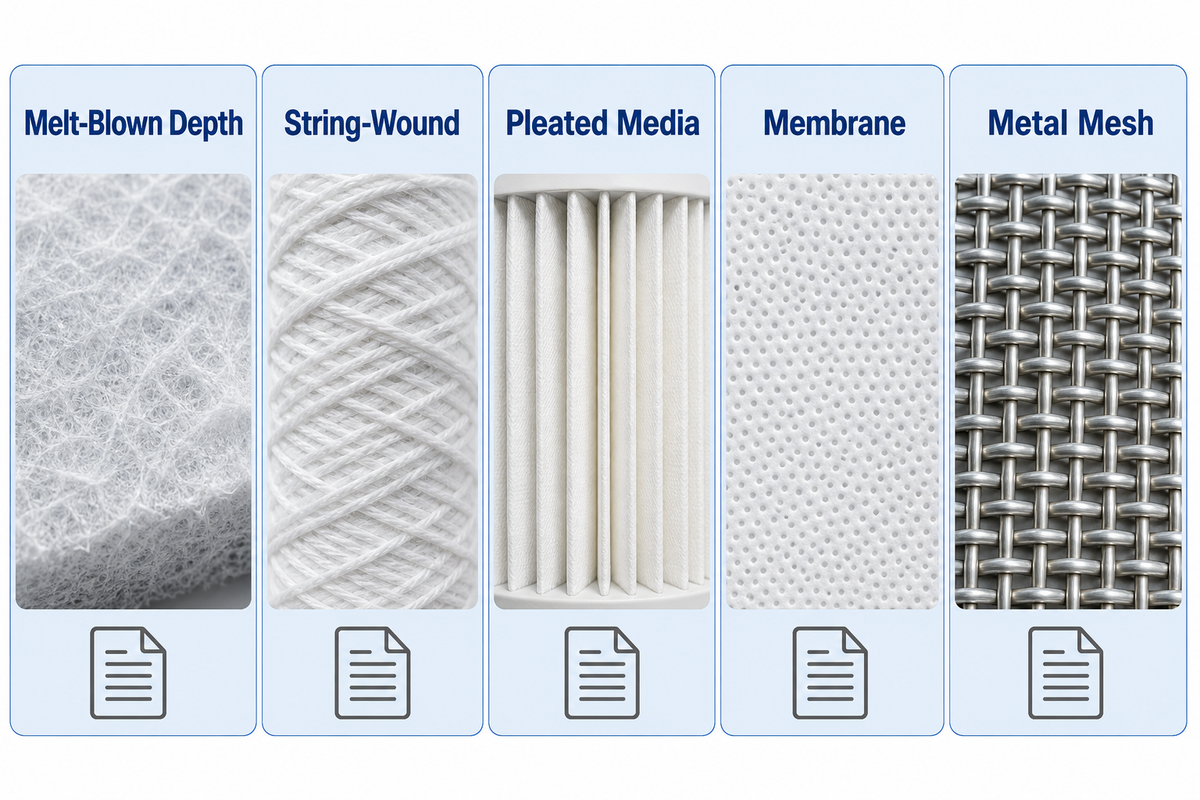
Media construction changes pore distribution, loading path, pressure response, and the evidence needed to interpret a micron number. Thus, interpretation of a micron number also varies. Melt-blown depth media, string-wound cartridges, carbon blocks, pleats, membranes, bags, meshes, sintered structures and ceramics shouldn’t be considered as equivalent filter types.
Media Construction Evidence Matrix
The type of filter determines which construction variables and acceptance evidence need to be controlled.
| Media type | Primary variable | Evidence request | Limitations / not suitable for |
|---|---|---|---|
| Melt-blown depth | Fibre and graded-density profile | Retention, pressure, lot recipe | No adsorption claim from micron data |
| String-wound | Yarn, tension, traverse, layers | Pattern and lot performance | Loose or shifted wind can alter paths |
| Carbon block | Blend, compression, binder | Particulate and adsorption results separately | Micron data cannot prove chemical capacity |
| Pleated media | Media area and pleat stability | Integrity and flow curve | Outside UDTECH’s stated line scope |
| Membrane | Pore structure and integrity | Process-specific validation | Micron label alone cannot prove sterility |
| Filter bag | Felt/mesh and seam construction | Bag micron rating and housing seal | Not interchangeable with a cartridge |
| Metal mesh | Opening and weave | Opening tolerance and bypass check | Deformable particles can behave differently |
| Sintered metal | Porosity and sinter structure | Retention and cleaning validation | Cleaning may change the baseline |
| Ceramic | Pore network and module seal | Integrity, chemistry, and flux record | Brittleness and seal limits remain separate |
The carbon filter may integrate both particulate and adsorption functions, but the carbon block filter requires separate evidence for each. Particulate rating means the filter captures a stated fraction under a test; it doesn’t measure adsorption capacity.
ASTM E3469-26 gives a narrow pharmaceutical example: chemical compatibility, active-ingredient or preservative binding, and particle shedding may need study before process-specific bacterial-retention testing. That scope is not a rule for every cartridge, but it shows why adsorption and compatibility cannot be inferred from a micron level. Review the ASTM E3469-26 scope and significance.
Use the Five-Field Micron Decision Card
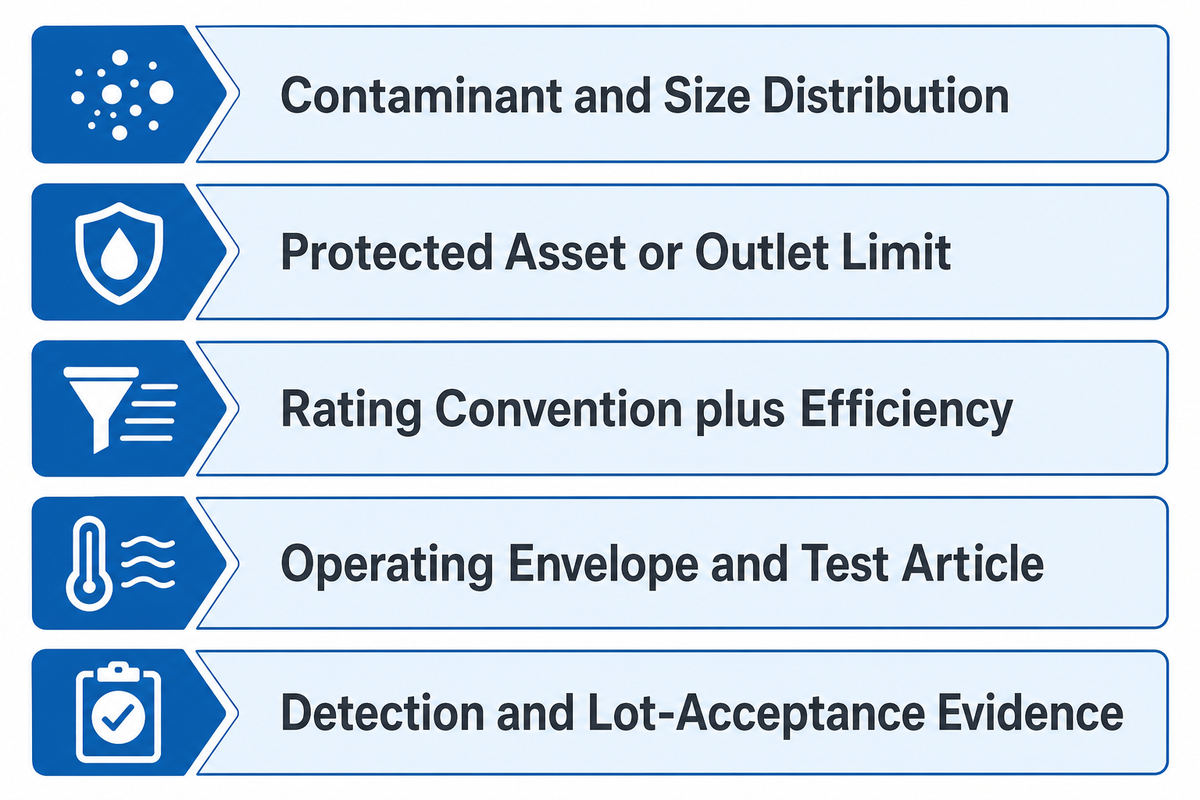
The Five-Field Micron Decision Card records the contaminant distribution, protected asset or outlet requirement, rating convention and efficiency, operating envelope and installed configuration, and verification and lot evidence. It’s an editorial procurement method, not a standard or UDTECH proprietary technology. For a narrow pharmaceutical sterilizing-filtration validation example, see ASTM E3469-26.
Five-Field Micron Decision Card
Record
- Contaminant and size distribution
- Protected asset or outlet limit
- Rating convention plus efficiency
- Operating envelope and test article
- Detection and lot-acceptance evidence
Do not substitute
- Appearance for a measured outlet result
- One filter life for another feed
- Machine setting for cartridge validation
- Nominal label for stated efficiency
- Initial result for terminal-life evidence
An industrial prefilter duty may accept a nominal coarse cartridge when its job is to reduce load before a separately verified fine stage. A final product-contact stage can require an absolute or validated result, complete housing and seal definition, compatible materials, and a documented detection limit. The same 5 micron language can’t resolve both duties. Evidence required is determined by the protected outlet and acceptance decision owner.
If a team installed a filter without a baseline, the card reconstructs what was omitted: feed, target, rating basis, operating envelope, and acceptance evidence. That record is more helpful than changing cartridges until one appears to work.
How manufacturers control micron-rating consistency across lots
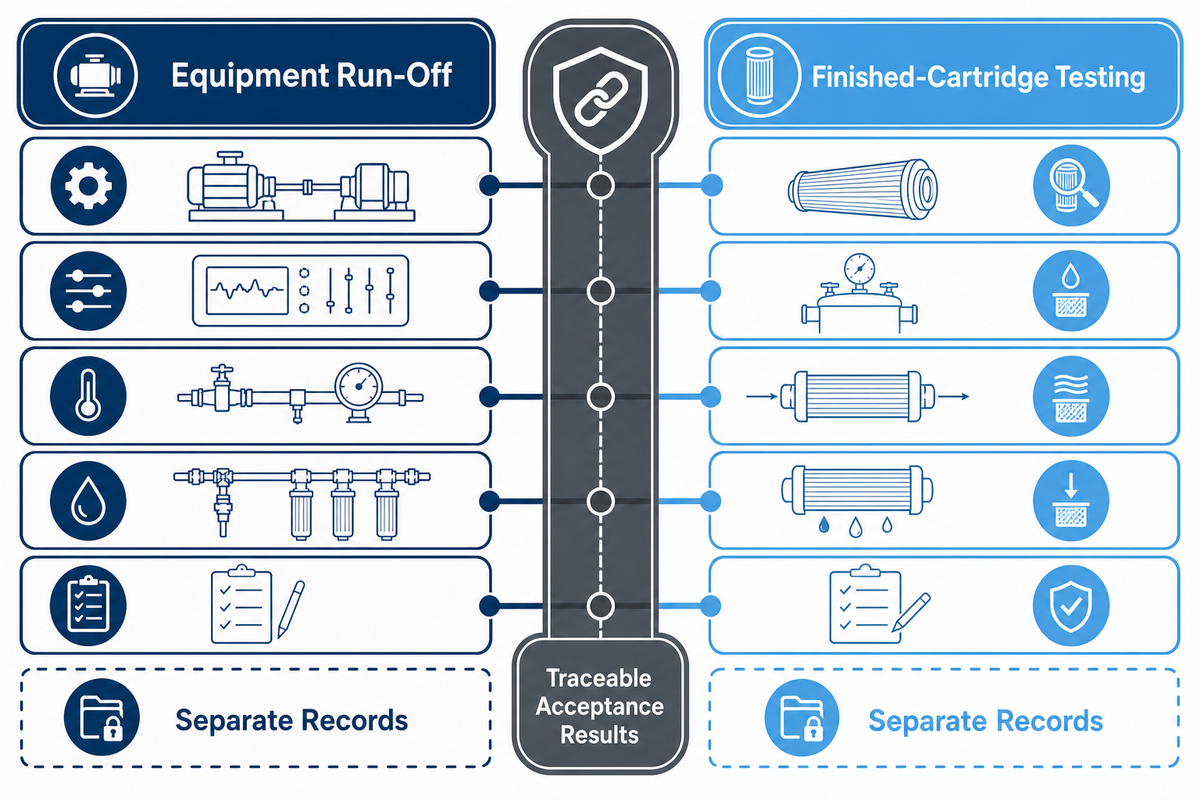
Manufacturers control consistency by freezing approved materials and process windows, measuring cartridge dimensions, sampling lots under matched conditions, and retaining traceable acceptance results. Equipment run-off shows that a machine can hold defined controls; finished-cartridge testing shows whether the product meets the buyer’s retention and operating requirements. For one formal hydraulic fluid power filter-element performance-test basis, see ISO 16889:2022.
Machine-to-Cartridge Evidence Split
The acceptance evidence record separates cartridge performance from machine stability. For melt-blown media, control resin identity, melt-flow behavior, die and air settings, collector distance, mandrel conditions, and traverse. For wound media, freeze yarn, tension, traverse pattern, layer count, core, and dimensions.
According to UDTECH, its production operates in a 6,000 m² standardized workshop with R&D, manufacturing, laboratory and testing equipment, full-process quality control, and trial production before shipment. These are first-party statements by UDTECH. These statements don’t replace the buyer’s finished-cartridge retention protocol or lot-release evidence.
Buyer objection: A successful factory acceptance test does not automatically certify every cartridge rating. Define which machine variables are accepted at run-off and which cartridge results are released by lot.
What to write in a filter cartridge micron specification
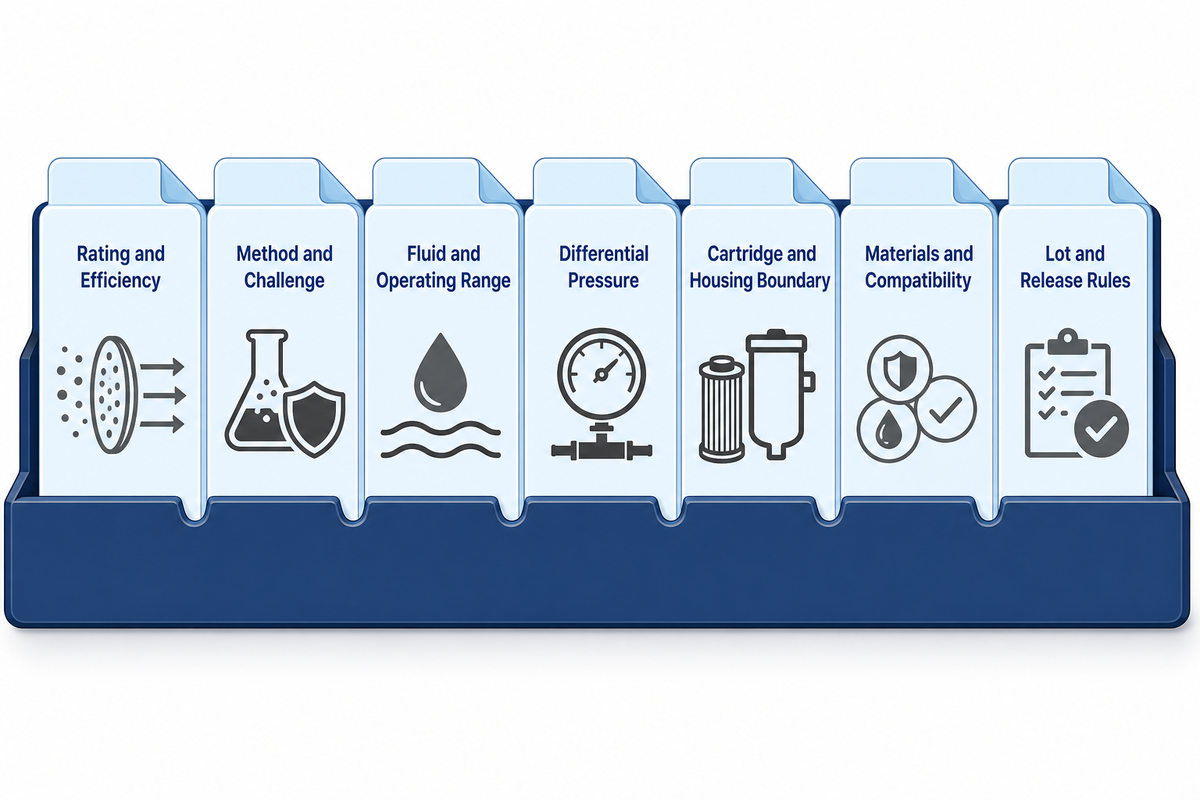
Filter cartridge specifications should state particle size and measurement convention, efficiency or beta ratio, nominal or absolute definition, test method and challenge, fluid and operating range, initial and terminal differential pressure, geometry, housing, seals, materials, lot sampling, documentation, failure rules, and retest authority. Where relevant to hydraulic fluid power filter elements, the ISO 16889:2022 multi-pass method is one named method for evaluating filtration performance.
Micron Evidence Pack
Copy-ready checklist
- Required particle size, notation, efficiency, and rating convention
- Test method, challenge material, concentration, and downstream detection limit
- Fluid, flow, temperature, viscosity, sample size, and test duration
- Clean, intermediate, and terminal differential-pressure conditions
- Cartridge geometry, housing, seals, support, and bypass boundary
- Media and component materials, chemical compatibility, adsorption/binding, and shedding checks where relevant
- Lot identity, sample plan, acceptance limits, report owner, failure rule, and retest authority
When not to buy from a micron label alone
Don’t approve a cartridge if the supplier leaves nominal or absolute undefined, fails to pair the stated size with a beta or efficiency value, or withholds the tested flow, fluid, pressure, and component boundary. Stop the purchase review if a critical claim relies on an undetectable downstream concentration, an untested seal arrangement, or only a clean-element result when terminal-life behavior matters.
A 2026 pharmaceutical filtration practice also illustrates that compatibility, binding and shedding may be outside the retention data. Buyers in other industries should translate that principle into their own materials, product-contact, cleaning, and regulatory requirements rather than copying its test protocol.
The rating matters because it controls which evidence belongs in the purchase file. Micron rating matters only within the named efficiency, method, fluid, configuration, and life stage.
From micron requirement to a production-line RFQ
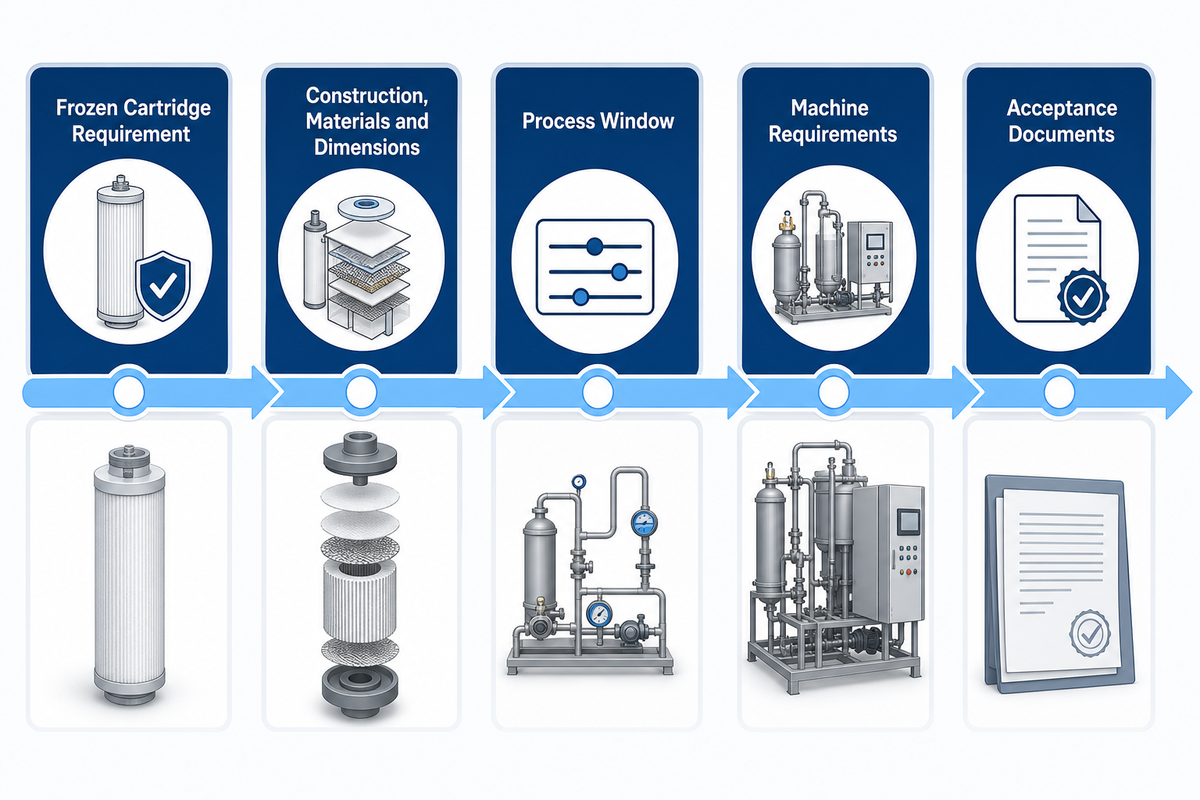
A production-line RFQ should begin after the finished-cartridge requirement is frozen. Interpret the required construction, materials and dimensions, process window, output basis, sampling plan, performance tests, traceability and acceptance documents into machine requirements without requiring the equipment vendor to make an assumption about the filtration duty. For a narrow pharmaceutical sterilizing-filtration validation example, see ASTM E3469-26.
Production-Line RFQ Handoff
The Production-Line RFQ Handoff converts a validated cartridge brief into equipment inputs without transferring product-performance responsibility. Review the filter cartridge production line after the Micron Evidence Pack is complete. Related planning routes include the PP melt-blown filter cartridge production line options and the production-line acceptance test guide.
Hypothetical example: a cartridge manufacturer wants two nominal product grades from one line. Before discussing output, the RFQ owner freezes resin and dimensions, rating definitions, test methods, lot sampling, acceptable clean and terminal pressure behavior, and recipe-change control. Only then can the equipment discussion cover die or winding controls, mandrel range, traverse, automation, inspection points, and documentation. Absent such a product brief, a quoted capacity cannot show that acceptable cartridges will be produced.
Send a cartridge brief, not just a micron number
Share the cartridge construction, target output, operating envelope, and required acceptance evidence with UDTECH.
Decision framework: choose evidence before choosing a number
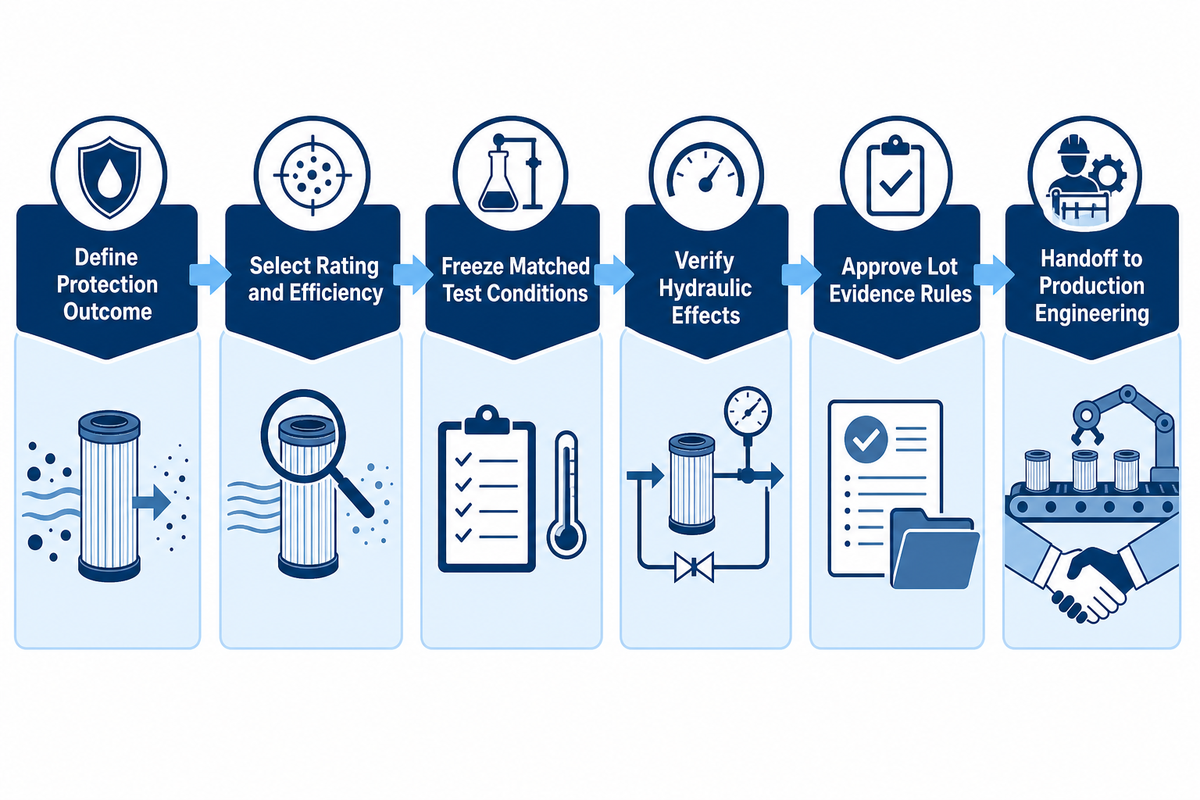
Reliable decision sequences define the protection outcome, choose a measurable rating convention, freeze comparable test conditions, assess hydraulic effects, require lot evidence, and hand the approved cartridge requirement to production engineering. The sequence ensures that a convenient catalogue number doesn’t become an unsupported performance promise. The ISO 16889:2022 scope for hydraulic fluid power filter elements illustrates why method and conditions belong in that sequence.
- Define the particle-control or protection outcome.
- Select the rating convention and required efficiency.
- Freeze the particle measurement and matched test conditions.
- Verify flow, clean pressure loss, terminal pressure, and expected loading.
- Approve lot sampling, traceability, failure, and retest rules.
- Hand the frozen cartridge specification to production engineering.
Frequently asked questions
Is a 5 micron filter better than a 30 micron filter?
Not automatically. A 5 micron filter targets a finer particle-size reference than a 30 micron filter on the same basis, but the better option meets the outlet requirement at acceptable flow, pressure loss, and filter life. Compare efficiency, media, fluid, test method, and loading conditions. The filter for your needs must protect the outlet without creating an unacceptable service burden.
Is a 20 micron or 5 micron filter better?
Choose from the contaminant distribution and protected asset. A 20 micron stage may reduce coarse loading before a finer cartridge, while a 5 micron stage may be needed for tighter particulate control. Compare both on the same rating convention, efficiency, flow, fluid, and differential-pressure basis. Lower numbers can shorten service life if the feed contains more fine solids than the stage can hold.
What will a 100 micron filter remove?
A 100 micron rating is a coarse particle-size reference. It doesn’t name contaminants or guarantee capture of every particle at or above 100 µm. A micron rating removes no named contaminant by itself; the claim needs an efficiency and a feed distribution. Ask whether the rating is nominal or absolute, what efficiency applies, and whether the test matches the actual fluid, housing, seal, flow, and pressure conditions.
What is the difference between nominal and absolute micron ratings?
Nominal and absolute are supplier-defined performance labels unless a cited method defines them. Nominal usually means partial retention at the stated size, while absolute signals much higher retention. Useful comparisons still need the exact percentage or beta ratio, test method, operating conditions, and the complete tested cartridge and housing boundary.
Can two cartridges with the same micron rating perform differently?
Yes. Filters with different micron ratings obviously target different size references, but water filters with different micron labels can also use different rating conventions. Even two cartridges carrying the same number may have different media, depth structures, pore distributions, geometries, seals, efficiency, pressure drop, capacity, and filter life. Compare particle counts, flow, fluid, temperature, viscosity, housing, loading stage, and method before calling products interchangeable.
How should a manufacturer verify micron-rating consistency?
Freeze the approved material and process recipe, define measurable dimensions and performance limits, sample each lot under matched test conditions, and retain traceable results. Keep machine run-off acceptance separate from finished-cartridge validation so each record has a clear owner and acceptance basis. Trend critical process variables and cartridge results by lot, document deviations, and assign authority for release, rejection, investigation, and retest before production begins.
References & Sources
- ISO 16889:2022 hydraulic fluid power filter-element scope International Organization for Standardization
- Loading and pressure-drop behavior in fibrous filters Aerosol and Air Quality Research
- ISO 2941:2009 public scope International Organization for Standardization
- ASTM F838-20 public scope ASTM International
- ASTM E3469-26 pharmaceutical sterilizing-filtration validation scope ASTM International
This article is a procurement and specification guide, not a process validation protocol, regulatory opinion, or product-performance guarantee. The responsible engineering and quality teams must approve application-specific materials, test methods, acceptance limits, and release decisions.