Get in touch with Suzhou UDTECH Technology Co., Ltd. Company
Contact Form 使用中

PP Melt Blown Filter Cartridge Machine

Every enquiry is answered within 24 hours 1 set Assembled and test-run at our factory before it ships 1–100 µm on 10″–40″ cartridges

Polypropylene granules go in one end and finished depth cartridges come out the other. That is what a PP melt blown filter cartridge machine does, in one continuous pass — extrude, attenuate with hot air, lay the fibre onto a rotating mandrel, cut to length. UDTECH builds those lines in two sizes, and this page covers what they make, how the micron rating is held, and what buying one into a US plant involves.

PP Melt Blown Filter Cartridge Machine

Models

2E&2M and 3E&3M — two and three extruder/die sets

Output

3,500–4,200 and 5,000–5,800 pcs per 24 h

Filtration accuracy

1, 5, 10, 20, 30, 50 … 100 µm

Filter cartridge envelope

10″, 20″, 30″, 40″; 28 mm inner diameter default

Power

70 kW and 100 kW connected; 28–32 and 38–40 kW/h running

Melt Blown Filter Cartridge Machine Capabilities

The line is a melt blown filter cartridge machine in the strict sense: fibre is formed and laid in the same pass, with no yarn, no core and no adhesive. Buyers also call it a PP filter cartridge making machine, a PP filter making machine, a filter machine or a PP spun filter cartridge machine — same fully automatic process, same output. What follows is how a melt blown filter cartridge making machine actually holds a rating.

Operational Process

Step 1

Feeding

Polypropylene granules are metered into the extruder hopper.

Step 2

Extrusion

The screw extruder melts and pressurises resin through heated barrel zones.

Step 3

Die head

The melt is pushed through a row of fine orifices into converging hot-air jets.

Step 4

Attenuation

High-velocity hot air spins the melt streams down into microfibres.

Step 5

Winding

Fibre lands on a rotating mandrel that also traverses, building the wall outward.1

Step 6

Cutting

A servo saw trims the continuous filter cartridge to 10″, 20″, 30″ or 40″.

PP Melt Blown Filter Cartridge Machine Process

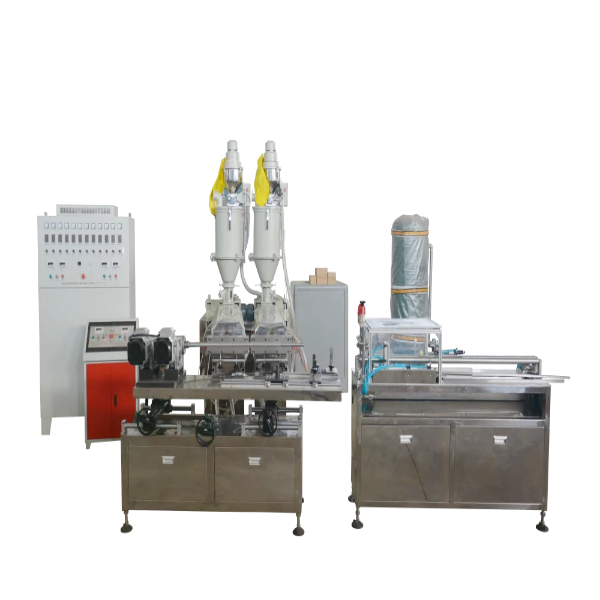
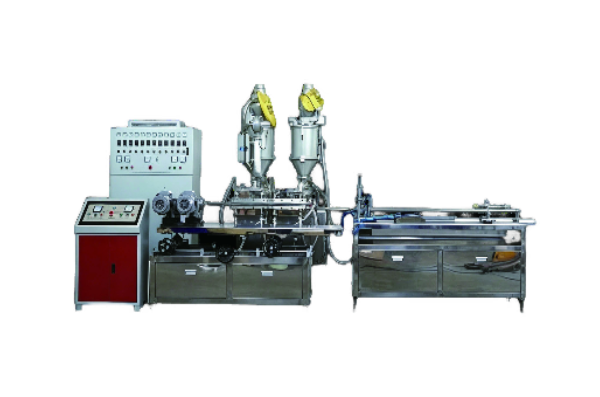
UDTECH 2E&2M line with enclosure — two extruders feeding two die heads onto a shared receiving carriage.

Model Extruder / die sets Output per 24 h Connected power Running power
2E&2M 2 3,500–4,200 pcs 70 kW 28–32 kW/h
3E&3M 3 5,000–5,800 pcs 100 kW 38–40 kW/h

Adding a third extruder and die set raises output by roughly 40% and connected load by about 43%, because throughput on this process scales with the number of dies rather than with line speed. Running power sits well under connected power on both models: the variable-frequency drive only draws what the current recipe needs.

The 100-Gram Baseline: what a stated pcs-per-day figure is really measuring

Output on a melt blown line is a mass-flow rate wearing a piece-count label. Where a builder states a basis at all, it is The 100-Gram Baseline: a 10-inch cartridge, 28 mm inner diameter, 100 g. The same machine making a 100 g cartridge and a 180 g one does not produce the same pieces per shift. Doubling the gram weight roughly halves the pieces: send the weight and length you will run and we will restate our figure at your basis, and ask every other supplier for theirs.

Polypropylene Feedstock and Resin Grades

Resin is the one consumable that decides how fine the line can run. Melt-blowing works across a wide melt-flow window, and the grade you buy sets where in that window the process operates.

A published review puts the melt-blowing window at roughly 35–1,200 g/10 min, with melt viscosity between 2 and 18 Pa·s.2

The trade-off nobody prints on a datasheet: a higher melt flow index improves fluidity and gives finer fibre, but lowers molecular weight and therefore fibre strength.

Narrow-distribution resin is what balances spinnability against the mechanical strength the cartridge wall needs to survive handling and differential pressure.

Regulatory Compliance

Polypropylene is covered by 21 CFR 177.1520, subject to that section’s own limits — density 0.880–0.913, melting point 160–180 °C, n-hexane extractable fraction at most 6.4 pct, xylene-soluble fraction at most 9.8 pct.3

The correct wording for the finished product is that it is made from resin covered by 21 CFR 177.1520. The regulation does not approve or certify a company, and no cartridge line can confer that status on the cartridges it makes.

Chemical compatibility and service limits

Polypropylene is why this depth filter format reaches so far beyond drinking water. A polypropylene filter carries wide chemical compatibility across acid, alkali and neutral duties, which is what puts the same cartridge filter into plating rinse, boiler feed and general water treatment as well as potable lines.

Performance Metrics

Temperature and differential pressure move together. A published melt-blown filter element range derates from 4 bar maximum differential at 30 °C to 2 bar at 70 °C on the same element.8

Rating and filtration performance are not the same axis: the coarse end of a meltblown range has to be built with co-located large-diameter fibre.

Particle loading is what ends a cartridge’s life. Differential pressure climbs as captured particles fill the depth of the wall, and the change-out point is a pressure decision rather than a calendar one.

Send us the resin grade you can source locally and we will tell you which micron band it will hold.

Ask about resin compatibility

Cartridge Output Envelope

The filter cartridge line’s dimensional range is set by tooling, not by software. Inner diameter follows the mandrel shaft; outer diameter and weight follow how long the cartridge stays under the die.1

Dimension
Range
Set by
Inner diameter
28 mm default; 10–150 mm with a matched mandrel shaft
Mandrel shaft change
Outer diameter
38–120 mm at 28 mm inner diameter
Build-up time under the die
Length
10″, 20″, 30″, 40″ (254–1016 mm) and other standard lengths
Servo cutting station
Filter cartridge weight
70–200 g, adjustable
Push-forward speed and throughput
Filtration accuracy
1, 5, 10, 20, 30, 50 … 100 µm
Process recipe (see below)
Market Standard: Two form factors carry most of the US market: the 2.5″ outside diameter series for slimline housings and the 4.5″ series for Big Blue housings. Both sit inside the range above.

Where the cartridges go

Reverse Osmosis Pre-treatment

In reverse osmosis pre-treatment the common convention stages a coarser sediment cartridge ahead of a finer polish stage before the RO membrane.7

Point-of-Entry & Point-of-Use

Whole-building units sit at the service entry; under-sink and countertop units sit at a single fixture.

Industrial Process Water

Industrial process water — cooling loops, boiler feed, plating and rinse lines.

Food, Beverage & Pharma

Food, beverage, pharmaceutical and chemical water filtration sits ahead of finer or absolute-rated stages.

RFQ Boundary
Notice

One boundary matters at RFQ time. Melt blown winding lines make double-open-end cartridges; 222, 226, fin and single-open-end configurations are added by a separate end-cap and adapter welding operation, which is quoted as its own scope.

Micron Rating Control and Dimensional Tolerances

Unlike a setpoint you dial in, the rating is an outcome. It falls out of four process variables acting on the fibre between the die and the mandrel, and holding it across a shift is what separates a controlled line from a hot one.

Specification 2E & 2M 3E & 3M
Output per 24 h 3,500–4,200 pcs 5,000–5,800 pcs
Total connected power 70 kW 100 kW
Actual running power 28–32 kW/h 38–40 kW/h
Filtration accuracy 1, 5, 10, 20, 30, 50 … 100 µm
Default inner diameter 28 mm (1.10 in); 10–150 mm (0.39–5.91 in) with a matched mandrel shaft
Outer diameter 38–120 mm (1.50–4.72 in) at 28 mm inner diameter
Filter cartridge length 254 / 508 / 762 / 1016 mm (10 / 20 / 30 / 40 in)
Filter cartridge weight 70–200 g (2.5–7.1 oz), adjustable
Raw material Polypropylene granules
Supply voltage AC 380 V / 50 Hz or 220 V / 50 Hz standard; other voltages configurable on request

The four levers, and which way each one pushes

Die-to-collector distance

Longer distance gives the fibre more cooling time before it lands, which raises thickness and porosity and lowers self-bonding — a loftier, coarser, weaker wall.

Hot-air pressure and temperature

More air and a hotter die both drive fibre diameter down as the melt leaves the spinneret, but the effect flattens out. A 2025 review of melt-blowing carries forward plateau figures of 35 kPa and 35 cm, measured on polyethylene rather than on polypropylene: read the direction as transferable and the two numbers as indicative.2

Mandrel rotation

Rotation speed sets surface density, fibre packing and porosity.

Push-forward speed

The axial traverse sets cartridge diameter and weight.

The last two are the useful part: rotation and traverse act on different axes, so the pore structure and the physical dimensions can be moved independently. One published apparatus study produced cartridges of 175.0 kg/m³ and 87.4 kg/m³ — a two-fold density difference — by moving die-to-collector distance from 20–25 cm to 25–30 cm, raising collector speed, and cutting spinneret throughput from 0.5 to 0.3 g/min per hole.1

“Fiber fineness — and therefore the coarse-to-fine gradient through the cartridge wall — is determined by die head geometry, hot air flow and mandrel distance, all maintained under PLC/HMI control.”

— UDTECH, published process specification

What a micron number does and does not tell you

Nominal ratings on melt-blown cartridges are not comparable between manufacturers, and the gap is not small. Cartridges from five different makers, all labelled one micron, have been measured from below 20% to above 98% efficiency.7

The catch is that the industry has no single definition to fall back on either: a 2023 trade review found the published definitions all over the map.10 Nominal is variously described as around 80% removal at the stated size, or as the 50th percentile of the pore distribution, while absolute is put at 99.9% or at the 99.5th percentile depending on who is writing.

Two honest limits on this product class

Published data on a melt-blown polypropylene cartridge range shows removal efficiency falling with rating: 99.98% at 1–20 µm, 99.9% at 40–90 µm, and 90% at 100–200 µm, with the coarse end needing a different construction.8 A second maker publishes its own curve at 54% removal in the 2–3 µm band on a cartridge sold at a stated micron rating.9

No cartridge or machine supplier we could find publishes a dimensional tolerance. Diameters, lengths and inner diameters are published as nominal values across the category, and in-line fibre measurement is still described in the research literature as future work rather than standard practice.

Pricing Mechanism, Power Supply and Lead Time

We do not publish a price list for this class of equipment. A PP melt blown filter cartridge machine price follows the configuration, and the configuration follows five things you decide.

Throughput tier Two extruder/die sets or three — this moves base equipment cost and connected load together.
Dimensional range Inner diameters outside the 28 mm default need a matched mandrel shaft; lengths outside the standard set need tooling.
Automation scope Servo cutting and winding stations, and any work to customize the end-cap format, are additions to the base line.
Electrical package Matching your local grid is standard; anything outside 380 V/50 Hz or 220 V/50 Hz is a line item on the quotation.
Documentation package Export documentation and factory inspection support are quoted as part of the order.

The Energisation Gap: running a 380 V / 50 Hz line on a US supply

Most US industrial buildings are served at 480Y/277 V, 60 Hz. The Energisation Gap is everything a filter machine built for 380 V / 50 Hz leaves to be settled on the quotation rather than at commissioning: voltage, frequency, motor volts-per-hertz, drive configuration, the transformer question and the approval documents below.

Approval is a legal term

+

This half stops installations because OSHA enforces it: 29 CFR 1910.303(a) requires workplace electrical equipment to be approved, and 29 CFR 1910.399 resolves that to acceptance by a nationally recognised testing laboratory — an accredited lab operating a recognised certification program.

A CE mark does not satisfy it

+

CE is an EU instrument and carries no US legal force.

Two more documents your inspector will reach for

+

NFPA 79 covers the electrical equipment of industrial machinery, and NEC Article 409 requires an industrial control panel to carry a short-circuit current rating on its label.

What lands on your dock is not the quoted price

Landed-cost component What it depends on Figure and date
Base duty (MFN) HTS classification of the line 3.1% under 8477.20.00, Extruders
Section 301 additional duty Whether the classification sits on List 1 +25% via HTS 9903.88.01; 8477.20.00 is on List 1, 8477.59.01 is not
Merchandise processing fee Entered value, with a floor and a cap 0.3464%, min USD 34.58 and max USD 670.86 from 1 Oct 2026, per CBP Dec. 26-14
Harbor maintenance fee Ocean freight only 0.125% of cargo value, fixed by 26 U.S.C. 4461
Electricity Your state, not a national average US industrial avg 9.17 cents/kWh, June 2026; Texas 6.58, Ohio 9.89, CA 20.746

⚠️ Two of those lines are worth a conversation with your customs broker before you order. The classification of a complete production line as an extruder or as other forming machinery is a 25-percentage-point question, and the tariff stack on this trade lane changed more than once during 2026. Confirm the current position for your entry rather than budgeting from any published figure, including this one.

Lead time

Lead time depends on model, customisation scope and where your order falls in the current schedule, so we quote it against your specification rather than publishing a generic figure. The sequence is fixed even when the dates are not: deposit, build slot, factory run-off, balance, shipment.

Payment

30% T/T deposit with the balance settled before shipment; L/C accepted, against a proforma invoice issued with your quotation. Minimum order is 1 set — we build and ship single lines.

Send your supply voltage and incoming capacity and we will tell you what the panel and the approval route need, before any price is discussed.

Ask the power supply question →

Quality Control & Testing

Every line is assembled and test-run at our factory before it ships. That run is where the recipe for your cartridge specification is proved, not the first week in your plant.

What ships with the line

An operation manual and a commissioning video ship with the line. Export documentation and factory inspection support are quoted as part of the order.

What we commit to

Installation assistance, startup and commissioning help, technical support for the automatic control system, and a direct line to technical service for overseas customers.

The maintenance interval that decides batch-to-batch consistency

The risk on this process is never the first batch — it is the tenth. Batch-to-batch inconsistency happens because die and spinneret passages narrow as polymer degrades against hot metal, so a line that passes its factory run can wander within weeks if that is left alone.

Trade sources put routine spinneret cleaning and replacement on a several-day cycle, with a full die service taking the line down longer.

Plan the PP melt blown filter cartridge machine parts position at the order stage, not after the first drift: spare-part lead times from Asia run into weeks, and an idle line costs far more than the part.

Listings in this category promise a high-quality stainless steel build without naming the grade — 304 and 316L differ under wash-down. Ask any supplier, us included, for the grade on wetted parts.

Certifications & Test Protocols

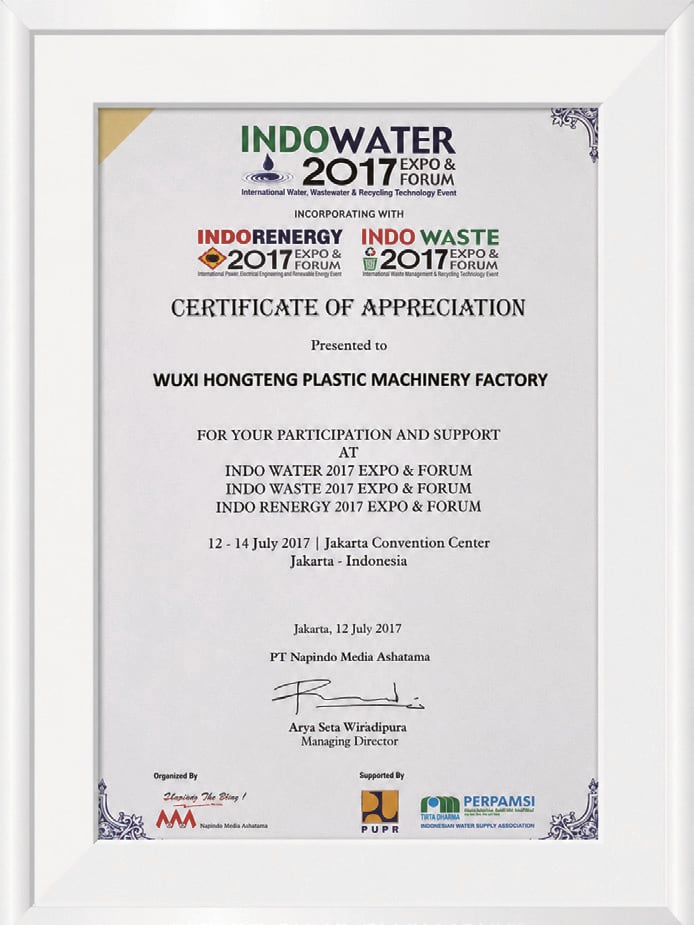
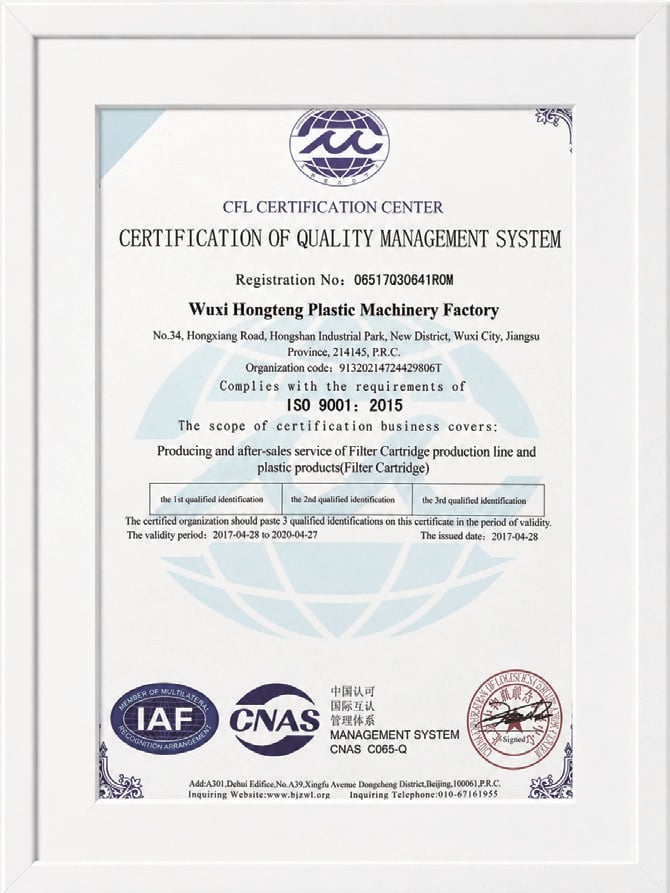
UDTECH builds these lines in a 6,000 m² workshop and has supplied filter equipment to over 55 countries. UDTECH holds ISO 9001:2015 and CE certification, along with national invention and utility model patents.

Certification of the cartridges your line produces is a separate exercise, because NSF/ANSI 42 and NSF/ANSI 61 attach to the finished product rather than to the machine that makes it. Both are issued by an accredited lab operating a certification program — NSF, IAPMO, WQA and UL Solutions are the bodies that run them.

Ask for the pre-shipment test protocol and what counts as a pass.

Request the test protocol →

× Enlarged Image

How We Work: From Enquiry to Commissioning

Enquiry

Every enquiry is answered within 24 hours by someone who has read your specification.

Configuration

We convert your cartridge specification into a line configuration and a proforma invoice.

Order

30% T/T deposit releases the build slot.

Build and run-off

The line is assembled and test-run at our factory before it ships.

Balance and shipment

The balance settles before shipment; the line is crated for ocean freight.

Commissioning

Installation assistance and startup support, with our technical service department reachable directly.

Eight things to settle before the order, not after

Decision

Why it belongs on the quotation

Micron range you will sell Sets the process recipe and the die configuration
Filter cartridge length and outer diameter Sets the cutting station and build-up time
Inner diameter Anything other than 28 mm needs a matched mandrel shaft
End-cap configuration The line makes double-open-end cartridges; caps and adapters are separate scope
Target output per shift Decides two extruder sets or three
Supply voltage and frequency Anything outside 380 V/50 Hz or 220 V/50 Hz is a quotation line item
Control-panel approval route Whether your plant needs a nationally recognised testing laboratory mark
Resin grade and spares kit Melt flow index sets the achievable micron band; spares avoid week-long stops

Bring these eight answers to the first message and what comes back is a real configuration rather than a request for more information. Leave them to commissioning and they arrive as change orders — the difference between planning to manufacture cartridges and discovering how to.

FAQ
Knowledge Base

Buying and Running a Melt Blown Cartridge Line

Comprehensive answers to operational, production, and technical requirements. Explore our FAQs to find exact configurations.

Price follows throughput tier, dimensional range, automation scope, electrical package and documentation. Send the five answers and you get a figure against your configuration rather than a range that fits nobody.

3,500–4,200 pieces per 24 hours on the 2E&2M and 5,000–5,800 on the 3E&3M. Piece counts on this process are a mass-flow rate in disguise — The 100-Gram Baseline above is the reference cartridge those figures are usually quoted against — so ask us, and every other supplier, which cartridge weight and length the figure is calculated at.

1, 5, 10, 20, 30, 50 up to 100 µm. The rating comes from die-to-collector distance, hot-air pressure and temperature, mandrel rotation and push-forward speed, held by the control system rather than set by an operator mid-run.

Standard supply is AC 380 V/50 Hz or 220 V/50 Hz, with other voltages configurable on request. Close The Energisation Gap on the quotation rather than at commissioning — voltage, frequency and the control-panel approval route: US workplace equipment must be approved by a nationally recognised testing laboratory, and a CE mark does not meet that requirement.

Melt blown lays molten fibre directly onto a mandrel in one pass and self-bonds without adhesive, so density can be graded continuously through the wall. String wound needs pre-spun yarn and a separate core, and approximates a gradient through winding tension and layer count.

Melt-blowing runs across roughly 35–1,200 g/10 min melt flow index. Higher index gives finer fibre but weaker fibre, so the grade is chosen against the micron band you intend to sell. Resin supply is normally arranged locally and is one of the eight items to settle at quotation.

Inner diameter runs 10–150 mm with a matched mandrel shaft against a 28 mm default; outer diameter 38–120 mm at that default; lengths 10", 20", 30" and 40". Specify non-standard dimensions at RFQ so the tooling is quoted with the line.

NSF/ANSI 42 covers aesthetic effects and material safety; NSF/ANSI 61 covers what a component leaches into drinking water. Both attach to your finished cartridge, not to the machine, and a melt-blown cartridge is frequently certified to NSF/ANSI 42 for material requirements only rather than for a particulate performance claim.

The deposit releases a build slot. The line is assembled and test-run at our factory before it ships, the balance settles before shipment, and the line is crated for ocean freight with its documentation package.

It depends on model, customisation scope and the current production schedule, so we quote it against your specification. The sequence does not change: deposit, build slot, factory run-off, balance, shipment.