Get in touch with Suzhou UDTECH Technology Co., Ltd. Company

Engineering Excellence
String Wound Filter Cartridge Machine
High-speed precision winding for universal cartridge production.
10 inch to 70 inch on one machine
1, 5, 10, 20, 50 and 100 micron
Quotes returned within 24 hours
Production scheduled at 30 working days
The UDTECH string wound filter cartridge machine winds yarn onto PP or stainless steel cores at 60–320 m/min, building cartridges from 10 inch to 70 inch without changing frames. Send us the cartridge you already sell — its length, bore, outside diameter and rating — and a UDTECH engineer confirms the fit against the winding envelope rather than sending you a brochure.
Send Your Cartridge Specification
Drawings and cartridge samples are treated as confidential, and an NDA is available before you send anything.
Cartridge length
10 inch to 70 inch on one machineMicron ratings
1, 5, 10, 20, 50 and 100 micronCartridge bore
28 mm standard, other diameters tooled to orderOutside diameter
29–150 mmWinding speed
60–320 m/minCore materials
PP or stainless steelQuote turnaround
24 hoursProduction lead time
30 working daysWarranty
12 month warranty from delivery01
Manufacturing Tech
String Wound Cartridge Production Capability
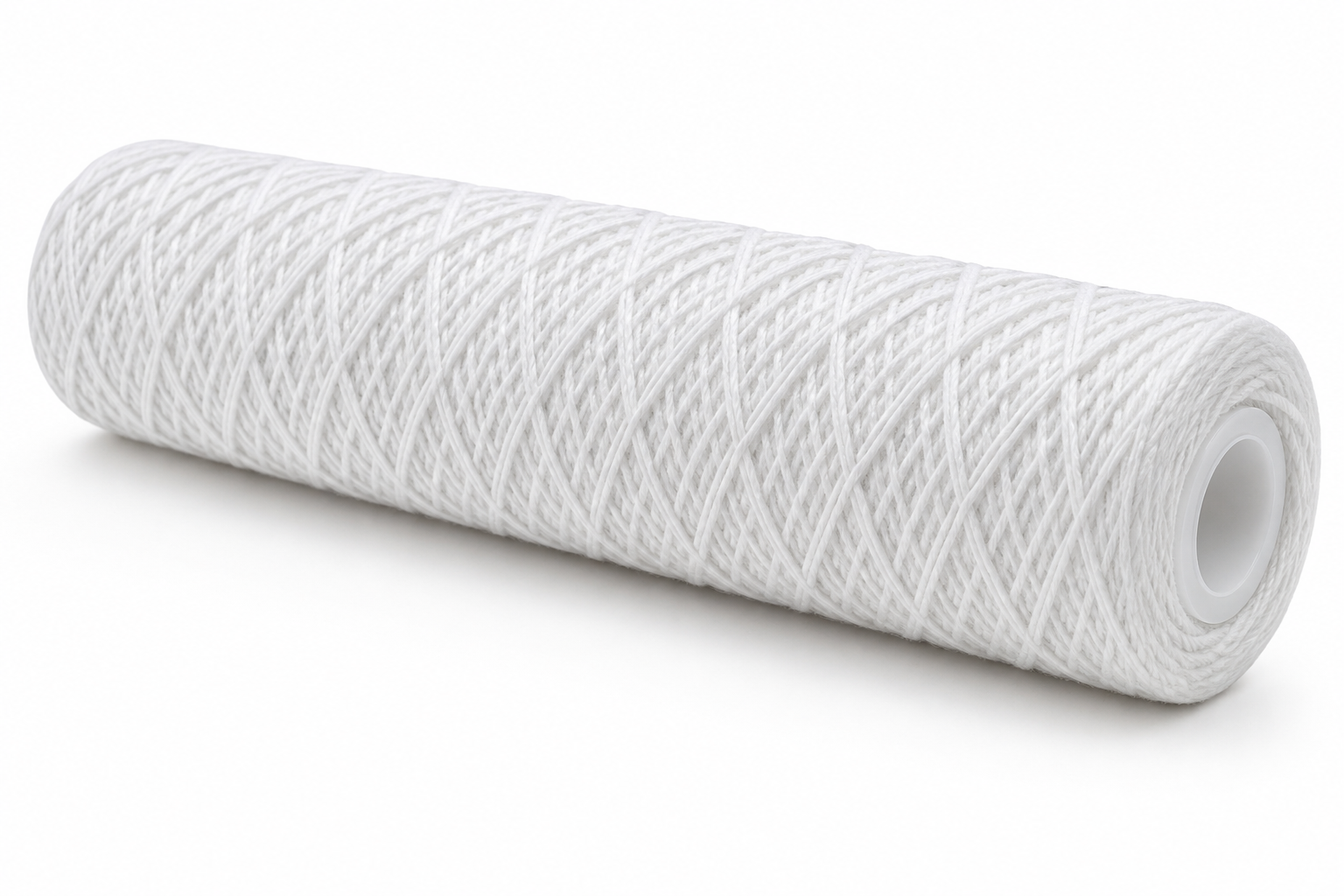
A wound cartridge is built, not moulded. Yarn winding does the whole job: yarn runs through a tensioner and a traversing guide onto a rotating core, laying a spiral and then a reverse spiral over it. The crossing spirals open diamond-shaped passages that run from the outer surface inward to the core.
That geometry is the whole product. A granted US patent1 describes the construction as a crisscross diamond lattice and states plainly that the inner base wind is deliberately wound tighter than the outer wind, which is what produces more and smaller flow passages at the inner wall than at the outer one. In that patent, now expired, the gradient is a deliberate construction rather than a property the yarn arrives with.
It is also not a free benefit. The same patent records that in earlier cartridges an open outer wind restricted fluid access to the channels in the tighter inner layer next to the core, and that those flow restrictions caused a higher pressure drop and a decrease in dirt-holding capacity.1 Untuned, a density gradient is a defect; tuned, it is what the precision-wound patents were written around.
02
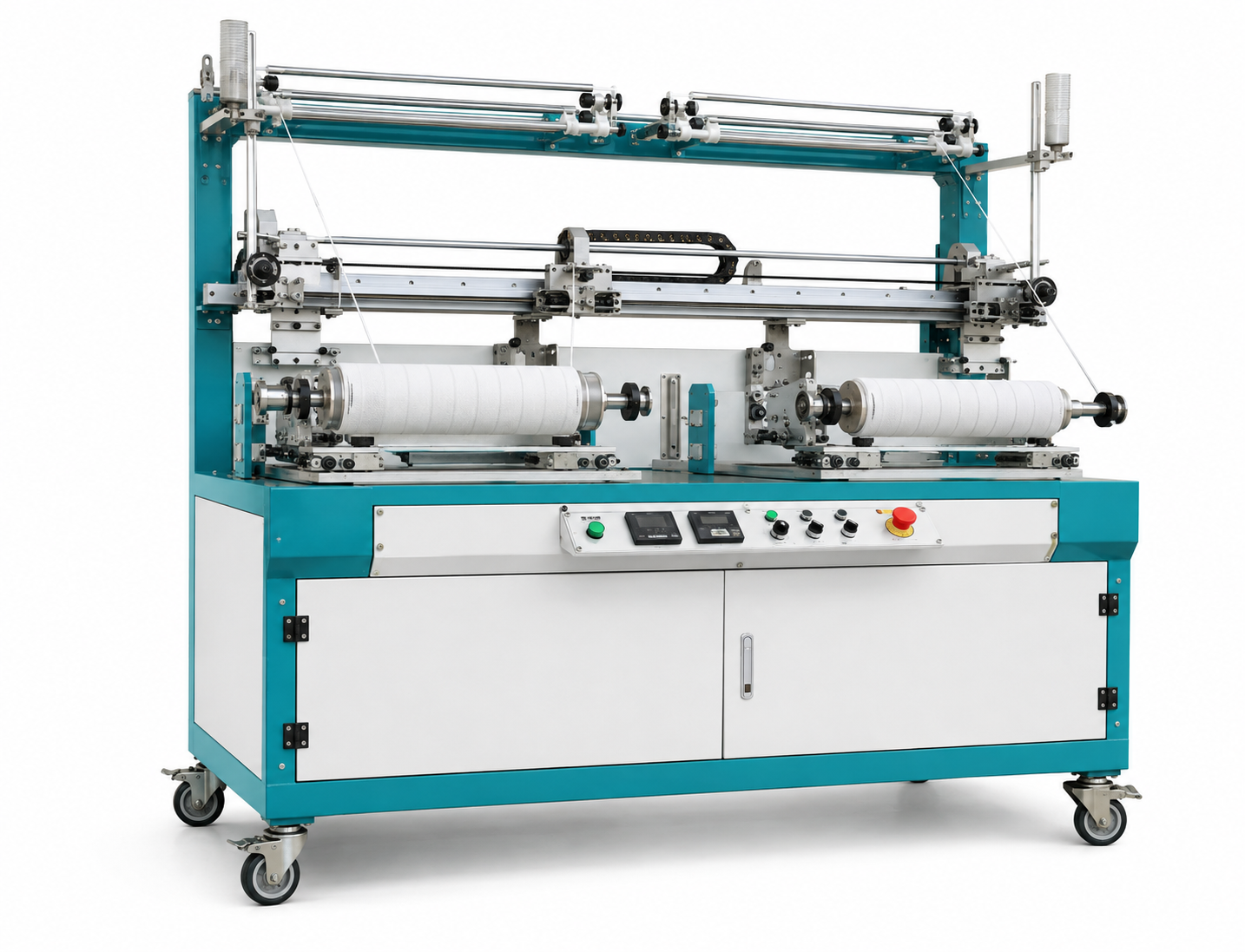
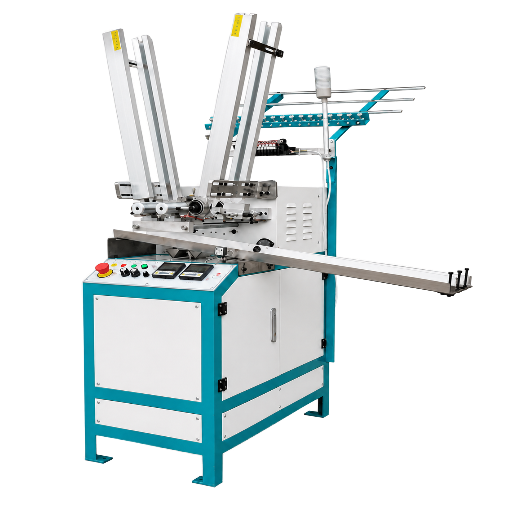
A cabinet-format winder on castors, with the two winding stations open to the operator. The traversing guide is the element that carries the yarn along the core.
Parameters
The rating comes from the settings
The same patent literature2 names five variables that fix retained particle size: how much yarn goes on, the winding tension, the lateral displacement per traverse, the filament diameter, and the loop structure of the yarn itself.
Unlike a moulded or extruded medium, none of them is a pore size. That is the structural reason a wound cartridge carries a nominal rating rather than an absolute one.
The ratio comes from the cam
Wind ratio is spindle revolutions divided by traverse frequency. On the UDTECH machine the traverse is driven by a reciprocating cam in polyformaldehyde. Whether the ratio is held by gearing or set in software is a question to put in your enquiry, and the answer decides what your range can be.
Change that ratio and the diamond geometry changes with it, which is the mechanism behind every micron figure in the table further down.
03
Specification
Electrical supply and drive
The machine is built for AC 380 V, 50 Hz as standard, and other voltages are configured to order. Drive power follows cartridge length: 0.18 kW at 10 inch, 0.25 kW at 20 inch, 0.5 kW at 30 inch and 0.55 kW at 40 inch.
Those small numbers matter to a United States buyer more than they look. A sub-kilowatt drive is not a plant-service problem, so at the published length classes a 60 hertz supply is a configuration question rather than an electrical upgrade. Ask what is supplied for your grid before you compare quotations.
Yarn and Core Material Options
Two choices decide what your finished cartridge can be sold into, and only one of them is the yarn. Both a cotton wound filter cartridge and a string wound polypropylene filter cartridge come off the same machine; what separates them is the package on the creel and the core underneath. On a metal core each media runs close to its own limit; put the same media on a polypropylene core and the ratings converge on one much lower number, because the core softens long before the yarn does.
The Core Ceiling
Call it The Core Ceiling: the temperature you can print on the box is set by the part of the cartridge you were not thinking about. Here the trade-off is unusually blunt. Choosing a polypropylene core buys you an all-plastic cartridge with nothing in it to corrode and a lower material cost; it costs you every degree above 120 °F the yarn was capable of. Wind a 275 °F nylon or polyester yarn onto a plastic core and 155 °F of what you paid for is gone. Glass fibre is the limit case: rated to 750 °F on metal, and on a polypropylene core not offered at all.
| Media | On a metal core | On a polypropylene core | What that means for your range |
|---|---|---|---|
| Bleached cotton | 250 °F / 121 °C | 120 °F / 49 °C | Hot service needs the metal core; the yarn is not the limit |
| Glass fibre | 750 °F / 399 °C | Not offered | The highest-temperature media in the family, and it requires a metal core |
| Nylon | 275 °F / 135 °C | 120 °F / 49 °C | Solvent and hydrocarbon duty, metal core |
| Polyester | 275 °F / 135 °C | 120 °F / 49 °C | Acid-side duty, metal core |
| Polypropylene | 200 °F / 93 °C | 120 °F / 49 °C | The default water media; the all-plastic build costs 80 °F |
| Rayon | 250 °F / 121 °C | 120 °F / 49 °C | Rarely specified now, listed for completeness |
| Glass-filled polypropylene core | — | 200 °F / 93 °C | Recovers the metal-core rating for PP media with no metal in the cartridge |
| Phosphoric acid 0–50%, PP media | 212 °F / 100 °C on 304 stainless | 135 °F / 57 °C | A 77 °F penalty for the plastic core in identical service |
| Sodium hypochlorite, 5% | Nylon 95 °F / 35 °C | 110 °F / 43 °C on polypropylene media | Cotton, glass fibre and rayon are not recommended at any temperature |
| Deionised water | 316 stainless accepted | Polypropylene accepted | Polypropylene is the only media listed for this duty; both cores are cleared |
These are published supplier ratings rather than a standard. Two independent tables disagree on four cells — one gives the polypropylene core 140 °F where the other gives 120 °F — and no standards body adjudicates between them. The shape holds even where the numbers do not: across one manufacturer’s chemical-resistance bulletin, 308 of 332 cells that list a polypropylene core carry a numeric temperature cap, while 187 of 188 metal-core-only cells carry none. Treat The Core Ceiling as reliable and confirm the exact figure with whoever supplies your media.
Yarn grade is a separate decision from yarn polymer
On a published compatibility scale for potable liquids, FDA-grade cotton scores excellent and plain cotton scores not recommended. FDA-grade polypropylene scores excellent and industrial polypropylene scores not recommended. Same polymer, same winding, same machine.
The regulation explains why. Under 21 CFR 174.5 any substance used as a component of a food-contact article must be of a purity suitable for its intended use, and no additive substance may migrate into food in more than the amount reasonably required to do its job. Under 21 CFR 177.1520(b)5 anything on the fibre besides the base polymer counts as an optional adjuvant substance needing its own clearance. So an FDA-grade yarn claim is really two claims: the resin meets the specification, and every surviving spin finish or sizing is separately cleared.
Only a minority of listed media grades are declared both FDA-compliant and free of sizing and yarn finish. Bleached cotton and fibrillated polypropylene carry both declarations; a grade sold as potable-water polypropylene carries the first without the second. If you are buying PP yarn for filter production on price alone, that second question is the one the price is hiding. The machine winds whichever grade you specify, and we will tell you which of the two questions your grade has actually answered.
String Wound Filter Cartridge Machine Insights
The Winder-Extruder Divide
A string wound winder and a melt-blown extruder are both sold as a PP filter making machine. They are not interchangeable, and they are not close: different customs categories, roughly a tenfold price separation, and a buyer who crosses The Winder-Extruder Divide without noticing concludes that someone is either overcharging or cutting corners.
| Dimension | String wound winder | PP spun / melt-blown machine |
|---|---|---|
| What it physically is | Spindle, tensioner and traversing cam | Single-screw extruder with a melt-blown die |
| Customs classification | HS 8451.59 | HS 8477.20, typed as a sheet extruder |
| Raw material | Yarn on a package | Polypropylene resin granules |
| Rating production | Winding geometry and tension | Die geometry, hot air and collection distance |
| Core needed | Yes — wound onto one | No — the cartridge is coreless |
| Drive power class | Sub-kilowatt per spindle | Tens of kilowatts connected |
| Published price band | Low thousands of US dollars | Tens of thousands of US dollars |
Critical Notice
We state The Winder-Extruder Divide plainly because it decides which quotations are even comparable. Suppliers who specialize in one side of it rarely quote the other, yet the industry's own listings file both under a single search term. Quotations for an extrusion line and for a winder answer different questions. If the table has just told you that you are on the wrong side of it, the melt-blown machine page is where that line is specified and priced.
Where your price actually moves
| Driver | Effect on cost | How to reduce it |
|---|---|---|
| Spindle count | Capacity is added a whole spindle at a time, and price follows | Size the spindle count against your real daily output, not a headline rate |
| Control system | A programmable ratio costs more than a geared cam anywhere in this machine class | Ask at enquiry which control this machine is built with before you plan a range around mid-build ratio changes |
| Length range | A wider traverse stroke is a bigger frame | State the longest cartridge you will actually sell |
| Bore tooling | Every bore outside 28 mm needs its own mandrel | Standardise your range on one bore where the market allows |
| Documentation | Export paperwork, the manual and test records take engineering time | Tell us at quotation which documents your inspector needs |
Make versus buy, at published prices
Before you price a machine, price the cartridge you would stop buying. Every figure below is either published by somebody other than us or derived from this machine's own rated drive, and the gaps in it are stated rather than filled.
| Line | Published figure | Where it comes from |
|---|---|---|
| Yarn on 10 inch cartridge | About 150 g | Granted US patent, worked example |
| PP filament yarn | USD 1.35 per kg | Two independent providers, commodity grade — read it as a floor |
| Yarn in one cartridge | About USD 0.20 | The two rows above, multiplied |
| Drive electricity, 1hr | 1.65 US cents | 0.18 kW at the EIA industrial rate of 9.17 cents per kWh |
| Operators per machine | One | A competitor's own published staffing |
| Cartridge bought in | USD 3.00 to 4.00 | Published quantity breaks, 2.5 by 10 inch |
| Gap 1 — the core | No published price | Searched across the same yarn and cartridge suppliers |
| Gap 2 — bulk trade price | None published >120 | 120 units is the highest published quantity break |
Cost Analysis
Twenty cents of yarn against three dollars of purchase looks decisive, and it is not. The core is unpriced, the trade price stops being published exactly where your volume starts to matter, and 1.35 is a commodity-grade floor that an air-textured or FDA-grade yarn sits above. What the table does settle is which three numbers you have to go and get before a machine can be justified: your core cost, your own bulk buying price, and the price of the grade you actually intend to wind.
Pricing Structure & Terms
Price follows spindle count, control system, the cartridge length range you need served, and the tooling for any bore outside the standard. There is no fixed price list for a configured machine; your figure comes back in a written quotation against your own cartridge specification.
Ask which of three labels a listed price belongs to — mechanical, semi-automatic or fully automatic — because in this machine class the band tracks the label rather than the frame. Customization is priced as tooling rather than as a surcharge, so tell us what you need to customize and it appears in the quotation as its own line.
How your quotation is produced
Send the cartridge specification and a process engineer returns a quotation within 24 hours on business days, with the fit assessment against the winding envelope alongside it. Production runs are scheduled at 30 working days, confirmed with your quotation.
Minimum order is 1 set — single machines are accepted. Payment is T/T or L/C, with the balance settled before shipment. The machine carries a 12 month warranty from delivery.
Lead time starts when the specification is approved and excludes transit. Where a delivery date is fixed, tell us at enquiry and we confirm feasibility before the quotation is issued. Ask at the same time which string wound filter cartridge machine parts your supplier treats as consumable. Traverse cams, yarn guides and tension pads wear against running yarn, and a spares list priced alongside the machine costs less than one priced during a stoppage.
Spindle and Shift Planner
Output Optimization Tool
Work out how many spindles your output needs from your own winding time, running hours and uptime rather than from anyone's published pieces-per-day figure.
Open the spindle planner ➔Cartridge Quality Control and Certification Boundaries
A winder earns its keep by repeating itself. Every check below is on the wound result, because that is what your customer measures.
Checks before a machine ships
- A run-off on your own yarn and core, at the ratings you intend to sell, can be written into the order before the machine is packed.
- Wound samples are measured for outside diameter and length against your specification, and the settings that produced them are recorded.
- Clean differential pressure is compared across samples from one setting, since a spread between them is a tension-control problem, not a media problem.
- The recorded settings ship with the machine, so your operator starts from a known state rather than from a first run.
Nominal, absolute, and the gap between them
A wound depth cartridge is nominal-rated, and NSF's own registered claim wording for particulate reduction uses the word nominal. That is not a hedge, it is a description of the construction: depth filters have no single well-defined pore size to be absolute about.
The gap this opens is wide enough to matter commercially. Behind the word absolute sit at least four thresholds in commercial use, running from a granted patent's 90 per cent removal to the Water Quality Association's 99.9 per cent, and a trade journal reported measurements of five manufacturers' 1 micron filters at efficiencies from below 20 per cent to above 98. The single-pass liquid test standard that once anchored the comparison was withdrawn in 2002.
Notice:
Decide which convention your label will use before you print it, not after a customer measures your cartridge against a different one.
This is the part buyers discover late, and it costs money when they do. No standard in United States drinking-water practice has a scope that reaches production machinery. Certification attaches to the media and to the finished cartridge, and it is your finished cartridge that will carry it.
| Standard | What it covers | What it does not cover |
|---|---|---|
| NSF/ANSI 61 | Materials in substantial contact with potable water. Washington State regulation names filter media explicitly as in scope | Valves, fittings, gaskets and screens are explicitly excluded — and so is the machine |
| NSF/ANSI 42 | Aesthetic effects on drinking water treatment units, graded in six particulate classes each requiring 85 per cent reduction | Production equipment. NSF's own register lists finished units by brand, model and replacement element, with no machinery category |
| 21 CFR 177.1520 | The polypropylene resin as supplied, under item 1.1a, with its own density, melting-point and extractables limits | The winder. The extractables test runs on the polymer in a resin kettle, not on a finished cartridge |
| 21 CFR 174.5 | Every component of a food-contact article, including residual spin finish and sizing on the yarn | Nothing about the equipment that assembles the article |
One correction worth having before you specify: NSF is not the only certifier. Certification to an NSF/ANSI standard may be issued by any accredited certification body, and several comparable programmes exist. If a supplier tells you a route is closed to you, check the accreditation rather than the brand name.
×
![Enlarged Filter Machine Detail]()
From Enquiry to Commissioned Line
01. Send us the cartridge, not the machine
your length, bore, outside diameter, rating and yarn. Machines are quoted from what they have to produce.
02. Fit assessment
we confirm which of your dimensions are standard, which need a mandrel or a stroke change, and which sit outside the envelope. It comes back with the quotation.
03. Then comes the written quotation
scope, spindle configuration, tooling, documentation, delivery and payment terms in one document, returned within 24 hours on business days.
Execution & Delivery
04. Build and run-off
on your own yarn and core, against the acceptance criteria set out under quality below.
05. Acceptance
is judged against the samples and the recorded settings from run-off, so agree those criteria in writing before the machine is built rather than after it lands.
06. Installation and commissioning
installation assistance, start-up and commissioning help on your own production line, technical support for the control system, and a direct line to the technical service department for overseas customers.
What a United States buyer should ask for at quotation
Electrical acceptance, not conformity marking, is what gates energising an imported machine in a US plant. Federal regulation defines acceptable equipment three ways: listed by a nationally recognised testing laboratory, inspected by an authority enforcing the national electrical code, or — for custom-made equipment built for a particular customer — determined safe by the manufacturer on the basis of test data, which the employer then keeps and makes available on inspection.
That third route is the one most imported machinery travels, and it turns a technical question into a paperwork question. Ask every supplier which route they expect you to use and what documentation goes in the crate.
03The Machine, and What the Company Has Shipped
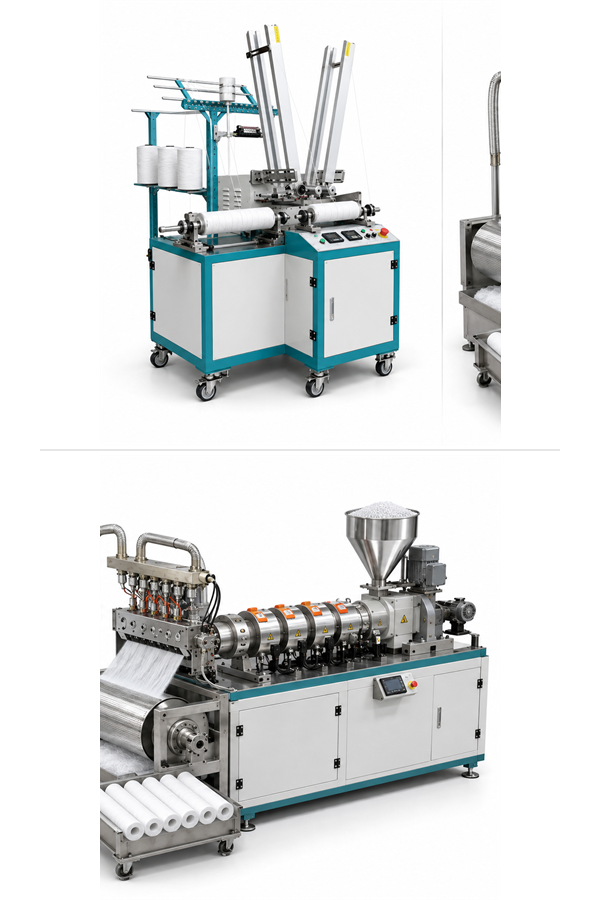
- The cabinet-format winder with its operator panel. One frame covers 10 inch to 70 inch.
- The open-frame configuration, in a short-stroke and a long-stroke frame, two winding stations on each.
- What goes in and what comes out: yarn packages on top, wound cartridges in three lengths, polypropylene cores below.
- The filter-equipment lines have shipped to more than 55 countries, the United States among them. That is a company supply record across all three cartridge lines rather than a reference list for this machine, and we would rather you judged the machine on the envelope above than on a number you cannot check.
Winding-pattern review
Send a sample or a drawing of the cartridge you make today and an engineer reads the winding pattern back to you — wind ratio, coil angle and where the density sits — before any question of a machine comes up.
Our experts ensure that every parameter is perfectly aligned with your production goals before the manufacturing process even begins. This proactive approach saves time and secures your investment.
05Ready to Upgrade Your Line?
Get a comprehensive analysis of your current string wound filter cartridges today.
Send a Cartridge for Review 06Spread 1 / 3
String Wound Filter Cartridge Engineering Tools
Production Utility
Spindle and Shift Planner
Every winder is priced and rated per spindle, so the question behind a quotation is how many spindles your output actually needs. This works from your own numbers rather than from anyone’s published pieces-per-day figure, because a piece rate quoted without its micron rating, diameter and length is not comparable between suppliers.
Performance Metric
Filtration Rating Converter
Three conventions describe the same filter performance and they are not interchangeable in conversation: removal efficiency as a percentage, log reduction value, and beta ratio. Enter one and read the other two, so that a specification written in one convention can be checked against a claim written in another.
Electrical Analysis
Fifty to Sixty Hertz Motor Effect
Machinery built for a 50 hertz grid gets shipped to plants running at 60 hertz, and the arithmetic of what changes is not a matter of opinion. Enter a motor and read the synchronous speed at each frequency, the speed change, and the torque consequence of running at the same voltage.
Frequently Asked
Questions
Find comprehensive technical answers regarding our string wound filter cartridge machines, specifications, and manufacturing capabilities.
What is a string wound filter cartridge machine?
A string wound filter cartridge machine is production equipment that winds continuous yarn onto a rotating core to build depth-filtration cartridges for water, chemical and industrial service. Suppliers also list it as a filter winding machine, as a wound filter cartridge making machine, or simply as a filter machine; the names describe one machine. It makes cartridges; it is not one. Searches for a water filter cartridge making machine return both, and the two markets differ by three orders of magnitude in price, so if you are here to replace a cartridge in a housing, this page is not what you need.
What yarn material and core size should I run?
Yarn first for the chemistry, core second for the temperature. Polypropylene yarn on a polypropylene core is the default for cold water and the cheapest build. Cotton, nylon, polyester and glass fibre extend chemical and temperature range, but every one of them is capped at 120 °F on a polypropylene core, so a hot duty runs into The Core Ceiling and needs a metal or glass-filled core. Bore follows your housing: 28 mm is the standard on this machine and other bores run on a matched mandrel.
How many cartridges will this machine make per day?
That depends on four things nobody can answer for you in a headline: cartridge length, micron rating, wall thickness and how many spindles you buy. A rate quoted at 10 inch is not the same machine hour as a rate at 40 inch, because a longer, tighter, thicker-walled cartridge takes more yarn and more time. Ask every supplier for a winding time at your own specification and put it through the spindle planner.
Single, double or multi-spindle?
Capacity is bought a whole spindle at a time. Work backwards from your daily output and your measured winding time, buy the count that covers it with a little headroom, then tell us the number — we will tell you what it changes in the quotation.
What is the difference between an electronic and a geared winding machine?
A geared machine holds the wind ratio with a cam and a gearbox; an electronic machine sets it in software and can change it part-way through a build. The consequence sits in the patent literature: a graded-density cartridge, coarse outside and fine at the core, needs the ratio to change mid-build, and the older routes to it — stopping the machine part-way, or running independently driven stepped motors — are described there as inefficient, exorbitantly expensive, or both. Ask which control this machine is built with before you compare prices, because it decides whether The Micron Dial turns during a build or only between builds.
Can the machine be NSF or FDA certified?
No, and any supplier who says otherwise is describing something else. Certification attaches to the media and to the finished cartridge. NSF's own certified-product register lists finished units by brand, model and replacement element and has no machinery category at all. What the machine can do is produce cartridges that qualify, provided you buy a yarn grade that carries the clearances and your own plant passes the certifier's facility audit.
What does the page mean by nominal rating?
That the rating describes filtration performance rather than a measured hole. Nor is there a universal threshold behind the word absolute — the conventions quoted further up this page run from 90 to 99.98 per cent. The rating converter shows the spread between them.
What changes for a 60 hertz plant?
The standard build is AC 380 V, 50 Hz. On a 60 hertz supply at the same voltage an induction motor keeps its rated output and current and turns twenty per cent faster, losing roughly a sixth of its torque; it does not fail. A motor fed through a variable frequency drive is insulated from the supply frequency altogether. What we will not do is tell you the wound result is unaffected without confirming it — ask us at enquiry and the answer comes back with the quotation.
What do these machines sell for?
There is no single string wound filter cartridge machine price. Published marketplace listings run between roughly US$800 and US$8,000, with five sellers across China and India publishing US$2,000 to US$4,000 for a mechanical single-spindle winder and one electronically controlled model listed at the top of that band; the spread is the automation step, not a market in disarray. Figures an order of magnitude above it sit on the far side of The Winder-Extruder Divide: a melt blown filter cartridge machine is an extruder, and the PP melt blown filter cartridge it makes has no core at all. That machine is priced on its own page, not on this one.
What change-out guidance should I give my cartridge customers?
Change on differential pressure, logged at least once per shift, and at least every three months regardless. Membrane manufacturers add a diagnostic worth passing on: replacing cartridges more often than every one to three months usually points at a problem upstream rather than at the cartridge. It is a useful thing to print on your own car