Get in touch with Suzhou UDTECH Technology Co., Ltd. Company

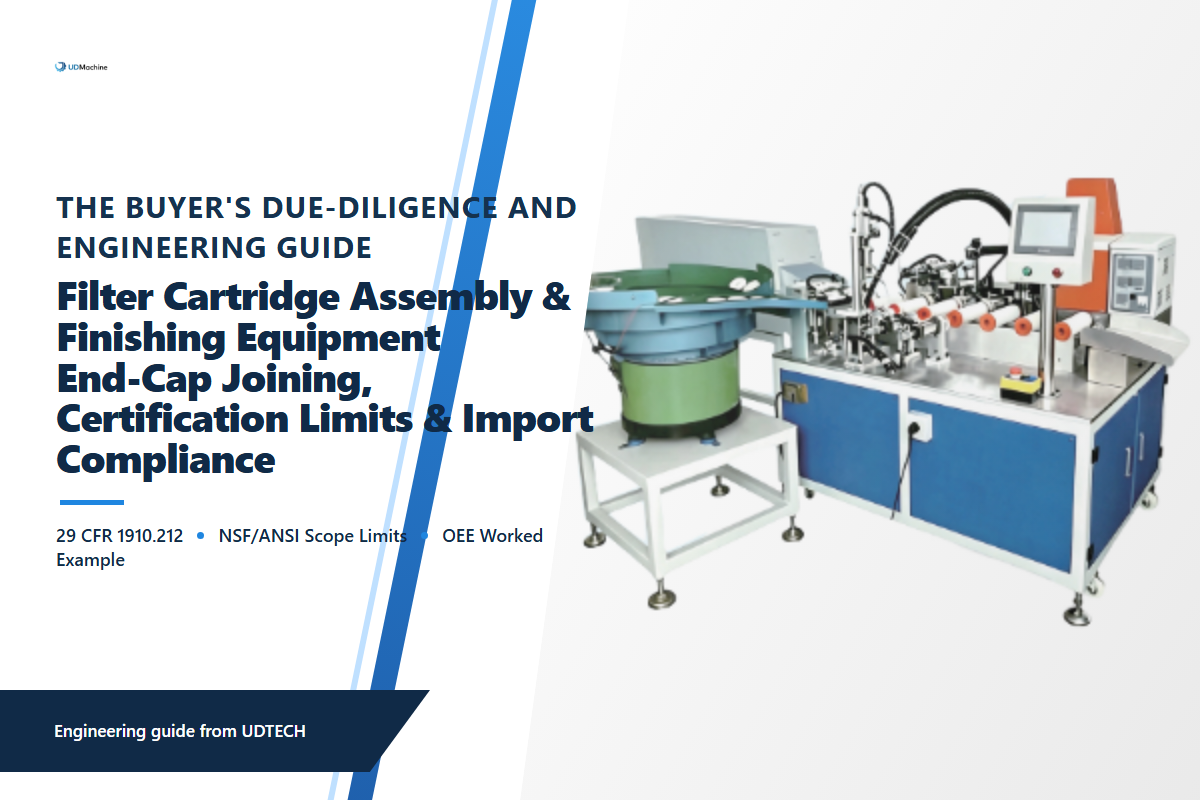
Filter cartridge assembly & finishing equipment includes machinery for joining a filter cartridge media, end cap sealing, trimming to length, seal verification, and sealing the cartridge into a shippable package. Assembly & Finishing Equipment describes the machinery that joins, seals, and finishes a filter cartridge after the media itself has been formed. This equipment is used after media forming (melt-blowing, string-winding, carbon-block extrusion) and before the cartridge leaves the facility. If you’re searching for this type of equipment in the USA, you’re searching for “filter cartridge making machine” or “filter making machine.” In India and the Gulf, the same type of equipment is searched as “pp spun filter making machine” or “ro spun filter manufacturing machine.” This is worth knowing when comparing quotes across regions. Assuming you know the configuration needed, UDMachine’s assembly & finishing equipment configuration page goes through a 14-field RFQ matrix. This guide comes before that one; it discusses the function of the equipment, the different ways to join media, where certifications end, and what the purchase order must include. Many readers find this guide while researching cartridge filter replacement programs or broader filtration systems; this equipment sits upstream of that replacement-parts market, and the vocabulary overlap is worth sorting out first.
Readers searching for air intake filters or engine intake filters in an industrial environment should note that those are a separate product category from the cartridge filter replacement parts this equipment assembles, though both rely on similar airflow and media-pleating principles. A reliable distributor or OEM buyer typically wants this production process running on automated machines that hold optimal, repeatable tolerances batch after batch, so every finished cartridge that leaves the line is high-quality and interchangeable with the last one.
Quick Specs
| Stage position | After media forming, before packaging |
| Core joining routes | Adhesive potting, mechanical retention, thermal fusion (ultrasonic, hot-plate, infrared, laser, spin-weld) |
| Automation tiers | Manual, semi-automatic, fully automatic |
| Acceptance framework | Factory/site acceptance testing per IEC 62381 |
| Safety framework | Machinery design limits per ISO 12100 |
What Counts as Filter Cartridge Assembly & Finishing Equipment
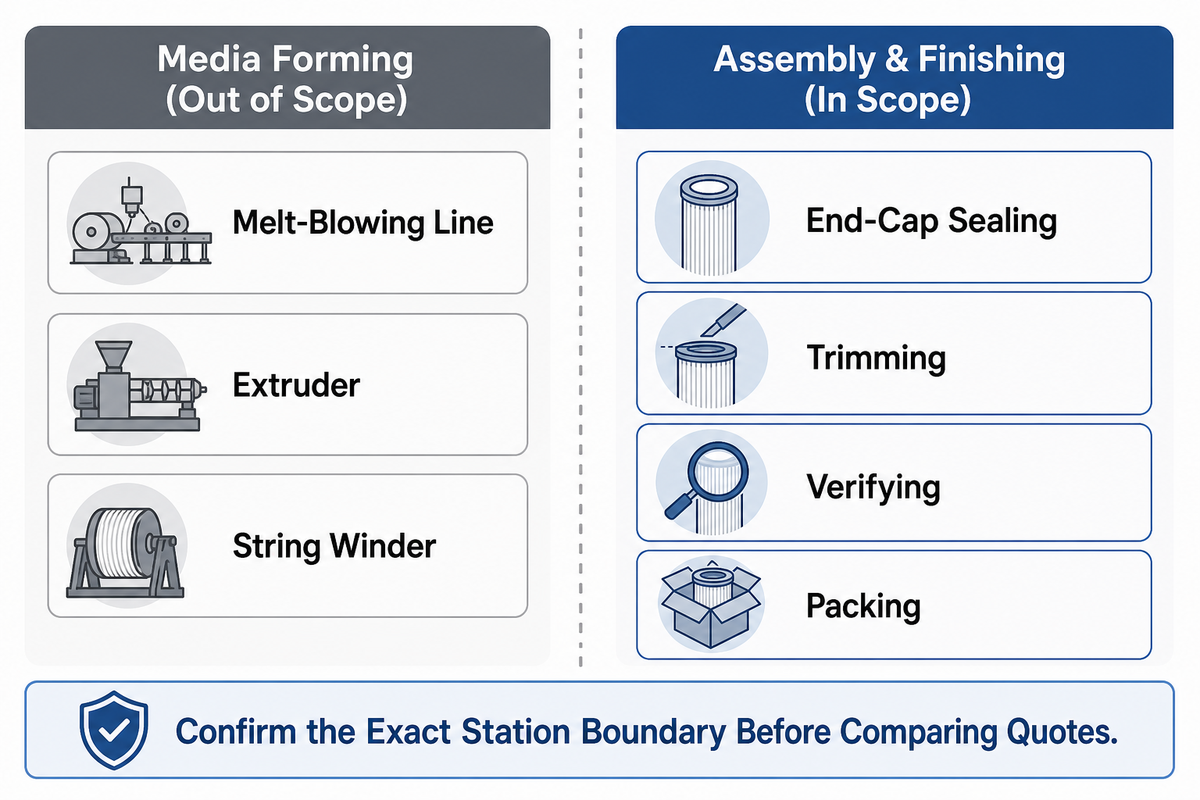
Assembly and finishing equipment describes the equipment utilized after the media is formed and before the finished cartridge leaves the plant. Middle seam joining, end-cap sealing, trimming, verifying, and packing make up this equipment category. Assembly and finishing equipment doesn’t include machines used to form the media.
Machines used to form the media include a melt-blowing line, an extruder, and a string winder, and each has its own process and equipment boundary. One supplier’s “assembly module” quote may include the finishing equipment described here while another may not. Confirm the exact station boundary, infeed, and outfeed when comparing suppliers’ quotes line by line.
The machine safety framework that applies across this whole equipment class is ISO 12100:2010, Safety of Machinery — General Principles for Design, Risk Assessment and Risk Reduction, which sets out the terminology and methodology for identifying a machine’s intended-use boundary before risk assessment starts. That boundary question — what this station is actually built to do — is the right first question for any assembly or finishing machine, not just a legal formality.
“ISO 12100:2010 specifies basic terminology, principles and a methodology for achieving safety in the design of machinery.” — ISO 12100:2010 Abstract, International Organization for Standardization
📐 Engineering Note
An extruder built to perform upstream carbon-block forming will hold a fixed outer and inner diameter and therefore is a fixed single combination. Downstream, an assembly station constructed to one end-cap geometry will not be flexible across all the cartridge families listed in the company catalog.
Once specified for media and micron ratings, pleated filters, depth cartridges and other designs involving mesh reinforcement share the same end-of-line joining and finishing stations, although the assembly equipment depends on the end cap and joining method, not on the micron ratings.
The true boundary of an assembly or finishing station is defined by the input and the output, not the name in the catalog.
How End Caps Are Sealed to the Filter Media
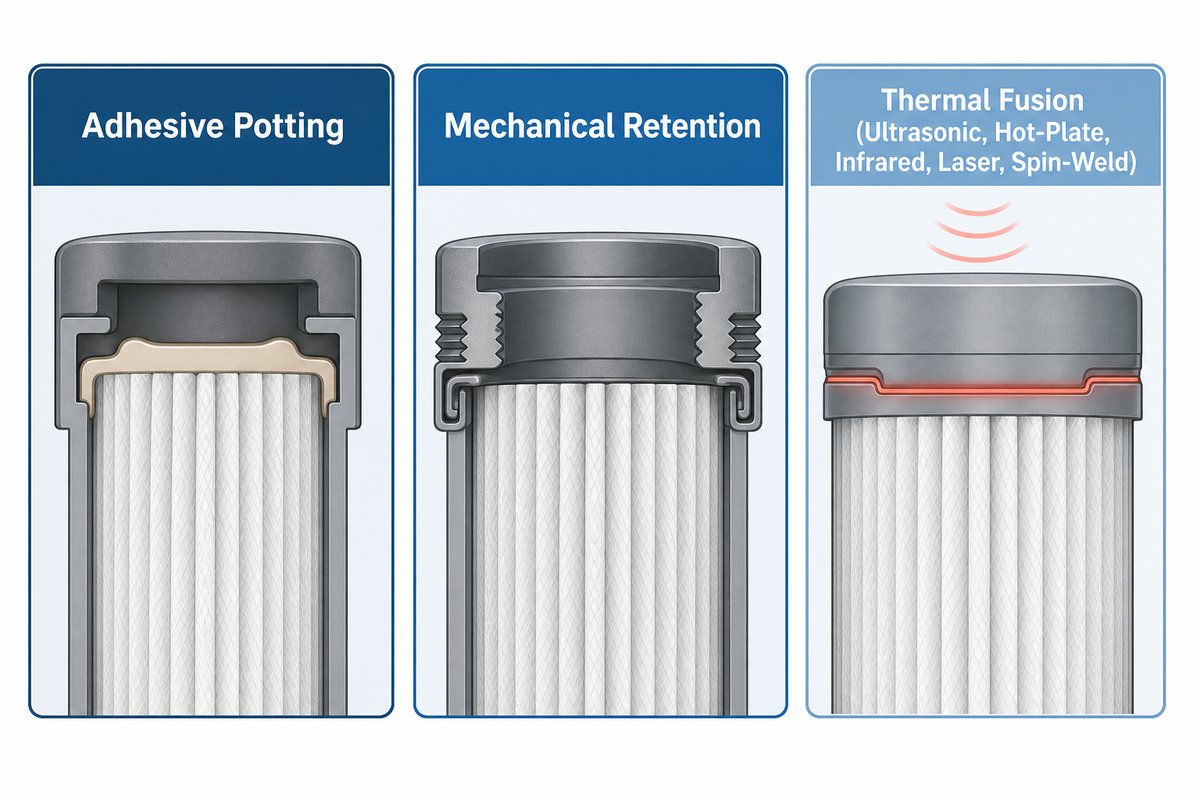
Division of end cap joiners into three families–adhesive potting, mechanical retention, and thermal fusion– is clear, and they aren’t substitutable on the same tooling. That input/output boundary from the previous section is exactly what decides which of the three families applies to a given joint.
Thermal fusion of end cap joins can further be divided by means of heat generation: internal friction or vibration heating used in ultrasonic and spin welding, and outside heating by means of hot plate, infrared and laser, as distinguished by the American Welding Society’s G1.1M thermoplastics welding guide.
The clearest documented example of a spin-weld set point comes from patent literature. US Patent 5,472,537, “End Capped Fibrous Filter Making,” assigned to Pall Corporation and granted December 5, 1995, describes a spin-welding example running at 500 rpm to 4,000 rpm, with 1,725 rpm given as the preferred speed, holding contact for 20 to 35 revolutions under an applied pressure the patent states should range from 20 psi to 100 psi, with 50 psi to 90 psi given as the preferred sub-range. That is a mechanism envelope, not a universal setting: the ratios of rpm, pressure, and contact time can be extrapolated to compatible thermoplastics, however, the actual numbers for a different polymer pair have to be determined by a trial weld.
| Joining type | Typical fit | Limitations / not suitable for |
|---|---|---|
| Adhesive potting | Low-temperature, cost-sensitive builds; relies on a cured bond rather than motion or heat | Not suitable above the adhesive’s cure-temperature service ceiling |
| Mechanical retention (snap-fit) | Tool-free rework; a technician can remove and reseat the joint without specialized tooling | Not suitable where a fully sealed, non-removable joint is required |
| Mechanical retention (threaded) | Field-serviceable cartridges needing repeat disassembly | Adds a thread-wear limit the other joining types do not have |
| Ultrasonic welding (internal-motion) | Chemical-resistant joints, no adhesive bleed, high-volume lines | Requires compatible, weldable thermoplastics on both sides of the joint |
| Spin welding (internal-motion) | Round end-cap joints at 500 rpm to 4,000 rpm per the patent example above | Preferred-speed data generalizes by mechanism, not by exact set point across polymers |
| Vibration welding (internal-motion) | Larger or irregular joint geometries than spin welding suits | Requires a flat-enough joint plane for consistent vibration contact |
| Hot-plate welding (external heating) | High-throughput lines, hard-to-weld materials such as PVDF | Dirt can adhere to the hot-plate mold over long runs |
| Infrared welding (external heating) | Hard-to-weld materials such as PTFE and PVDF without mold-dirt buildup | Non-contact heating element adds cost over basic hot-plate tooling |
| Laser welding (external heating) | Precision joints, automated high-throughput lines | Laser systems carry their own federal product-certification requirements — see the compliance section below |
Laser-based welding is the one case where the machine, not just the cartridge, can fall under a separate certification regime: equipment that emits laser radiation is a radiation-emitting product under FDA’s radiation-emitting product rules, which require the manufacturer to certify compliance against federal performance standards, supported by its own quality-control and testing program. That is a certification track on the welding system itself, entirely separate from whether the finished cartridge holds an NSF or FDA listing, covered next.
Choose your joining route based on the material pair and service conditions first; let the certification question follow the technology, not the other way around.
Finishing Operations After the End Caps Are Sealed
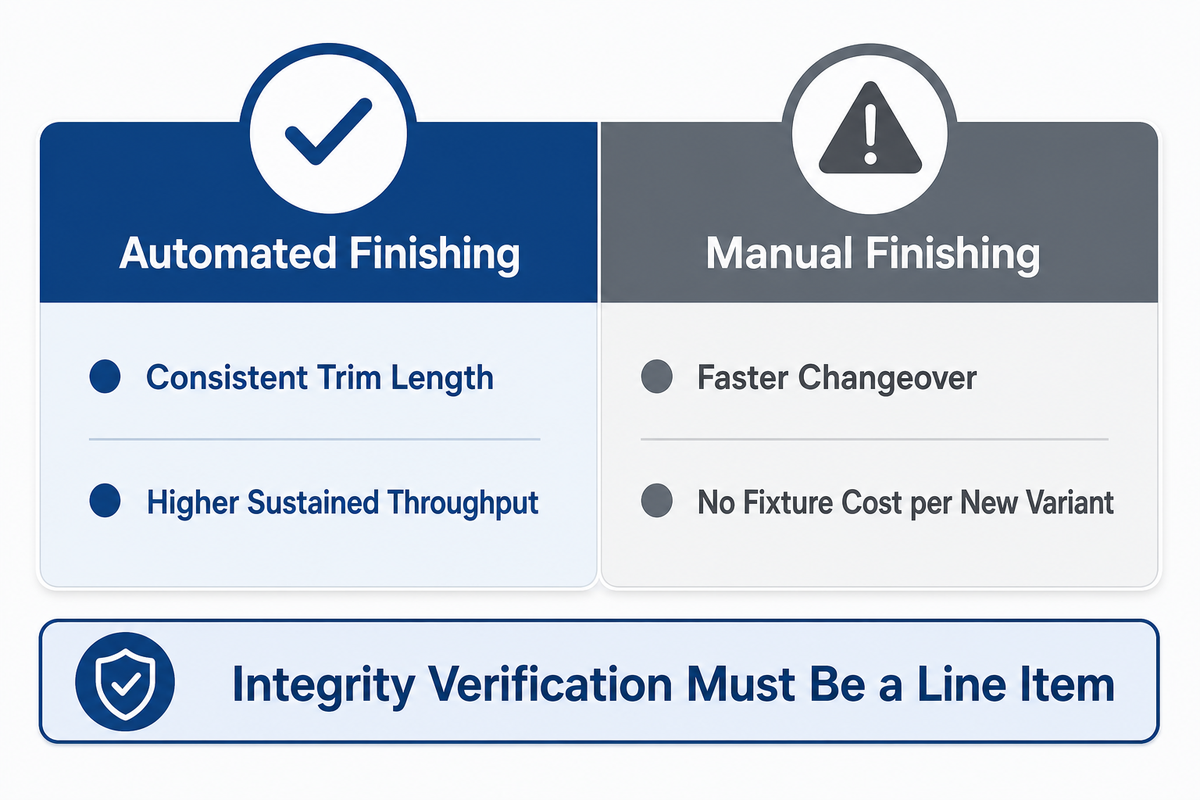
Finishing covers trimming to length, integrity verification, visual and dimensional inspection, reject handling, and packing. Once the joining route from the previous section is locked in, finishing is the next station on the same line. Integrity Verification must be a line item and not a footnote under “inspect.” Bubble-point or pressure hold testing, the method described by ASTM F316-03(2019) for membrane integrity, can detect a leak which would otherwise be invisible. Skipping this testing to save a station in the process trades an inexpensive internal catch for a costly external return.
✔ Automated finishing
- Consistent trim length and inspection criteria shift to shift
- Higher sustained throughput once set up
⚠ Manual finishing
- Faster changeover across many cartridge families
- No fixture cost per new product variant
If a plant performs six small batch runs of cartridge families, whether automating finishing is worthwhile is a question of transition time, which is resolved in the automation section below. The point here is what finishing verifies — dimension, appearance, seal integrity — not whether a machine should do that verification.
Finishing stations built well keep product quality reliable from the first unit through the last. Automated machines hold the process steady shift after shift, but a technician still bears the burden of downtime resulting from changeover to different families, as well as the subsequent packaging operations.
Manual, Semi-Automatic and Fully Automatic Assembly Lines
Three automation tiers are defined by what stays in an operator’s hands: manual lines where a person loads, joins and unloads every cartridge; semi-automatic lines where the machine joins but a person still loads or unloads; and fully automatic lines where loading, joining, and discharge all run without touching each cartridge. The right tier is less about raw throughput and more about the number of families of products that a single station must run and the cost of switching between those families. UDMachine’s assembly & finishing equipment configuration page lets you weigh these three tiers against your own product-family count before requesting a quote.
Semi-automatic
- Lower capital cost
- Faster changeover across product families
- Throughput capped by the manual load/unload step
Fully automatic
- Highest sustained throughput for one or two product families
- Higher capital cost and tooling cost per family change
- Labor cost per unit falls as volume rises
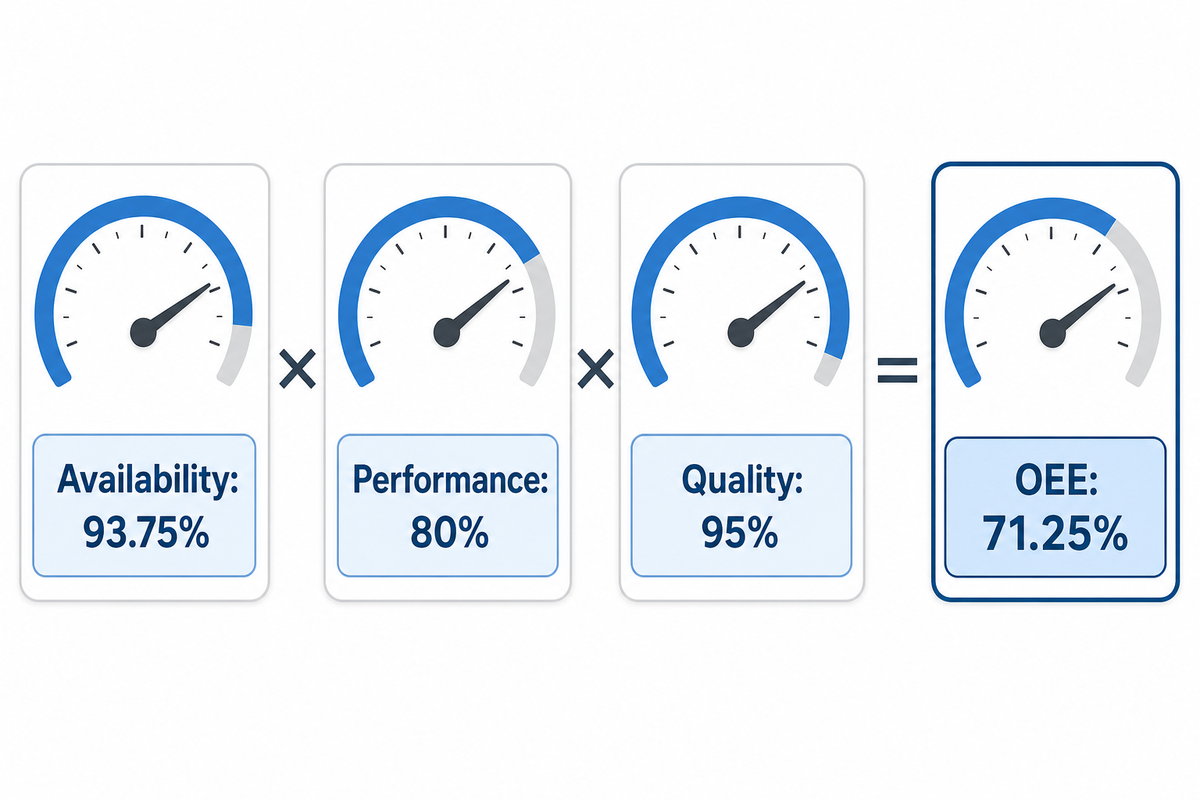
That “5,000 pieces/day” brochure figure assumes zero changeover and zero rejects — it’s a nameplate rate, not a measured output. The standard way to check a real production line against itself is Overall Equipment Effectiveness, OEE, defined by the University of Tennessee’s Manufacturing Extension Partnership as Availability multiplied by Performance multiplied by Quality. Here’s a worked example: a shift runs 480 minutes, with a 30-minute planned changeover, leaving 450 run minutes. A production line that can complete a cycle in 6 seconds would generate 4,500 cycles in the allotted time. If the line actually produces 3,420 good units, out of 3,600 attempted, the three factors work out to Availability of 93.75% (450 of 480 minutes), Performance of 80% (an ideal 6-second cycle against an actual 7.5-second average), and Quality of 95% (3,420 accepted of 3,600 attempted). Multiplying those three gives an OEE of roughly 71.25%.
Consider that number as a diagnostic, not a pass/fail on that particular external metric. The commonly cited “85% is world class” benchmark is itself built from 90% availability, 95% performance and 99% quality — three component targets, not a property of your specific process. One 2023 peer-reviewed study of the human-factor side of OEE, published in the International Journal of Engineering Business Management, treats OEE against the ISO 22400 framework rather than as a single pass-fail number across dissimilar processes — a caution worth taking seriously before comparing a manual station’s OEE directly against an automated one’s. Think more about how this metric compares against itself from last month.
As compared to the fixed automation line, building a line in stages, on a modular construction, lets a plant add automation later without disassembling what already runs efficiently. The high-efficiency and high-performance language in a brochure is only as useful as the OEE method above describes for your own shop floor; a value conveyed by an intermediary is less valuable than the same number documented directly and, ideally, by the builder of the equipment as well.
A nameplate rate assumes nothing goes wrong; your OEE tells you what actually occurred.
Why Your Machine Supplier Cannot Certify the Cartridge
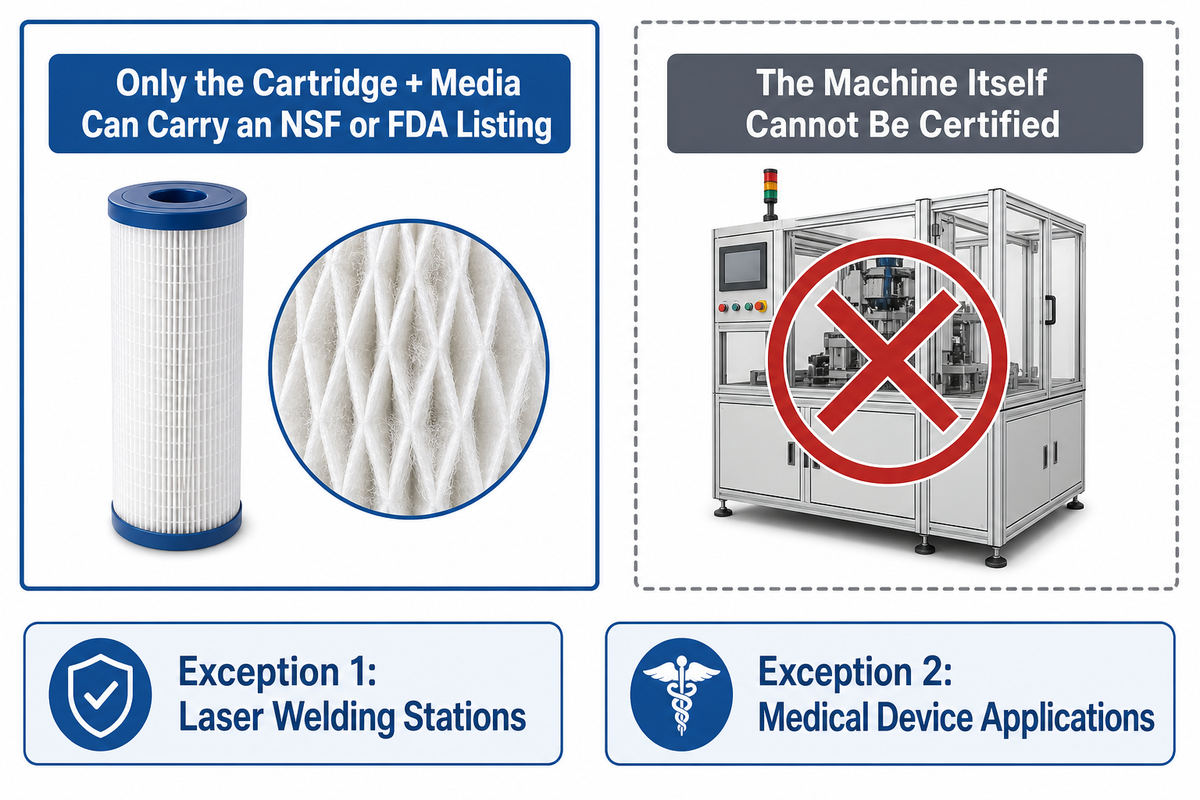
Certification for drinking-water and general filtration applications attaches to the finished cartridge and the media inside it, never to the machine that assembled it. That OEE figure from the previous section describes how the machine runs; it says nothing about whether the machine itself can carry that certification.
This certification boundary is explained in more depth on UDMachine’s CTO activated-carbon line page: a cartridge machine can be sold as capable of producing certifiable cartridges, but it cannot itself hold an NSF or FDA listing. Two further details matter here: NSF is not the only certifier — any accredited body may certify to an NSF/ANSI standard — and certified particulate-reduction claims commonly use the word “nominal,” which is a defined term, not a marketing qualifier.
General comment: two exceptions. The first is laser welding stations. As noted, these can be regulated products under the FDA’s rules on radiation-emitting products — this is a separate certification track from cartridge-filtration certification. The second is medical device and pharmaceutical filter applications. In this case, installation qualification and process validation may be required for the assembly machine, irrespective of whether the cartridge has filtration certification. This is a regulated end-use case that falls outside the general industrial and water filtration scope of this document and would have to be assessed separately.
OSHA and the US food equipment rules add another, related, separate aspect. They impose specific requirements for guards, dust, and cleanability of equipment, yet meeting these requirements doesn’t certify the equipment as meeting the requirements for filtration, and thus doesn’t qualify. It’s a safety and sanitation requirement, not a filtration requirement.
⚠️ Important
If a brochure states that the machine is NSF certified, ask for the listing number and confirm that it is issued to the cartridge or the media, not the equipment. A machine cannot hold that listing. Laser-product certification and medical-device process validation are different, narrower tracks; do not let either one be used to imply a cartridge-filtration certification that does not exist.
US Import and Installation Compliance Checklist
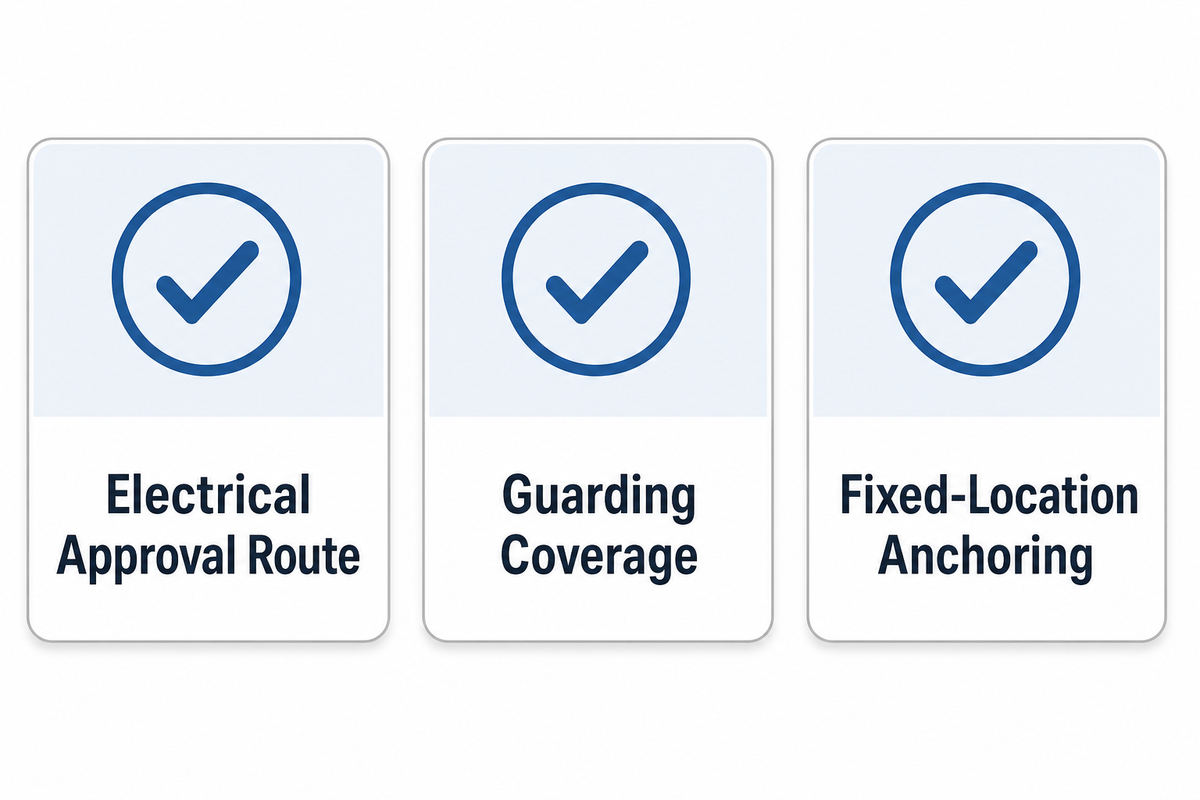
Three items are needed on a purchase order for equipment brought to a US workplace and aren’t found in a typical inspection report of a factory. Acceptable electrical equipment under general industry electrical rules is approved as defined in 29 CFR 1910.399, which in practice resolves to listing by a nationally recognized testing laboratory (NRTL). Hazard guards are required for point of operation, nip point, rotating, and chip and spark hazards as described in 29 CFR 1910.212, and machines intended for a fixed location must be anchored to prevent movement. Whenever a new machine is installed, its energy-isolating devices must be capable of accepting a lockout device.
A CE mark doesn’t satisfy any of this. 29 CFR 1910.303(a) sets the approval requirement, and federal regulation defines acceptable equipment three ways: listed by an NRTL, inspected by an authority enforcing the national electrical code, or — the route most imported custom machinery actually travels — determined safe by the manufacturer on the basis of test data that the employer keeps on file and makes available on inspection. That third route turns what looks like a technical problem into a paperwork problem: get the retained test data in writing before the machine ships, not after an inspector asks for it.
Compliance checklist — copy these into your quote request:
| Parameter | Recommended range | Why it matters | How to verify |
|---|---|---|---|
| Electrical approval route | NRTL listing or retained test data | CE mark alone does not satisfy 1910.303/1910.399 | Request the NRTL mark or the retained test-data package in writing |
| Guarding coverage | Point-of-operation, nip-point, rotating-part, chip-and-spark | Required under 1910.212 for all machines | Physical inspection at FAT against the guarding drawing |
| LOTO provision | Energy-isolating device accepts a lockout device | Required on every new machine install | Confirm the isolator hardware accepts a standard lockout hasp |
| Panel voltage / frequency | Match destination supply exactly | Mismatch is a commissioning delay, not a warranty item | State destination voltage/frequency in the PO line item |
| Fixed-location anchoring | Anchored per 1910.212 for fixed-location machines | Prevents movement-related guarding failure | Confirm anchor points in the installation drawing |
| Counterparty identity | Verify legal entity is the manufacturer, not an unrelated trading intermediary | Limited-control intermediaries can’t commit to FAT or spec changes | Request business license and factory address match |
| Factory Acceptance Test | Equipment stays on factory premises until FAT sign-off | Catches defects before shipment, while schedule slip is still recoverable | Written FAT protocol with pass/fail criteria in the PO |
| Spare-parts list | Written confirmation of routine-wear items (seals, welding tips, sensors) | Stocking decisions depend on knowing what wears vs what fails | Request the list in writing before the machine ships |
| Lead-time margin | Budget beyond the 25-day average delay seen on late deliveries | 45% of a 264-machine sample shipped late | Build schedule float into the installation timeline |
| Merchandise Processing Fee | 0.3464% ad valorem, $34.58-$670.86 band (FY2027) | A separate landed-cost line item, not part of the equipment price | Confirm with your customs broker at quote stage |
CE is an EU instrument; the US electrical acceptance question has its own three routes, and only one of them is usually realistic for custom import machinery.
What to Put in the Purchase Order Before You Pay
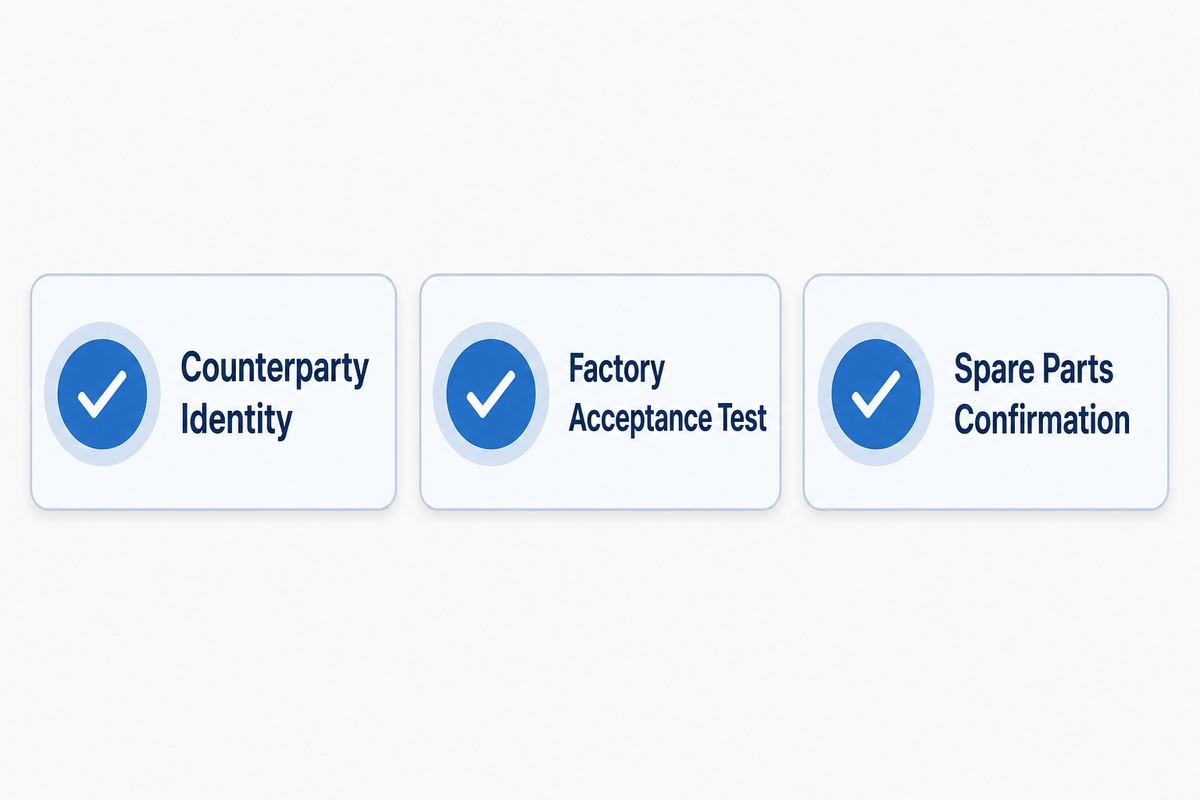
A US international law firm advises that the first consideration when considering a payment to source capital equipment from China is identity of the counterparty. Resolve the deal legal entity and determine if it’s a manufacturer or its related export company. Don’t engage with an intermediary that has limited if any control over production.
Other considerations the firm names, in order, include: testable specifications; demanding that the equipment remain on the factory premises until a Factory Acceptance Test; reserving payment to the manufacturer until after the tested equipment ships; arranging import and installation requirements before production of the equipment begins; confirming which spare parts, software, and documentation will keep the equipment running later; and agreeing what happens if the manufacturer defaults.
First, contact the brand directly on which parts they consider routine replacements (seals, welding tips, and sensors) and ask for written confirmation of replacement cartridge parts. The same consideration should be taken in the case of the filters that the line itself manufactures: know the list of items which will eventually wear out (and not fail) to ensure spares are stocked prior to failure. The same 14-field RFQ matrix used to configure the line also documents which parts the supplier classifies as routine wear items.
You should know the limitations of platforms’ protections. For example, with Alibaba’s Trade Assurance policy, standard accounts have 30 days from delivery to submit a refund request, while Enterprise and Enterprise Pro accounts get 60 days. Thirty days can quickly pass when you consider a piece of equipment that still has to be installed, and put into service under operational conditions to gauge its performance before a defect surfaces.
Lead time is its own risk category, and is documented in a Georgia Tech industrial engineering capstone on the delivery of built-to-order machines: for 264 machines made by one manufacturer since the end of 2022, 45% were delivered late, with an average delay of 25 days. The same capstone states its breakdown of delay causes twice, and the two sections contradict each other in terms of the ranking of causes. That discrepancy is worth flagging: treat these percentage breakdowns as an ordering of likely causes, not exact figures, and build a margin of safety into your schedule regardless of which number you started with.
One more line item belongs in the cost side of the purchase order, separate from the equipment price: the US Merchandise Processing Fee stays at an ad valorem rate of 0.3464%, with an FY2027 band running from a minimum of $34.58 to a maximum of $670.86, effective October 1, 2026, per US Customs and Border Protection’s published notice.
45%
of 264 sampled built-to-order machines delivered late
25 days
average delay on those late deliveries
30 days
Alibaba’s standard refund window from delivery
The purchase price represents the cost to obtain the machine, and doesn’t represent the cost to own the machine.
The Dedication Test: When a Dedicated Line Is Not Worth It
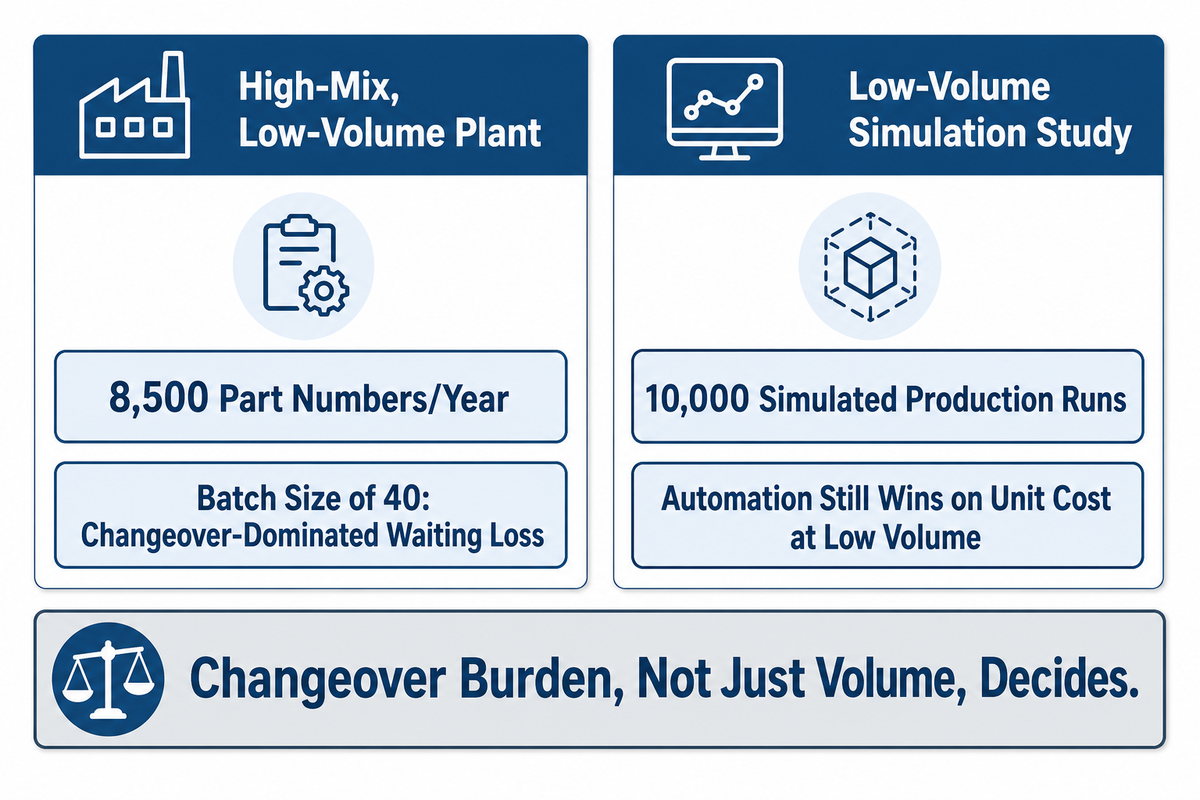
Changeover burden is what makes dedicated automation a poor choice for some plants, not just high volume. That ownership cost from the purchase-order math in the previous section shows up most directly in changeover time, which is exactly what this gate weighs. NIST’s own workshop report on manufacturing automation notes that small batches, including single batches, mean quick turnaround and reprogramming, and that a number of product variants against limited capital can make dedicated automation financially and structurally unsound. One 2024 peer-reviewed study at an operating high-mix, low-volume plant running roughly 8,500 part numbers a year at an average batch size of 40 found the same pattern directly: product variation made changeovers the primary source of waiting loss, and cellular, flexible processing outperformed a single dedicated machine on that specific shop floor.
This isn’t always the case. Saying it is would be misrepresenting the data. However, a separate 2024 simulation study, which looked at 10,000 production runs, showed that, even for low production runs, most of the automation choices would still result in lower unit costs compared to manual production. In the end, the economics are specific to the situation. There’s no point in setting a universal volume threshold. The factors that define the best approach are specific to your situation due to product-family count, tooling reuse, and the cost of labor. Run the OEE method on your numbers from the automation section before making your decision.
The Dedication Test. To receive a formal quote for automated dedicated equipment, answer these three questions: how many product families must one station run without a hardware change; what’s the changeover burden compared to total run time in your actual batch size; and what’s the binding constraint, availability of capital or flexibility of production? One published two-station infrared end-cap welder datasheet lists 15kW connected load on a 380V, 50Hz three-phase supply — supply voltage and connected load vary by builder and by destination, so state your site’s actual voltage and frequency in the purchase order line item (see the compliance table above) rather than assuming that figure. The growth in low-volume lines doesn’t automatically represent a “Stay Manual” case as noted in the simulation above. Size your line based on today’s output and reassess when the actual volume changes.
✔ Advantages of staying manual/semi-automatic
- Lower capital exposure while product mix is still settling
- Changeover time stays low across many families
⚠ Limitations of staying manual/semi-automatic
- Unit cost may still lose to automation even at lower volumes — confirm with your own OEE numbers, not a rule of thumb
- Labor cost per unit doesn’t fall the way it does on an automated line as volume rises
Why We Write This
UDMachine builds PP melt-blown, CTO activated-carbon, and string-wound filter cartridge production lines, and fields the same assembly-and-finishing questions from buyers evaluating a dedicated end-cap welding station for the first time. This document captures the questions on joining method, certification scope, and import compliance most often asked before configuring a matrix. The research for this document includes the Pall end-cap welding patent and the US import compliance citations.
Q: What is a filter assembly?
A filter assembly is the complete cartridge unit — media, core, end caps, and any gasket or adapter — built to fit a specific housing or application.
This guide covers the equipment needed to assemble and finish a unit. Media is joined in a cylinder, end caps are sealed on, and the finished unit is ready for testing or packing. The final assembly of different types of filters (pleated, string-wound, melt-blown) is similar, yet the components are different. Even though all three are filter assemblies, and all three become replacement filters, the assembly process is different.
Q: How much does a filtration assembly cost?
There is no single number — cost depends on automation tier, joining method, product-family count, and compliance scope, and it depends on total cost of ownership, not just the sticker price.
Manual or semi-automatic equipment, which may use either adhesive or mechanical joining, is less capital intensive than a fully automated thermal-fusion line. The total cost of ownership is the purchase price of the machine, tooling for each product family, FAT and acceptance testing, spare parts and documentation, and the import compliance items discussed previously.
As noted in the purchase order section, the purchase price tells you the acquisition cost of the machine only. The total cost of ownership will be significantly more.
Q: Who is the largest filtration company in the world?
There is no single “largest” by every measure — Donaldson, Pall (a Danaher company), Eaton, MANN+HUMMEL, Camfil, and Freudenberg Filtration Technologies are commonly named among the largest global filtration manufacturers.
Pall’s 1995 spin-welding patent is cited earlier in this guide; the patent itself is long past its term, but the spin-weld mechanism it documents is still a live reference point for joining-route selection. None of these companies sells the assembly and finishing machinery discussed in this guide as a catalog product — they build cartridges and media, and any assembly technology they develop (such as Pall’s end-cap patent above) stays in-house rather than going to market as a standalone machine.
Q: How is a filter cartridge end cap sealed?
By adhesive potting, mechanical retention, or thermal fusion (ultrasonic, hot-plate, infrared, laser, or spin welding) — the choice is driven by the material pair and service conditions, not by a default house process.
See the joining-route table above.
Q: Can one assembly line handle more than one cartridge size or filter family?
Sometimes, within a tooling-defined range, but size range alone does not guarantee fit — component materials, cap geometry, joining route, and changeover target all have to be compared.
This answers the same question the automation-tier and decision-framework sections earlier in this report address with respect to throughput and changeover time. It is important that you treat each product family separately in the quote request in case a single station does not fit every product family of your offering.
References & Sources
- ISO 12100:2010, Safety of Machinery — General Principles for Design International Organization for Standardization
- AWS G1.1M/G1.1:2006, Guide for the Welding of Thermoplastics American Welding Society
- US Patent 5,472,537, End Capped Fibrous Filter Making Pall Corporation, via Google Patents
- ASTM F316-03(2019), Standard Test Methods for Pore Size Characteristics of Membrane Filters by Bubble Point and Mean Flow Pore Test ASTM International
- Radiation-Emitting Product Performance Standards FAQ U.S. Food and Drug Administration
- 29 CFR 1910.303, Electrical General Requirements U.S. Department of Labor / eCFR
- 29 CFR 1910.399, Definitions Applicable to Electrical Standards U.S. Department of Labor / eCFR
- 29 CFR 1910.212, General Requirements for All Machines Occupational Safety and Health Administration
- Industrial Engineering Capstone, Built-to-Order Machine Delivery Time Georgia Institute of Technology
- Buying Expensive Equipment from China: Seven Questions to Answer Before You Pay Harris Sliwoski LLP, China Law Blog
- Merchandise Processing Fee Notice, CBP Dec. 26-14 U.S. Customs and Border Protection
- Overall Equipment Effectiveness Implementation Guide University of Tennessee Manufacturing Extension Partnership
- Peer-reviewed comparison of OEE benchmarking practices SAGE Journals
- NIST IR 7940, Manufacturing Automation Workshop Report National Institute of Standards and Technology
- High-mix, low-volume manufacturing changeover study, 2024 PLOS ONE
- Simulation-based automation unit-cost study, 2024 Springer, Production Engineering
Configure Your Assembly & Finishing Line →
Ready for a quote? UDMachine’s assembly & finishing equipment configuration page takes you through the 14-fields of the RFQ matrix for your cartridge, joining route and line.
Reviewed by the engineering team of Suzhou UDTECH Technology Co., Ltd.