Get in touch with Suzhou UDTECH Technology Co., Ltd. Company

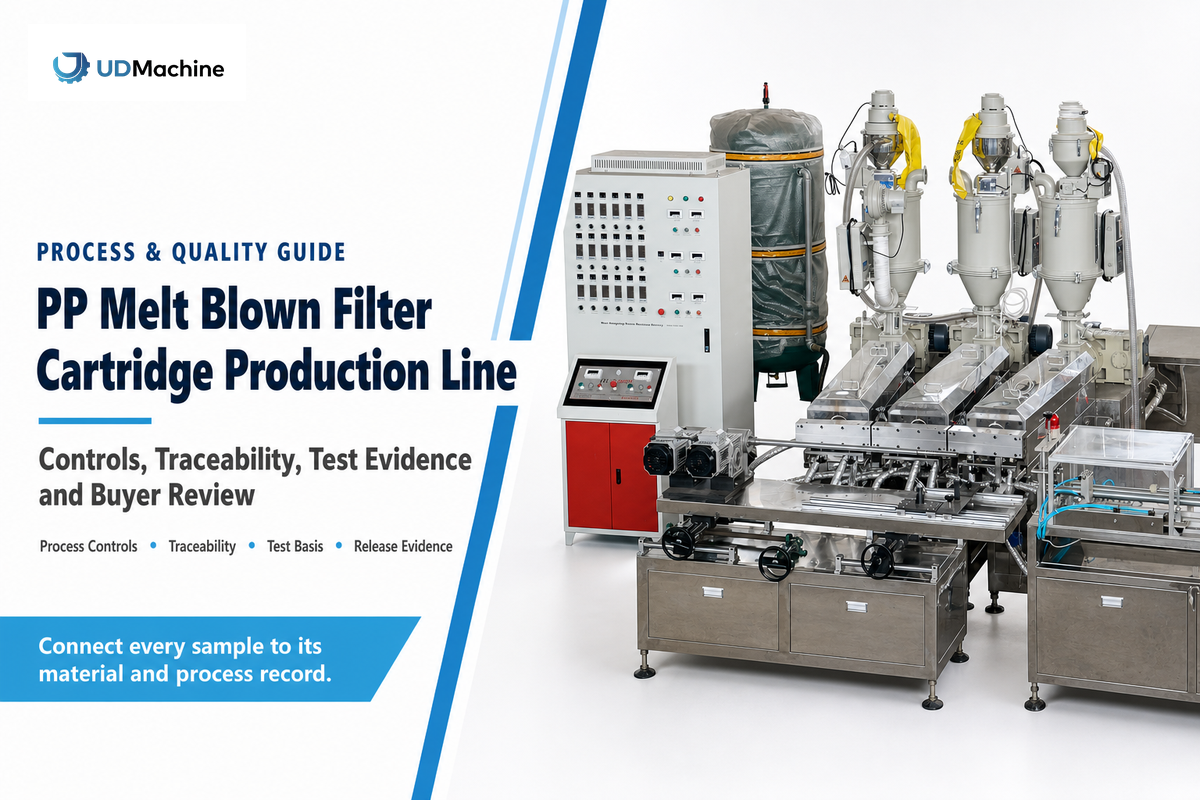
A PP melt blown filter cartridge production line is a manufacturing system that turns a documented polypropylene input into a tubular liquid depth-filter element. Process controls and other acceptance criteria (e.g. tests and inspections) must be performed in order to determine if a cartridge is released. Production or operation of a cartridge doesn’t necessarily establish that the cartridge is released. In the absence of that critical link, an unrelated third-party report or a study of flat air media can’t validate a finished lot of liquid-filter cartridges.
Updated September 2026. Published by XCX for Suzhou UDTECH Technology Co., Ltd.
Bottom line: A credible line converts a controlled PP input into a repeatable cylindrical liquid depth cartridge, but machine motion alone cannot prove micron performance. Buyers should audit 7 control points, normalize capacity claims, and require a resin-to-release evidence chain.
TL;DR
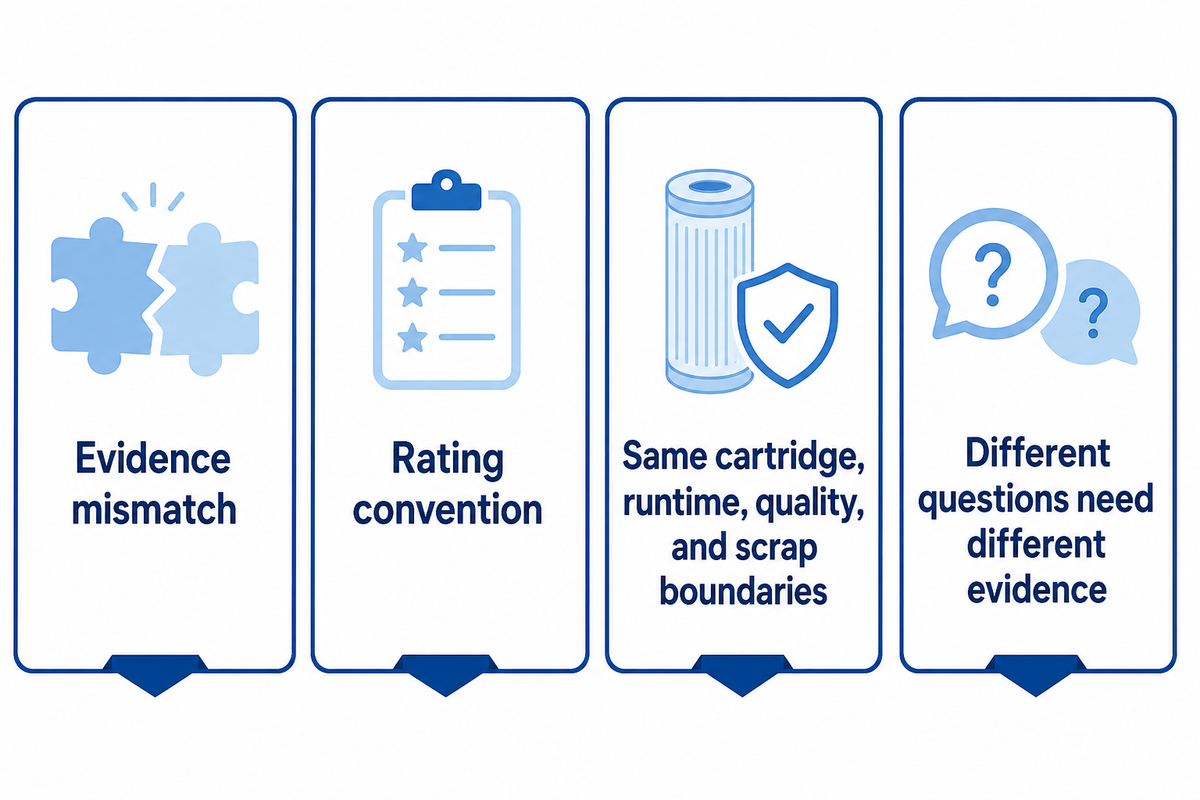
- The least obvious risk is evidence mismatch: research on flat electret air media doesn’t validate a cylindrical liquid filter cartridge.
- A micron number needs a rating convention, challenge method, flow condition, product geometry, and efficiency or retention result.
- Capacity comparisons become useful only after both suppliers use the same cartridge, runtime, quality, and scrap boundaries.
- FAT, a material process trial, finished-product testing, and site commissioning answer different questions.
Quick audit scope
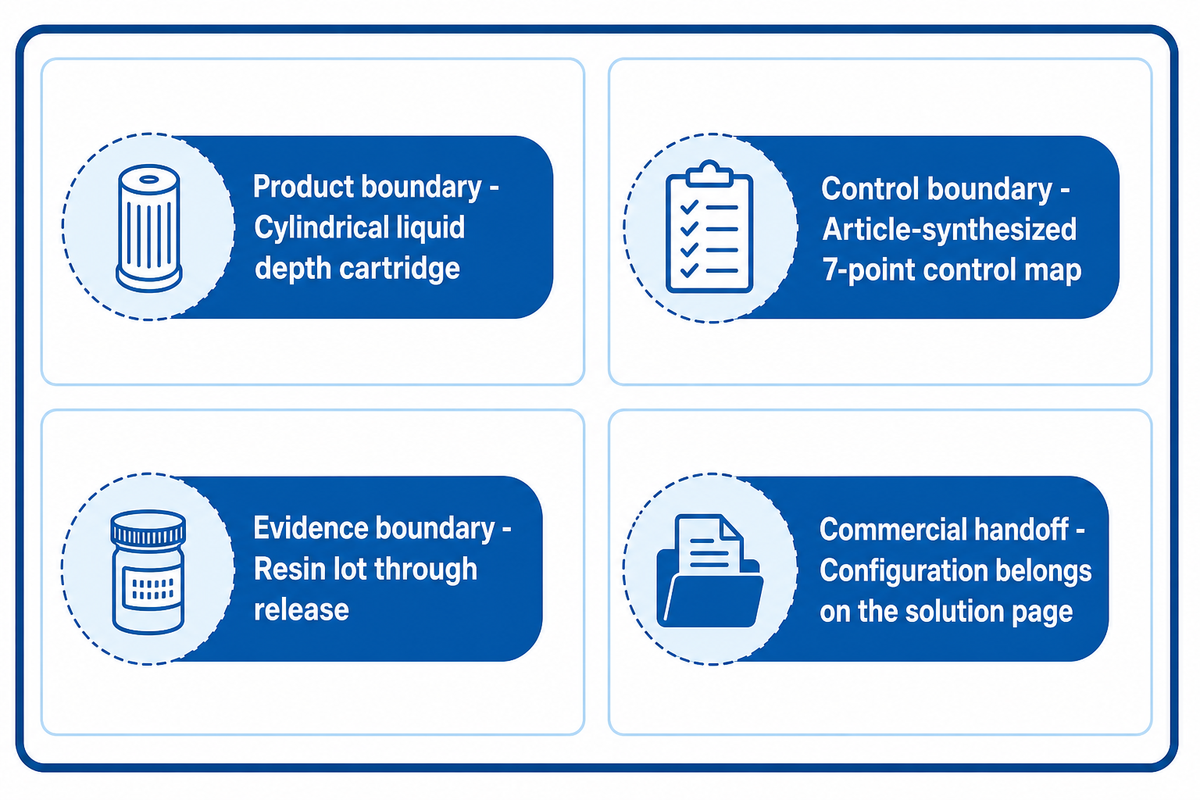
Product boundary
Cylindrical liquid depth cartridge
Cylindrical liquid depth cartridge
Control boundary
Article-synthesized 7-point control map
Article-synthesized 7-point control map
Evidence boundary
Resin lot through release
Resin lot through release
Commercial handoff
Configuration belongs on the solution page
Configuration belongs on the solution page
What a PP melt blown filter cartridge production line does
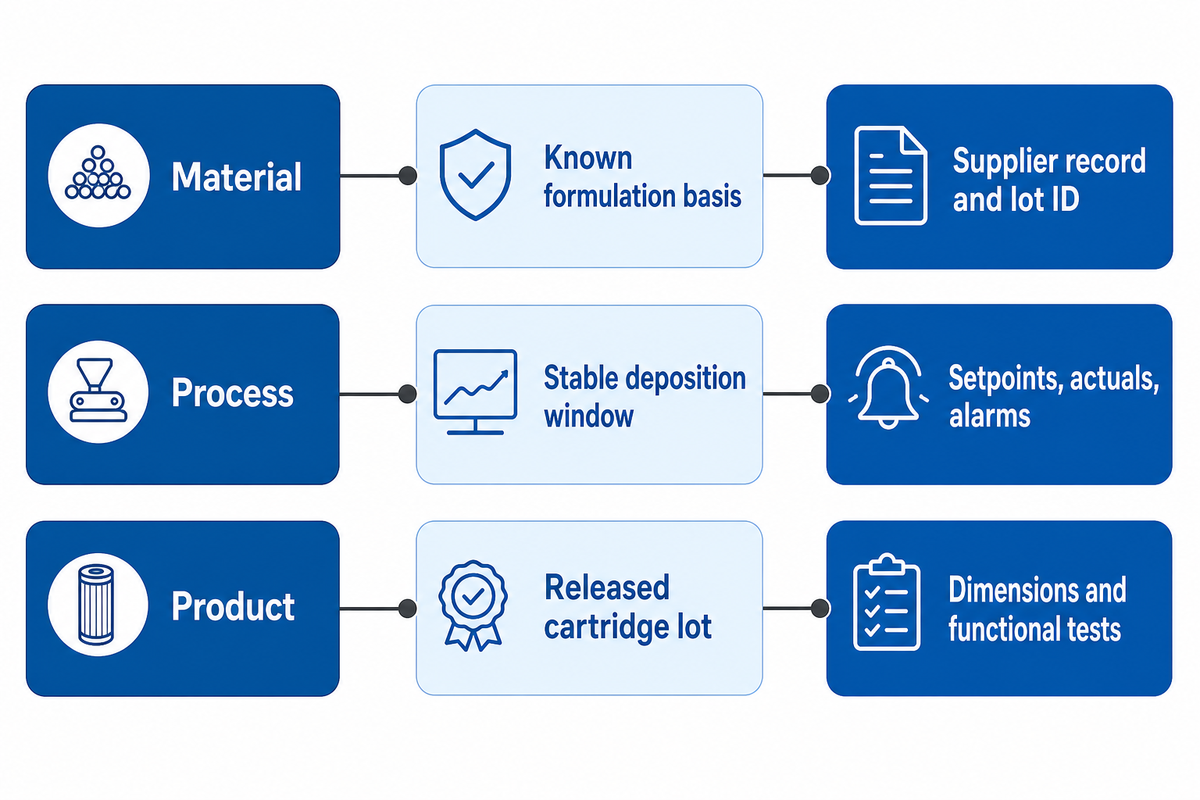
A PP melt blown filter cartridge production line turns a documented polypropylene input into a tubular liquid depth-filter element. The process sequence melts and meters the polymer, attenuates it into fibers, deposits those fibers on a rotating collector, cools the tubular structure, and cuts it to length. A defined test program assesses whether sampled cartridges meet the agreed filtration requirements.
Scope boundary: Buyers may call this equipment a melt blown filter cartridge machine, filter making machine, making machine, or PP spun filter line; “meltblown” is an alternate spelling. This guide covers cylindrical cartridges for liquid filtration. Flat electret media for masks or air filtration can involve charging and aerosol tests that do not transfer to a liquid cartridge.
| Lane | Starts with | Controlled result | Evidence to retain |
|---|---|---|---|
| Material | PP resin lot | Known formulation basis | Supplier record and lot ID |
| Process | Approved recipe revision | Stable deposition window | Setpoints, actuals, alarms |
| Product | Defined geometry | Released cartridge lot | Dimensions and functional tests |
A production line operating continuously for a long duration doesn’t confirm that cartridges produced during that operation are acceptable to the buyers. The bounds of continuous operation must be established by the buyers.
From PP resin to a finished cartridge
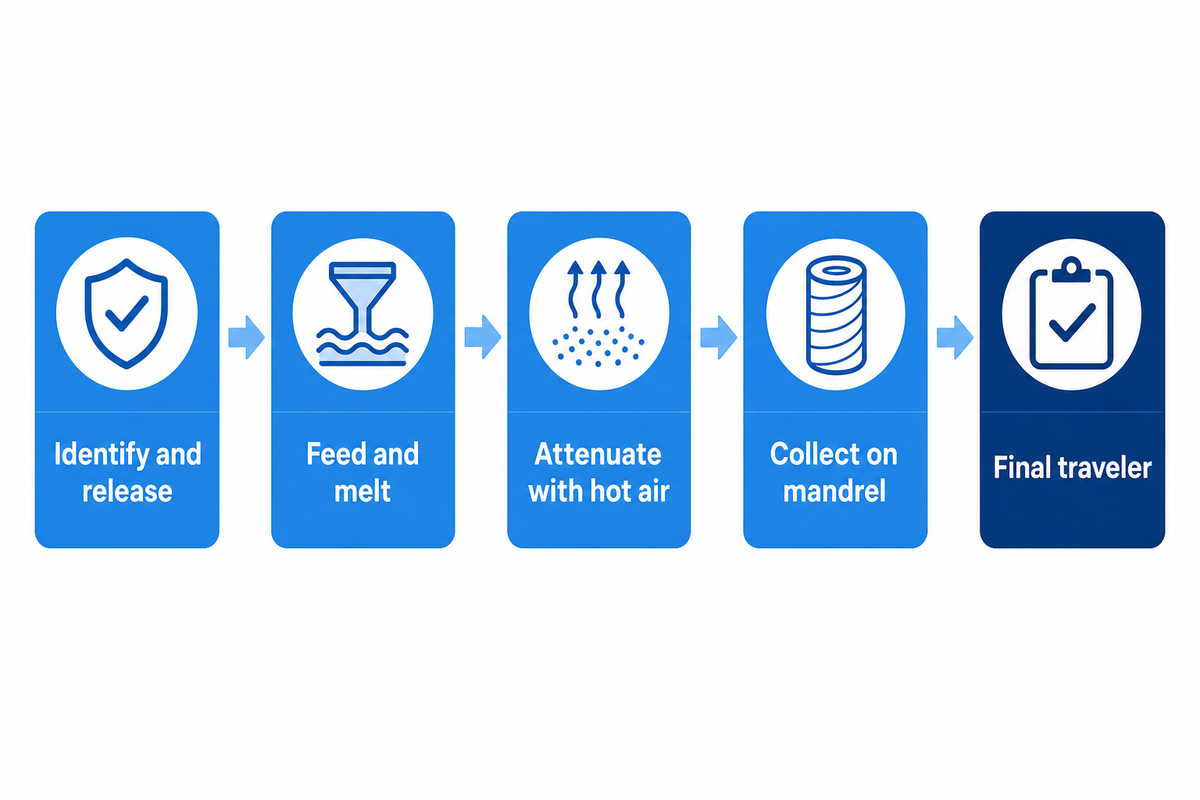
Filter cartridges are made through a manufacturing process that feeds and melts PP material, meters it through the die, uses high-speed hot air to attenuate the melt into filter media, then cools and cuts the tube; where specified, finishing can include a thermal bonding process. Records must keep every step tied to the same resin lot and recipe.
| Step | Input | Action | Observation | Record |
|---|---|---|---|---|
| 1 | Resin delivery | Identify and release | Lot and condition | Incoming record |
| 2 | Released raw material | Feed and melt | Load and thermal stability | Trend log |
| 3 | Polymer melt | Meter through die | Flow balance | Recipe actuals |
| 4 | Melt streams | Attenuate with hot air | Fiber formation | Air and temperature trend |
| 5 | Fiber stream | Collect on mandrel | Build and surface | Motion trace |
| 6 | Warm tube | Cool and stabilize | Shape retention | Cooling condition |
| 7 | Continuous tube | Cut to defined length | Ends and dimensions | Inspection result |
| 8 | Cut element | Finish if specified | Assembly condition | Final traveler |
The continuous cartridge apparatus study focuses on the mechanical movement of the apparatus and describes structural outputs. It does not create a formula that other melt blown filter machines can use. The 2023 apparatus study mentions a collector distance of 30 cm, a rotation speed of 40 RPM, a linear speed of 10 mm/s in the forward direction and 80 mm/s in the return direction, a forward interval of 40 s and a return interval of 5 s, a cycle time of 47 s, alternation of 23.5 s, a distance band of 20-25 cm and 25-30 cm, and a collector speed band of 1500-1800 RPM and 1700-1900 RPM. These observations are specific to the study and not settings provided by UDTECH.
Common mistake: Treating the extruder, die, and collector as separate equipment islands. Process drift at Step 2 can appear later as an apparent collection or cutting problem, so the investigation must retain the complete time sequence.
Buyer objection: A video can’t demonstrate the identity of the materials used, show process trends, or identify the output that was rejected or the test criteria. The evidence needed to show these should be contained in the supporting documents.
7-Control-Point Line Audit
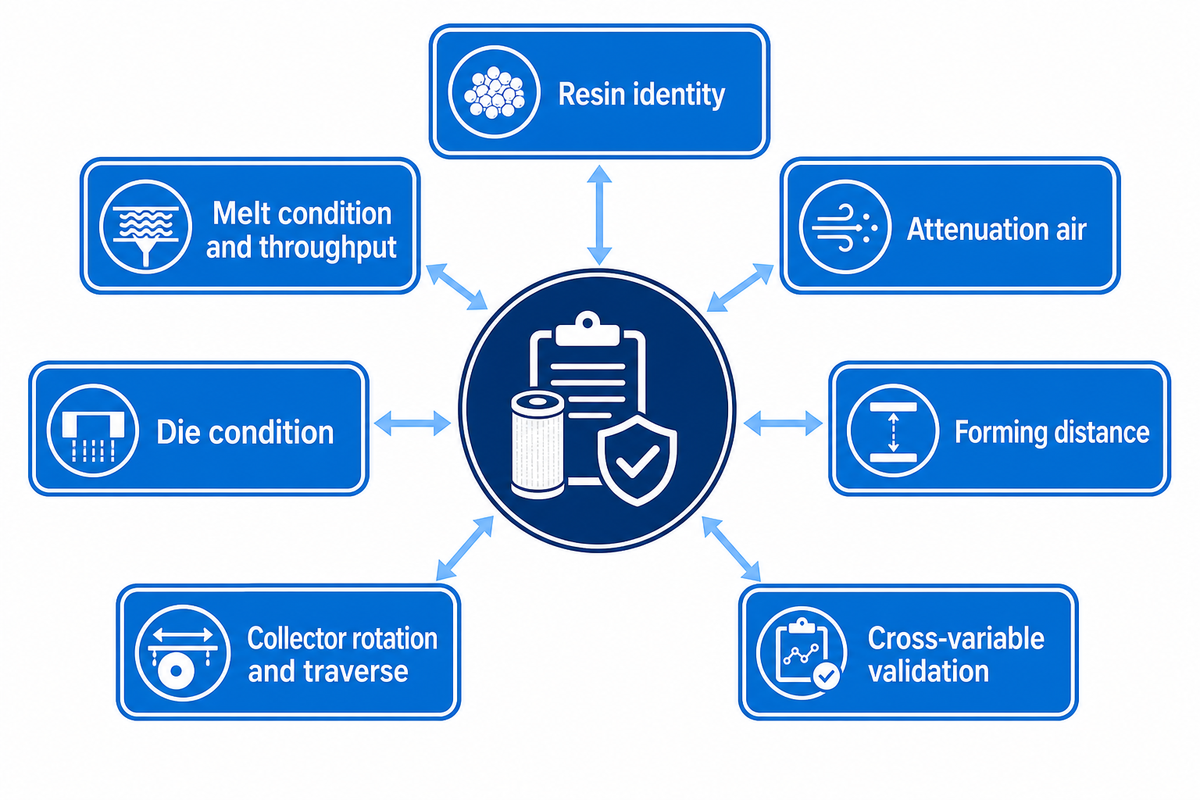
This article synthesizes interacting process variables to create the Seven-Control-Point Line Audit. Each group in the synthesis defines the evidence needed to show the interaction of a process control variable and result of a sampled cartridge. The last table in the article also shows diagnostic lines.
The interacting controls in the synthesis are: the state of the resin; the state of the melt; attenuating air; the state of the die; forming distance; rotation and traverse of the collector; and cross validation of controls. Buyers should align their records to a time line to show interaction of the controls and show deviation of the controls to results of sampled cartridges.
| Audit line | Control point | What may move | Evidence | Limitation / not suitable for |
|---|---|---|---|---|
| 01 | Resin lot | Melt response | Lot ID and release | Cannot prove finished filtration |
| 02 | Melt window | Viscosity and stability | Zone actuals | No universal setpoint |
| 03 | Throughput | Mass delivery | Stable-run trend | Headline rate hides rejects |
| 04 | Hot air | Fiber attenuation | Temperature and flow | Air-media results do not transfer |
| 05 | Die and nozzle | Flow distribution | Inspection and cleaning | Time interval alone proves little |
| 06 | Forming distance | Collection condition | Setup and change record | Patent examples are not recipes |
| 07 | Rotation | Wall build | Axis actual and alarm | Speed alone cannot set rating |
| 08 | Traverse | Axial distribution | Position trace | Must match collector geometry |
| 09 | Interaction review | Combined response | Recipe revision and trial | Requires product testing |
U.S. patent record US4925601A cites strategies that modify airflow and forming distance in order to adjust bulk and permeability of filter-type materials. It’s also noted that values for a given resin and product can’t be extrapolated to other products.
Illustrative failure investigation: One shift sees a heavier wall near one end of the tube. Raising traverse speed may mask the weight pattern while leaving melt delivery or nozzle distribution unresolved. Better review aligns the 7 control records on one timeline, identifies the first deviation, then tests samples from before, during, and after the event. The scenario is a diagnostic method, not a claim about one supplier’s machine.
PLC programs can be saved and repeated, however saved programs don’t guarantee control over the process.
How line settings become filtration behavior
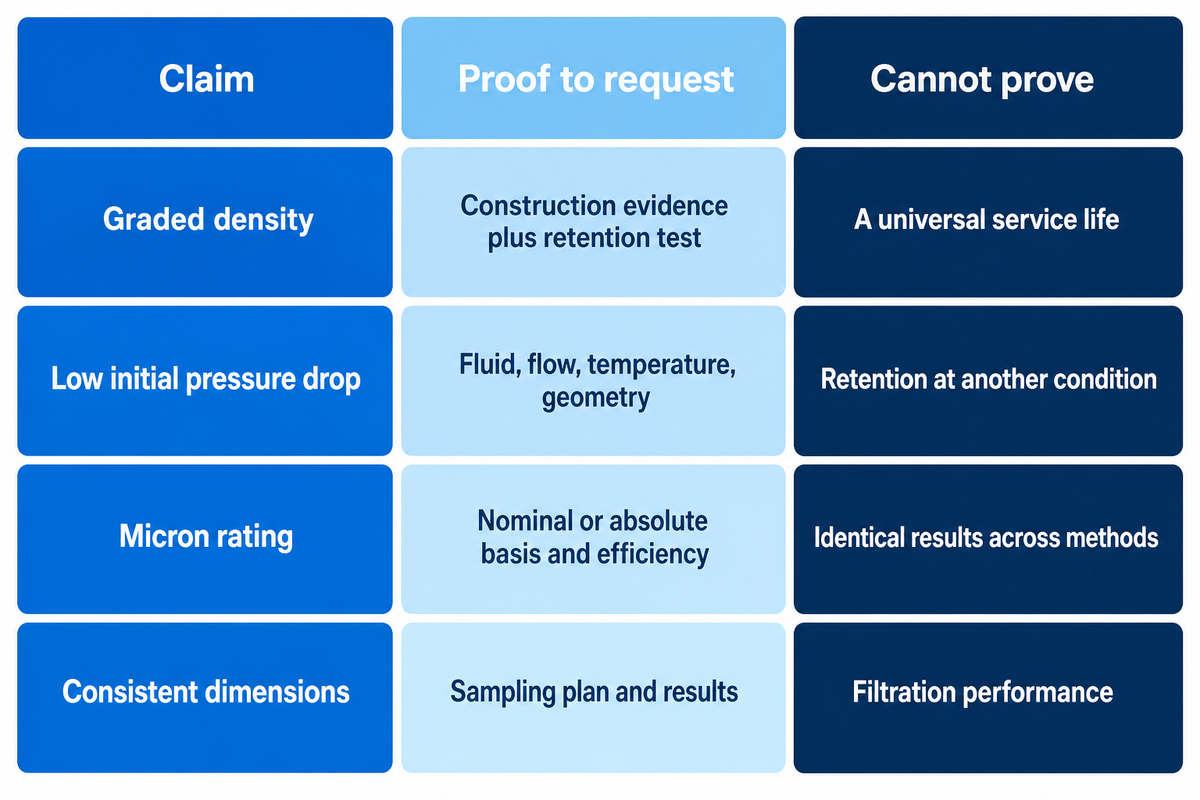
Density and void structure affect initial differential pressure, loading, and the contaminants retained. What a filter cartridge offers must match stated filtration needs, because various industries may involve larger particles, different fluids, and different filtration processes. Graded density can shape the retention medium, but the test method and conditions must be disclosed; appearance, weight, and labels alone do not establish retention efficiency.
| Claim | Plausible mechanism | Proof to request | Cannot prove |
|---|---|---|---|
| Graded density | Coarser outer and finer inner structure | Construction evidence plus retention test | A universal service life |
| Low initial pressure drop | Open initial flow path | Fluid, flow, temperature, geometry | Retention at another condition |
| Micron rating | Particle-size classification | Nominal or absolute basis and efficiency | Identical results across methods |
| Consistent dimensions | Repeatable collection and cutting | Sampling plan and results | Filtration performance |
What does micron rating mean for a melt-blown cartridge?
Micron rating is size-based, but becomes decision-ready only when the supplier discloses the achieved capture percentage, challenge method, flow condition, and test conditions. Advertised melt blown filter features don’t prove a defined retention result. A technical filter-rating discussion offers an example where the same size-based rating may represent different efficiencies.
Common mistake: Approving a water filter cartridge because its surface looks fine and its weight is on target. Those checks can catch construction drift, but only a defined functional test answers the retention question.
Two samples labeled “5 micron” require method, efficiency, challenge material, flow, geometry, and lot identity before a supplier can define them as equivalent. A cartridge filter used in various industries may face different fluids and larger particles, so filtration processes and test methods are not interchangeable; what a filter cartridge offers must be stated as a method-bound result.
Resin-to-Release Evidence Chain
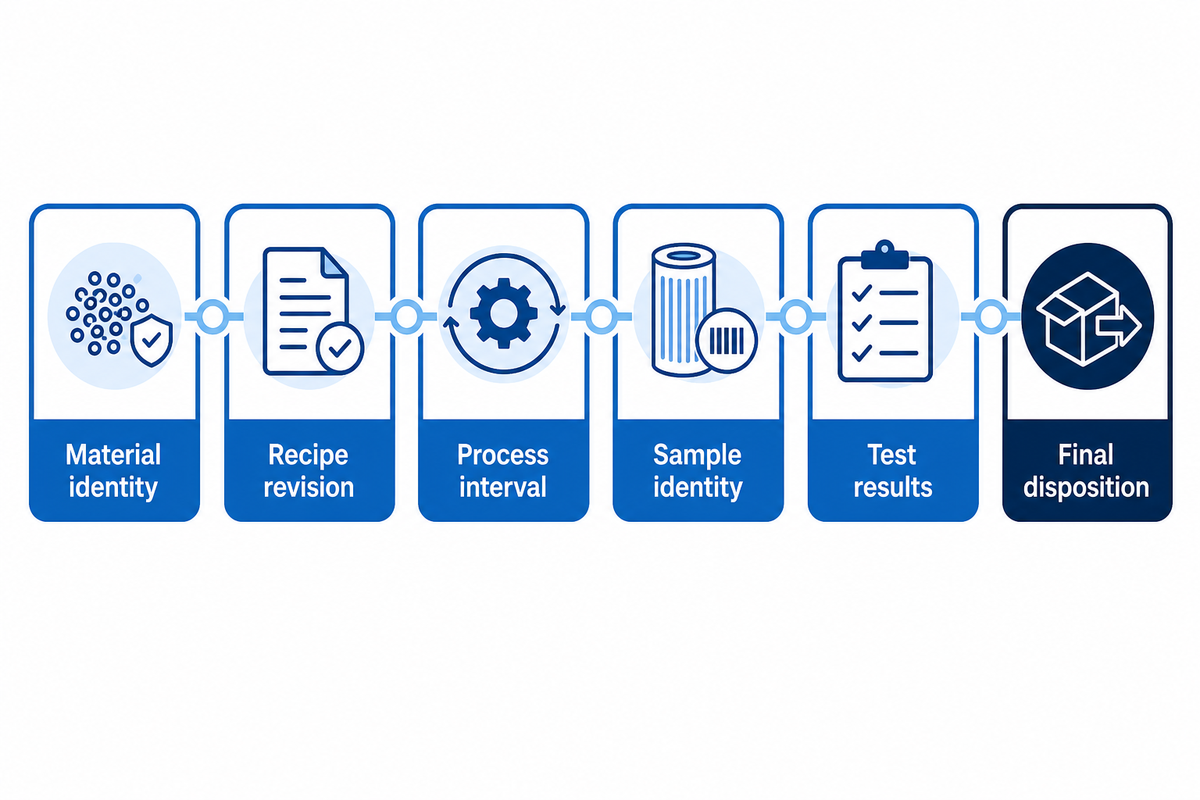
Resin-to-Release Evidence Chains link a material lot to its recipe, samples, test results, and the lot’s final disposition. Users of the Chain may identify samples pertaining to the process under review, but should test whether each sample belongs to the claimed process interval before relying on the final lot-release decision.
The Evidence Chains highlight omissions in the sampling and testing functions of quality control, and allow the investigator to identify sampling and testing pull points where linkage in the Chain hasn’t been established. The Chains should be developed based on the requirements of the product and the test method rather than based on the judgment of the investigator.
| Chain row | Evidence object | Owner | Release question | Limitations / not suitable for |
|---|---|---|---|---|
| 01 | Material identity | Receiving | Correct lot released? | Does not approve end use |
| 02 | Recipe revision | Process engineering | Correct revision loaded? | Command is not actual condition |
| 03 | Startup record | Operator | Stable state declared? | Needs defined criteria |
| 04 | Process trend | Line control | Deviations contained? | Sampling rate matters |
| 05 | Geometry and mass | Quality | Construction accepted? | Not a retention result |
| 06 | Surface review | Quality | Visible defects contained? | Hidden structure remains unknown |
| 07 | Pressure-drop test | Test function | Flow behavior accepted? | Condition-specific result |
| 08 | Retention test | Test function | Rating basis met? | Method-specific result |
| 09 | Lot disposition | Authorized reviewer | Release, rework, or hold? | Authority must be defined |
Process instability can lead to shifts in differential pressures. Using the Evidence Chain, the reviewer can determine the lots affected and samples to be retrieved.
Practical connection: The site’s guide to polypropylene inputs for melt-blown cartridges helps define the material side of this chain, while the gradient density cartridge guide explains the construction claim that still needs test evidence.
In supporting a contractual obligation, a supplier may protect its process set points, and thereby its confidential process, while establishing and maintaining control of the process and the output in a manner that’s Traceable to the Contract.
How to normalize production evidence without comparing machine offers
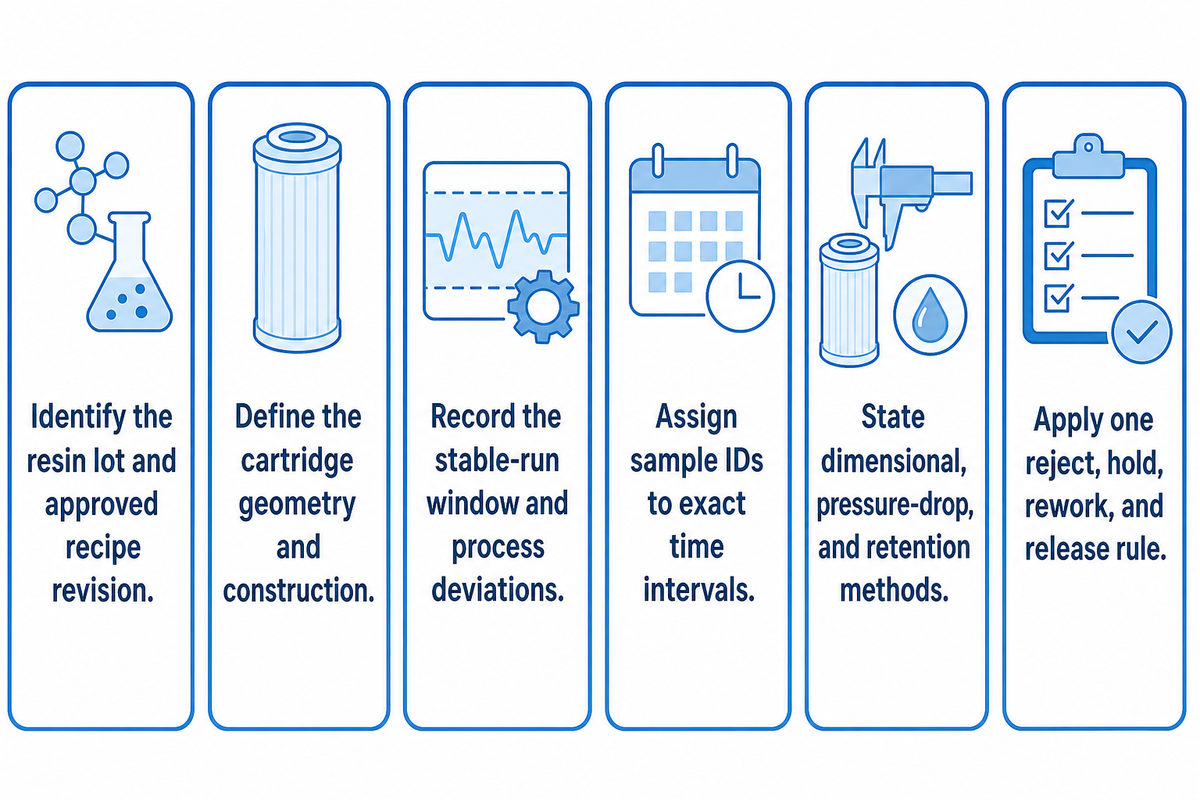
Production evidence is only comparable when records are produced under the same control of materials, product dimensions, sampling scheme, test method and disposition rule. This section won’t address comparisons for line capacity, utilities, models and prices. These will be addressed in the solution. Rejecting a client’s gross output claim will help protect the integrity of the statistic by preventing it from being mistaken for proof of repeatable cartridge quality.
Production-evidence normalization card
- Identify the resin lot and approved recipe revision.
- Define the cartridge geometry and construction.
- Record the stable-run window and process deviations.
- Assign sample IDs to exact time intervals.
- State dimensional, pressure-drop, and retention methods.
- Apply one reject, hold, rework, and release rule.
Illustrative 11-field evidence worksheet
The examples that follow are illustrative audit entries and don’t represent UDTECH limit setting values, specifications, or permissives.
| Evidence field | Example A | Example B | Review decision |
|---|---|---|---|
| Resin lot | Lot PP-01 | Not recorded | Traceability gap |
| Recipe revision | Rev. 3 | Current recipe | Require revision ID |
| Stable-run window | 8 hours | Not defined | Set one clock |
| Sample interval | Every 1 hour | End sample only | Expose time gaps |
| Cartridge length | 250 mm | 250 mm | Product basis aligned |
| Outer diameter | 60 mm | 63 mm | Do not combine results |
| Mass record | Per sample | Shift average | Retain raw values |
| Pressure-drop method | Method stated | Pass only | Request conditions |
| Retention basis | Method and efficiency | 5 micron label | Label is insufficient |
| Reject disposition | IDs and cause | Removed | Require traceable reason |
| Release approval | Named reviewer | Automatic | Define authority |
One trial record demonstrates traceability by including the resin lot, stable interval, sampled cartridges, test method, and disposition. The other record shows only gross pieces collected over a 24-hour period. Although the latter record may show a larger headline number, it can’t demonstrate consistent cartridge quality.
Cost-effective claims warrant case-by-case justification and a defined total cost of ownership (TCO).
Commercial boundary: Line sizing, utility loads, model selection, quoted output, and witnessed machine acceptance belong in the PP melt-blown filter cartridge production line solution. For adjacent cartridge technologies, the broader filter cartridge production line overview serves as the parent directory, not as the specification source for this PP guide. The site’s production capacity basis checker and production line scope readiness checker can prepare those commercial inputs.
Why machine demonstration is not finished-cartridge proof
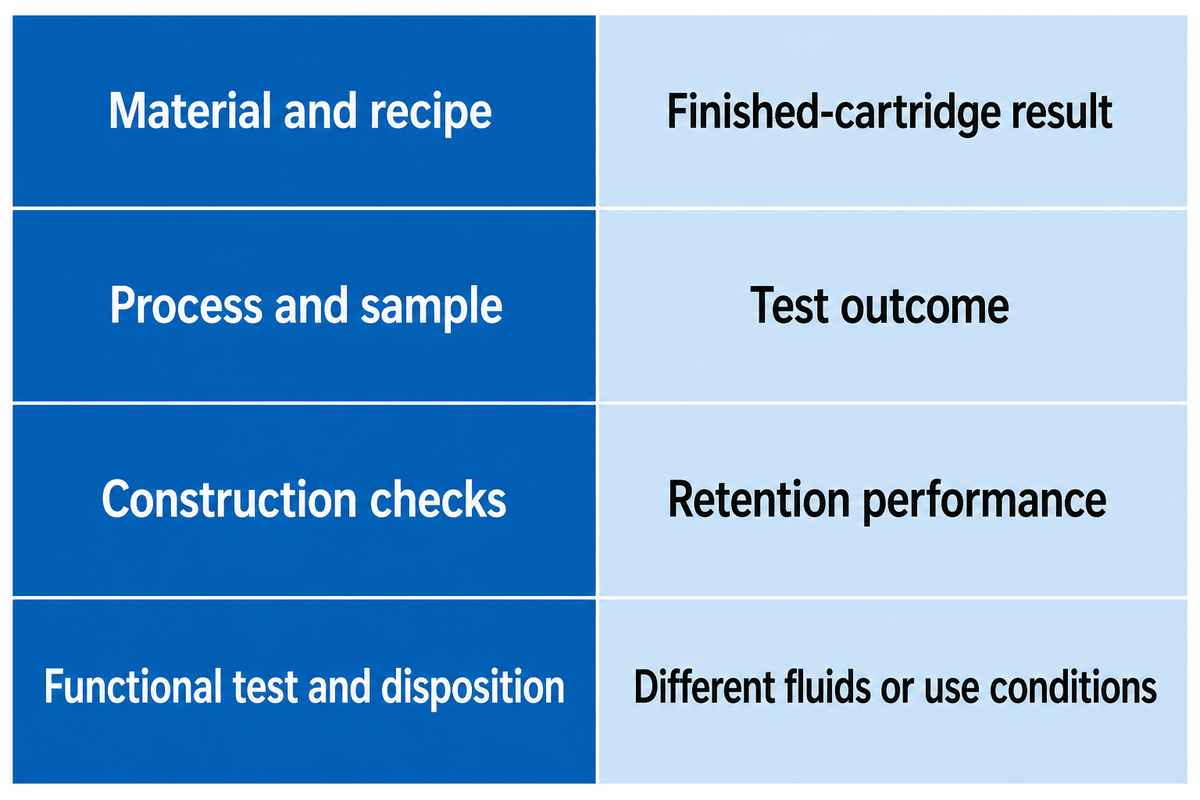
Machine demonstrations can show visible operation, but finished-cartridge quality needs its own evidence chain. Buyers should connect the process record to construction checks, functional tests, and a traceable disposition. This keeps a successful motion sequence from being misreported as proof of filtration performance.
| Evidence layer | Primary question | Required record | What remains open |
|---|---|---|---|
| 1. Material and recipe | Which input and revision ran? | Lot ID, recipe ID, actuals | Finished-cartridge result |
| 2. Process and sample | When was each sample made? | Time window, trends, sample IDs | Test outcome |
| 3. Construction checks | Does the sample match its defined build? | Geometry, mass, visible condition | Retention performance |
| 4. Functional test and disposition | Did the sample meet the stated method? | Conditions, results, reviewer decision | Different fluids or use conditions |
Records of process trials must show information including the resin lot, the basis for the product, stable run definition, sample location, sample retention, measurement systems, test methods, and responsibilities, and disposition. FAT and commissioning records, process utility system settings, and commercial acceptance remain separate project documents on the solution-page side of the boundary.
Illustrative quality decision: A line makes visually uniform cartridges, but the planned retention test is unavailable. The honest disposition is “construction checks complete; filtration result open,” with retained sample IDs, test owner, due condition, and consequence. Marking the whole project accepted would erase the exact condition the buyer still needs answered.
Deferred testing is controlled by the remaining open items, the owner of those items, prerequisites, testing on a pass basis, the due condition of those items, and any corrections.
Material, safety, and compliance boundaries buyers should verify
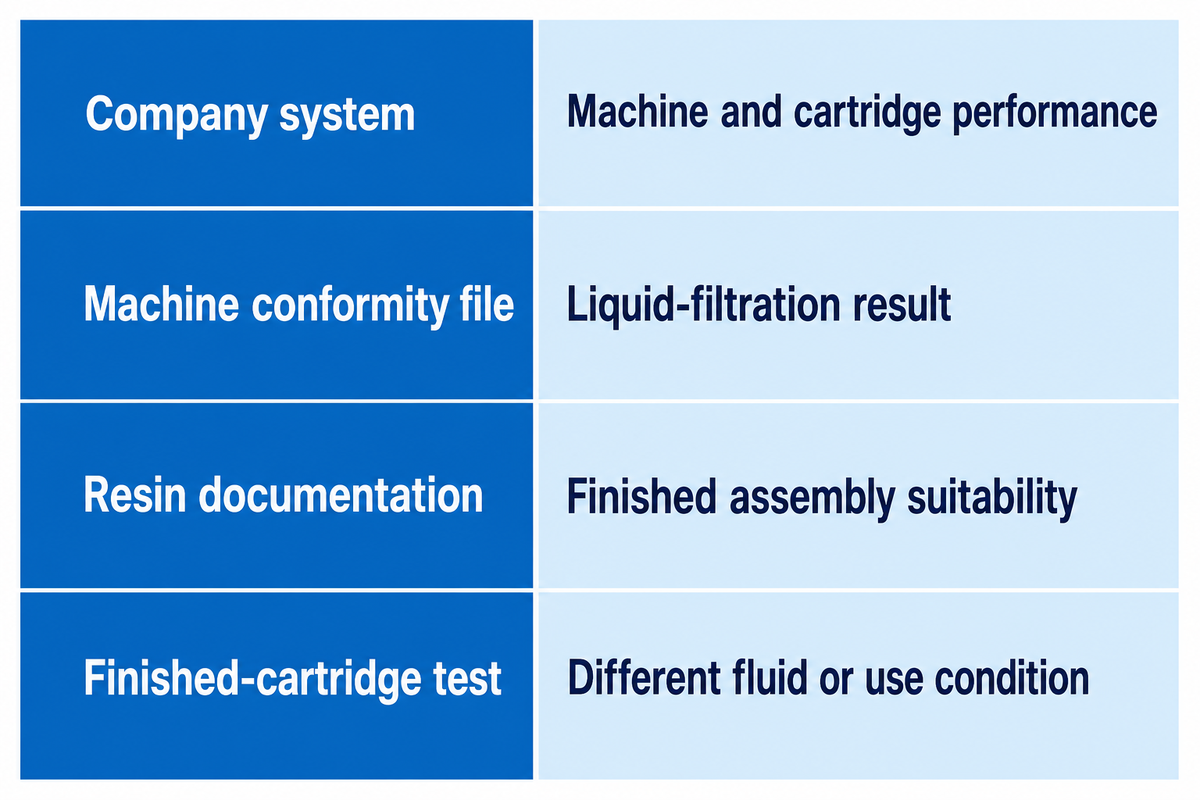
Company management system certificates, machinery conformity documents, resin status and finished application approval allude to different things. Company management system certificates can’t be relied upon to verify machine conformity, material suitability or cartridge performance. Similarly, each of the aforementioned documents can’t be relied upon to verify performance outside the scope of the document.
“A manufacturer declares that the product meets all the legal requirements for CE marking.”
The Commission page states that CE marking doesn’t signify that a product has been officially deemed safe by the EU or other authorities. Accordingly, this article doesn’t publish an unverified “EU CE certification” claim for UDTECH or use CE as proof of cartridge quality.
| Evidence level | Question it can answer | Question still open |
|---|---|---|
| Company system | Defined management-system scope | Machine and cartridge performance |
| Machine conformity file | Applicable machine and legal scope | Liquid-filtration result |
| Resin documentation | Material identity and stated conditions | Finished assembly suitability |
| Finished-cartridge test | Result under stated method and conditions | Different fluid or use condition |
Regarding food contact in the United States, conditions are established in 21 CFR 177.1520 for specific olefin polymers. 21 CFR 174.5 sets conditions on purity, GMP, limits, and compliance with other regulations. For food and beverage filtration, resin identity alone doesn’t establish finished-cartridge compliance; water-treatment suitability and other applications require their own application-specific evidence.
Worker protection requires a separate review. In the U.S., OSHA 1910.212 addresses guarding against hazards at points of operation and from ingoing nip points, rotating parts, flying chips, and sparks. A broader project hazard review should separately consider hot surfaces, electrical work, startup, cleaning, maintenance, exhaust, and destination-market requirements with qualified safety specialists.
When not to buy on a certificate headline
Literature such as brochures shouldn’t be relied upon as information verifying that a device has been approved. Nor will component records be allowed to substantiate a complete device assembly or a cartridge. The reviewer should verify the named product, legal entity, document status, and destination-market scope.
Common failure mode: FAT records a running process, while the file lacks the safety and conformity documents needed for the destination jurisdiction. Product acceptance and legal placement obligations should remain separate checklist lines.
Buyer objection: Being able to reference a legal document isn’t enough; the named legal entity must be the same as the subject of the certification, the equipment, and the jurisdiction under consideration. If applicable laws of the jurisdiction govern the buyer’s decision, the referenced document must apply to the actual legal entity, equipment, and destination-market scope under review; the buyer should retain a qualified professional practicing in that jurisdiction when legal conformity is material.
How to evaluate process and quality evidence
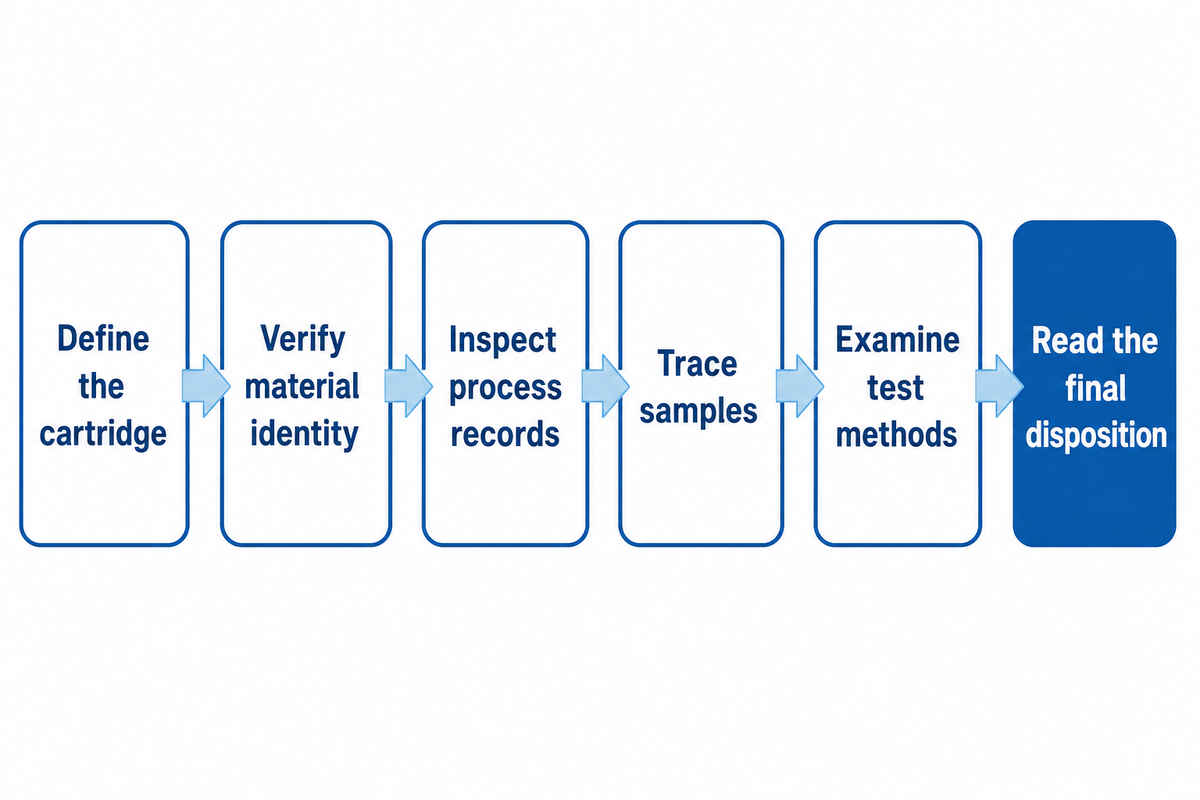
Process and quality evidence should be reviewed in a fixed order: define the cartridge, verify material identity, inspect process records, trace samples, examine test methods, and read the final disposition. This keeps the guide informational while configuration, utilities, output guarantees, witnessed acceptance, and quotation choices remain on the commercial solution page.
Evidence request for a process-quality review
- Define cartridge geometry, construction, raw material, rating convention, and test condition.
- Identify the resin lot and approved recipe revision used for each trial.
- Map the article’s 7 control groups to measured actuals, alarms, and deviations.
- Link each retained sample to its exact production interval.
- Provide dimensional, pressure-drop, and retention results with methods and conditions.
- Record hold, rework, reject, release, and unresolved-item ownership.
A string wound filter cartridge uses a process different from melt blowing, and therefore a different process audit would be required. Labels such as sediment filter, polypropylene filter, spun cartridge, and PP spun filter cartridge are common. These terms do not provide sufficient information to identify the cartridge construction method. Consequently, it’s difficult to compare the evidence given by prospective buyers unless the actual construction method of the cartridges is confirmed.
Search labels such as meltblown filter cartridge, melt blown filter cartridge making, or blown filter cartridge making machine may appear across filtration applications, but each cartridge offers value only when the filtration need and test basis are defined. When the evidence brief has been completed, commercial configuration and quotation questions should be moved to the solution page rather than repeated in this guide.
Missing test basis
Request method, conditions, efficiency, geometry, and lot link.
Request method, conditions, efficiency, geometry, and lot link.
Mismatched scope
Normalize product, clock, accepted output, and auxiliary boundaries.
Normalize product, clock, accepted output, and auxiliary boundaries.
Defined project
Proceed to configuration and witnessed evidence planning.
Proceed to configuration and witnessed evidence planning.
Buyer objection: The most favorable price should not be the sole basis of award; other considerations should include responsibilities, obligations, site work, spares, and evidence.
Frequently asked questions
How are PP melt blown filter cartridges made on a production line?
Answer
PP resin is identified, fed, melted, and metered through a die. Heated air attenuates the melt into fibers that collect around a rotating form while synchronized motion builds the tubular wall. The cartridge is cooled, cut, and optionally finished. A credible record links the resin lot, recipe, process observations, samples, tests, and release decision.
Which production-line controls have the biggest effect on cartridge quality?
Answer
No single setting controls quality by itself. This guide groups the review into seven areas: resin identity; melt condition and throughput; attenuation air; die condition; forming distance; collector rotation and traverse; and cross-variable validation. Actuals, deviations, sample IDs, and finished-cartridge tests must be read together under one stated test basis for the sampled product.
How should buyers compare production evidence from two trials?
Answer
Place both records on one basis: resin lot, recipe revision, cartridge geometry, filter housing fit, stable-run window, sample interval, measurement method, reject rule, and release authority. Larger gross piece counts aren’t stronger quality evidence when the sample trail or acceptance method is missing. Compare commercial capacity only on the solution-page side of the boundary.
Is a fully automatic line proof of consistent micron performance?
Answer
No. Automation can improve repeatability of feeding, motion, cutting, alarms, and data capture. Filtration performance still depends on material control, maintained process conditions, calibrated measurements, sample design, and a stated retention-test basis. Ask which variables are monitored, which alarms stop production, who may revise a recipe, and how every production lot is tied to finished-cartridge results.
What evidence should link a process trial to the finished cartridge?
Answer
Link the material lot and recipe revision to a stable production interval, process actuals, deviation records, sample IDs, construction checks, and a defined functional test. The final record should name the reviewer and disposition. If a test is deferred, record the owner, prerequisite, due condition, and consequence instead of implying that the cartridge already passed.
Turn the evidence audit into a project brief
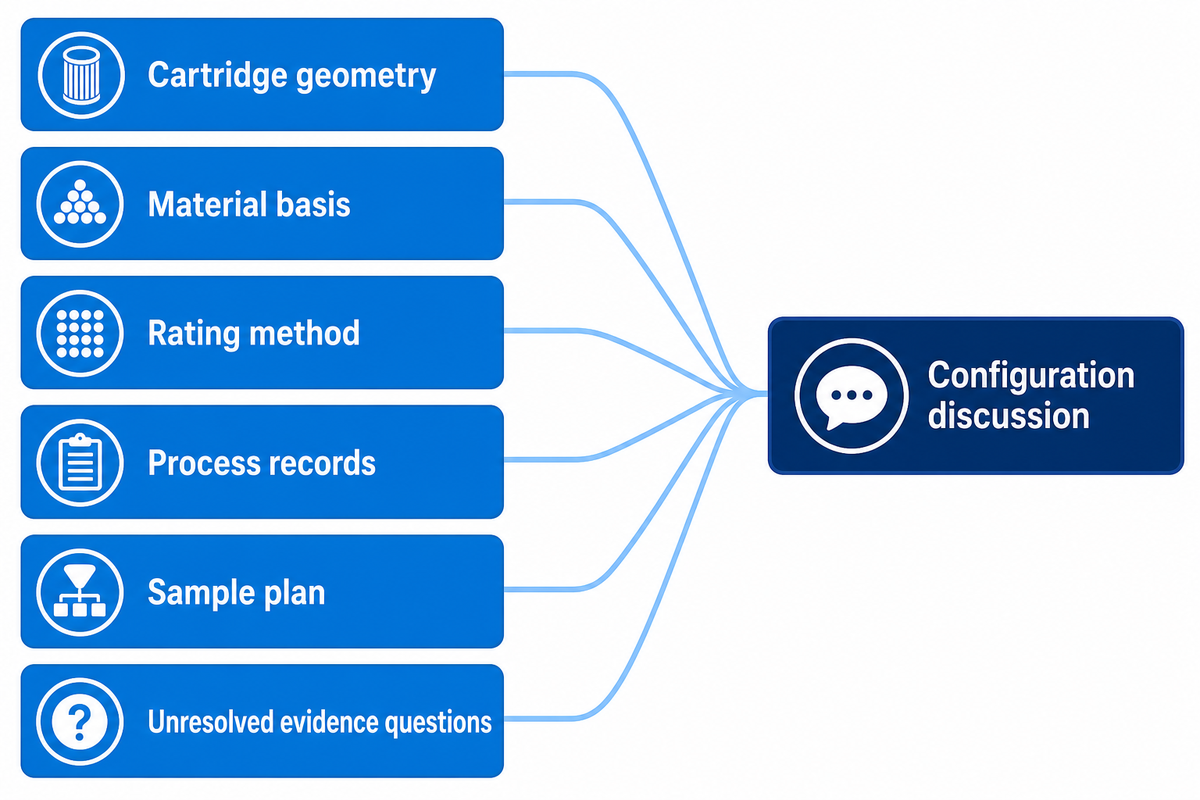
Bring your cartridge geometry, material basis, rating method, process records, sample plan, and unresolved evidence questions. Submit that brief for a configuration discussion without replacing missing proof with generic claims, and keep each promised result tied to a document, sample, or test condition.
About UDTECH: Suzhou UDTECH Technology Co., Ltd. produces PP melt-blown, CTO activated-carbon, and wire-wound filter equipment. UDTECH reports a 6,000-square-meter standardized workshop and equipment exports to more than 55 countries; buyers should request current project references, scope documents, and service terms during commercial review.
Transparency note
This guide separates general process evidence from supplier-specific claims. It does not publish unverified UDTECH ISO or CE marketing statements, universal setpoints, production rates, power figures, regulatory approvals, or cartridge performance. Project values require current documents, defined test conditions, and an agreed acceptance plan. Claims of superior filtration performance, higher filtration efficiency, high filtration efficiency, or effective filtration remain undefined until the product quality evidence and specific filtration requirements are stated.
References & Sources
- A Continuous Production Apparatus for a Frame-Type Melt-Blown Filter Cartridge, Machines, 2023.
- US4925601A: Melt-blown fibrous filter medium, Google Patents record.
- 21 CFR 177.1520: Olefin polymers, Electronic Code of Federal Regulations.
- 21 CFR 174.5: General provisions for indirect food additives, Electronic Code of Federal Regulations.
- CE marking guidance, European Commission.
- 29 CFR 1910.212: General requirements for all machines, Occupational Safety and Health Administration.
- Filter ratings and certifications: key distinctions, Water Technology.