Get in touch with Suzhou UDTECH Technology Co., Ltd. Company

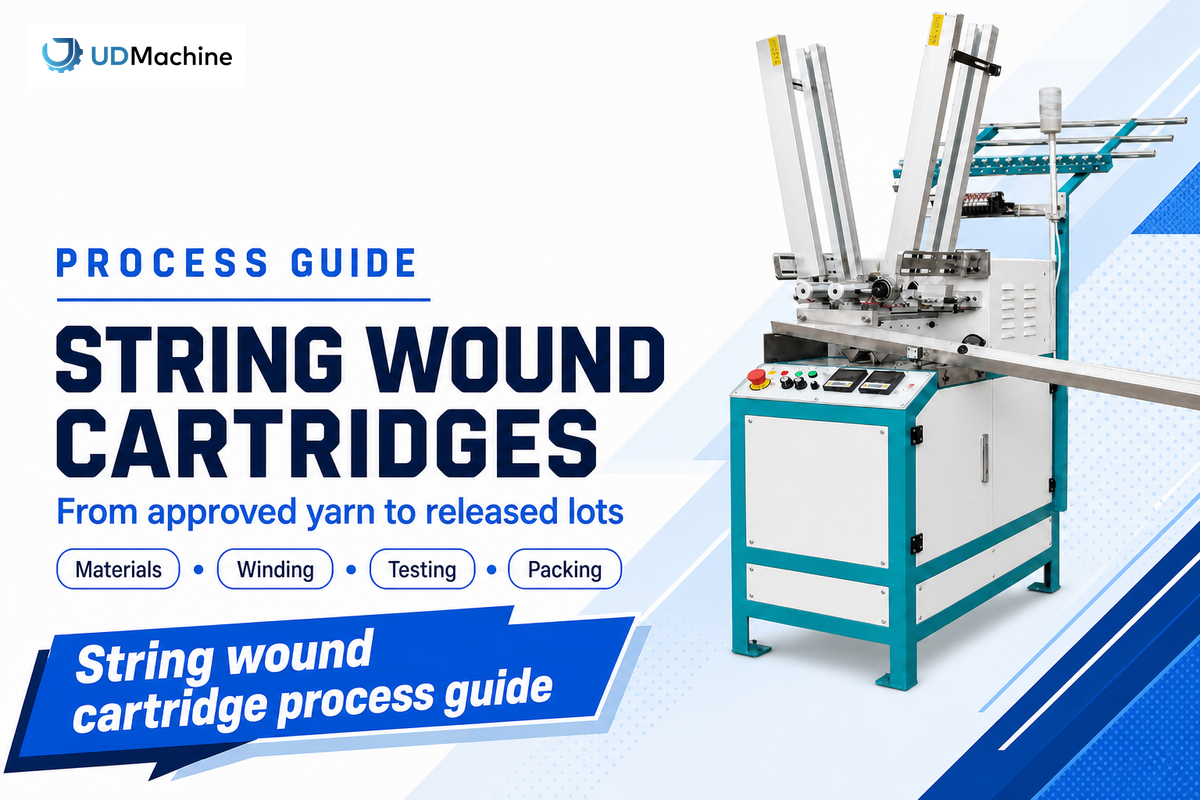
The string wound filter cartridge manufacturing process is a six-stage route that begins with specified yarn and a support core, then continues through preparation, winding, finishing, testing and packing. The practical challenge is carrying the right material and product identity through all the process stages while keeping performance tests and a machine’s winding settings separate.
Quick Specs
- Primary inputs: filtration yarn and a perforated support core.
- Core operation: controlled yarn placement around the rotating core.
- Finishing: plain ends or specified caps and seals.
- Output measure: accepted, packed cartridges per agreed run.
In brief: Wind approved yarn around a prepared core, finish the specified ends, verify the product and pack released pieces. The winding recipe forms the media structure; tests establish what that structure can remove.
- Choose the yarn and core as a complete liquid-contact assembly.
- Separate linear yarn speed from finished-piece output.
- Account for trial samples and trim before calculating yarn cost.
- Include finishing and packing in the equipment scope.
String Wound Filter Cartridge Manufacturing Process: The Route
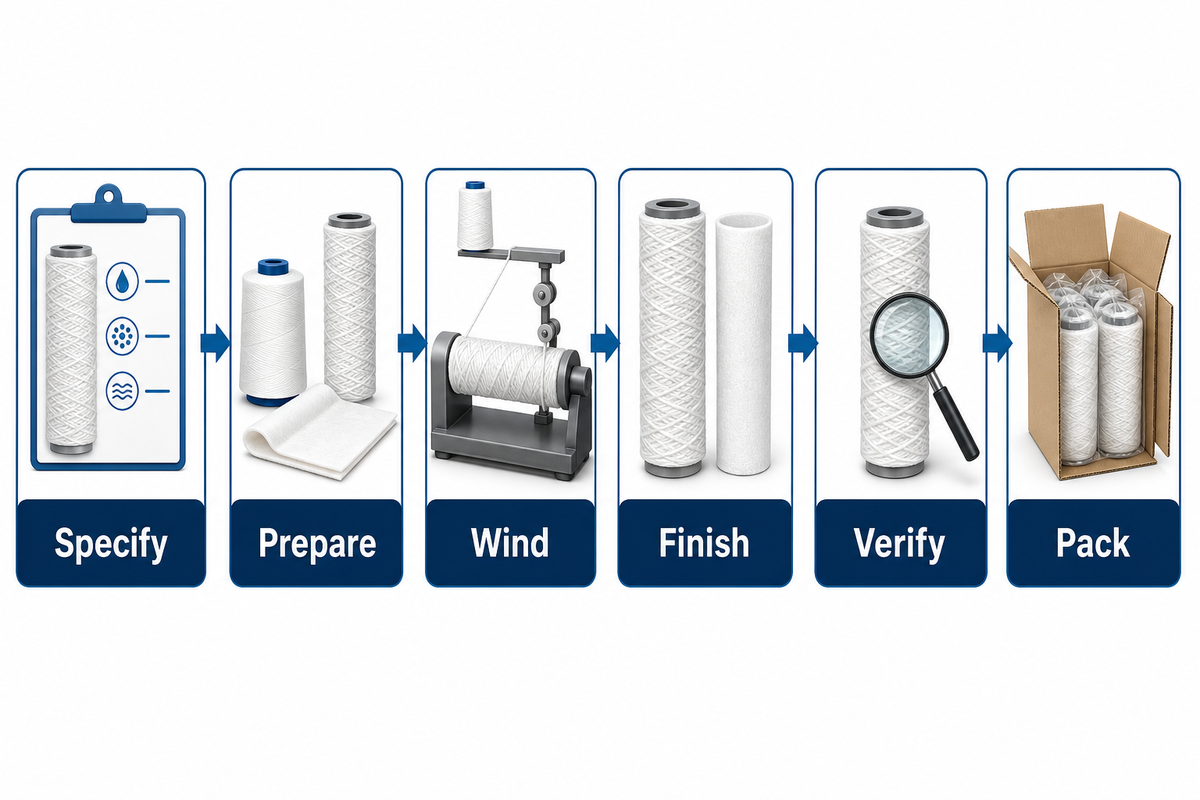
Wound-Cartridge-Line: Prepared yarns and cores are processed through six integrated stages, to create a traceable filtration Product. Winding creates the filter media, and finishing establishes the required end geometry. The final handoff and test protect the product. Yarn and core production occur in separate upstream operations, unless specifically integrated for the project. NIST IR 8536 describes manufacturing traceability as a continuous, time-ordered chain of provenance, a useful model for recording each handoff in this route.
6-Station Material-to-Cartridge Map
The 6-Station Material-to-Cartridge Map sets and defines the structure of the handoffs to prevent downstream rework, and assigns the next operation for each input.
| Station | Input → operation → output | Handoff that prevents rework |
|---|---|---|
| 1. Specify | Application and drawing → select yarn/core → matched input specification | Procurement and quality agree material grades and actual finished dimensions. |
| 2. Prepare | Released core and yarn package → inspect, mount and thread → ready assembly | Operator checks core seating and an unobstructed yarn path. |
| 3. Wind | Yarn plus rotating core → traverse and build layers → wound cylinder | Production records recipe, yarn lot and final dimensions. |
| 4. Finish | Wound cylinder → secure/trim ends and required assembly → finished cartridge | Quality separates plain-ended products from capped or bonded designs. |
| 5. Verify | Finished pieces → dimensional checks and specified tests → accepted lot plus segregated samples | Challenged samples do not automatically return to saleable stock. |
| 6. Pack | Released dry pieces → identify and protect → traceable packed lot | Packing reconciles product code, lot and accepted quantity. |
How are filters manufactured?
Filter manufacturing is dependent on the media structure. Wound cartridges use yarn laid around a porous core; melt-blown polypropylene cartridges form fibers from molten polymer; pleated filters fold sheet media before assembly. Different input preparation and forming equipment are required for each route. Select the route for the required cartridge structure, and include its finishing and tests in the line.
When assessing quotes, consider differences in material. A pleated filter’s greater surface area comes from its folded geometry, while a wound product develops depth through its layers of yarn. Surface filters and depth filters also load differently. Comparing a winding unit with a unit for melt-blown or spun filters means comparing the complete production process, as the operations to prepare the input and give it a final shape before either route reaches its finished product checks differ.
Define the starting inventory as polymer, yarn or prepared cores when comparing quotes for a 10-inch cartridge line. In the case of purchasing yarn, many checks will remain, and the costs will need to be assessed. Procurement can then compare the same starting inputs and the same packed output across offers.
Step 1: Match Yarn and Cores to the Cartridge Specification
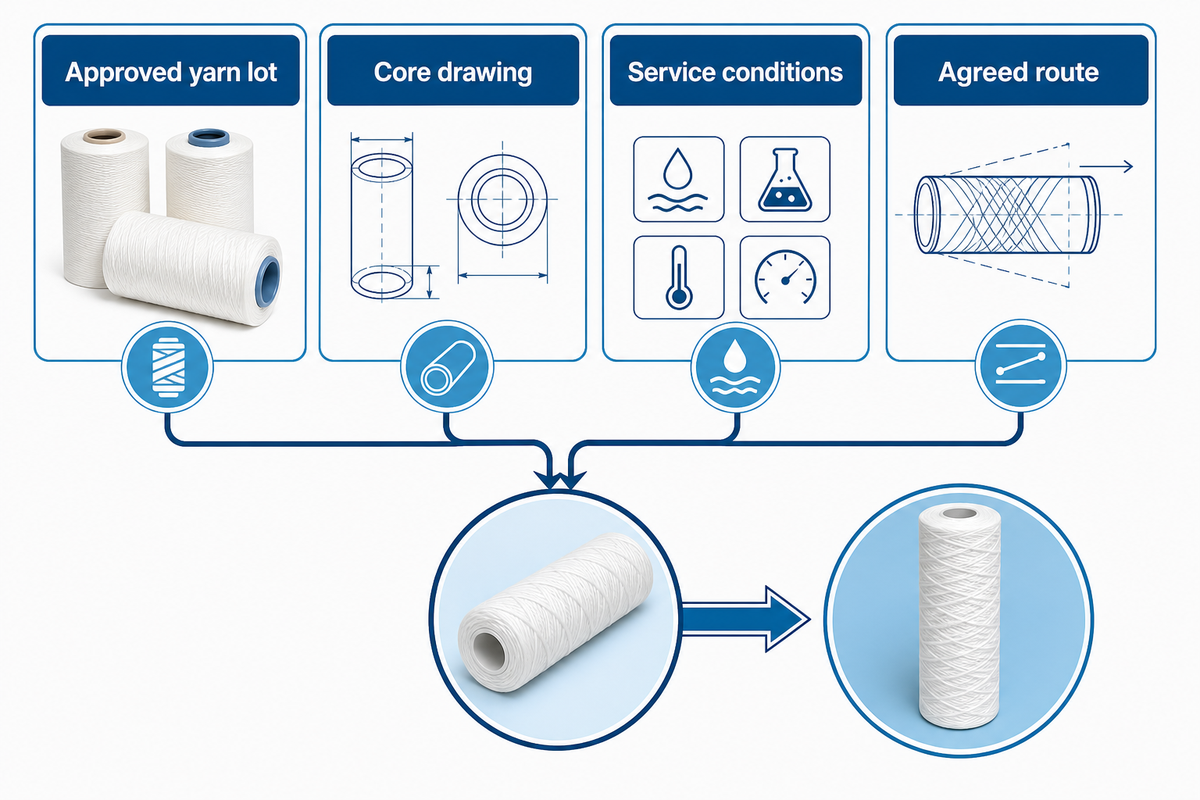
The selection of yarns and cores is dependent on the intended liquid, the temperature, the flow and the requirement for the removal of particles. A polypropylene string wound cartridge still requires a defined construction of yarns and support geometry. Compatibility can’t be determined by the naming of materials alone. Purchasing should work from the complete product specification before releasing inputs to the winding station. The University of Nebraska-Lincoln sediment-filtration guide explains why a micron rating and its stated removal efficiency need to be read together when selecting a cartridge filter.
| Type or configuration | Production implication | Buyer decision | Limitations / Not suitable for |
|---|---|---|---|
| PP yarn on PP core | Both components are made from polypropylene; yarn grade still matters. | Check the complete construction against the liquid and temperature. | No universal chemical or temperature approval follows from the polymer name. |
| PP yarn on stainless-steel core | A metal support changes the core supply and mounting checks. | Specify alloy, dimensions and end interface. | A steel core does not remove the yarn’s service limits. |
| Cotton-yarn construction | Different absorbency and fiber characteristics affect handling. | Qualify the yarn and core together for the application. | Do not inherit a PP cartridge’s compatibility statement. |
| Glass-fiber-yarn construction | Media handling and fiber control need their own assessment. | Confirm the full assembly is appropriate for the duty. | Temperature capability cannot be inferred from the yarn alone. |
| Staple-fiber spun yarn | Fiber cohesion and package consistency affect the winding feed. | Compare approved yarn lots rather than color alone. | A heavier cylinder does not prove better retention. |
| Continuous-filament textured yarn | Texturing creates a different yarn structure. | Require sample performance for the exact yarn construction. | A historical patent is not a generic performance guarantee. |
| Plain-ended cartridge | End securing and trimming complete the wound body. | Match the housing sealing arrangement. | Do not add a cap-bonding station without a product requirement. |
| Capped cartridge | Caps, joints and any seals add assembly work. | Define joint materials and inspection points. | Extra components introduce their own liquid-contact limits. |
| Long or large-diameter cartridge | Travel, support and handling must fit the actual geometry. | Trial the largest intended product, not only the shortest sample. | A nominal 20-inch format does not specify its outside diameter. |
If a buyer wants to know whether polypropylene filters or string wound is better, the buyer may be mixing construction with material. A polypropylene filter cartridge can be string wound. For industrial filtration, record the yarn’s polymer and construction separately from the cartridge’s form; color and a nominal micron label leave both questions unresolved when procurement compares proposed filtration solutions for different industrial processes.
Hypothetical startup: A small manufacturer plans 10-inch and 20-inch cartridges for process water. The owner initially asks for a complete factory, while procurement already has quotations for finished cores and polypropylene yarn. Procurement has already received quotes for finished cores. Purchasing those inputs allows the team to take on a more defined project for winding and finishing. Quality still needs to review and approve the grade of the yarn and the dimensions of the incoming core. Supplier availability does not establish filtration performance. The plant manager is able to run both lengths and decide if upstream equipment is warranted. Finance should compare the purchased-input cost with the full cost of making inputs, including inspection and handling. The useful first purchase is the equipment needed for the agreed route, with responsibility for every handoff written into its scope.
Purchased inputs aren’t interchangeable merely because they fit a 28 mm bore. UDTECH specifies bore as standard, but an actual core drawing and an approved yarn grade are to be provided to the buyer. A change of core material or yarn construction needs to be included in the product specification prior to production restart.
Step 2: Prepare the Core and Feed the Yarn
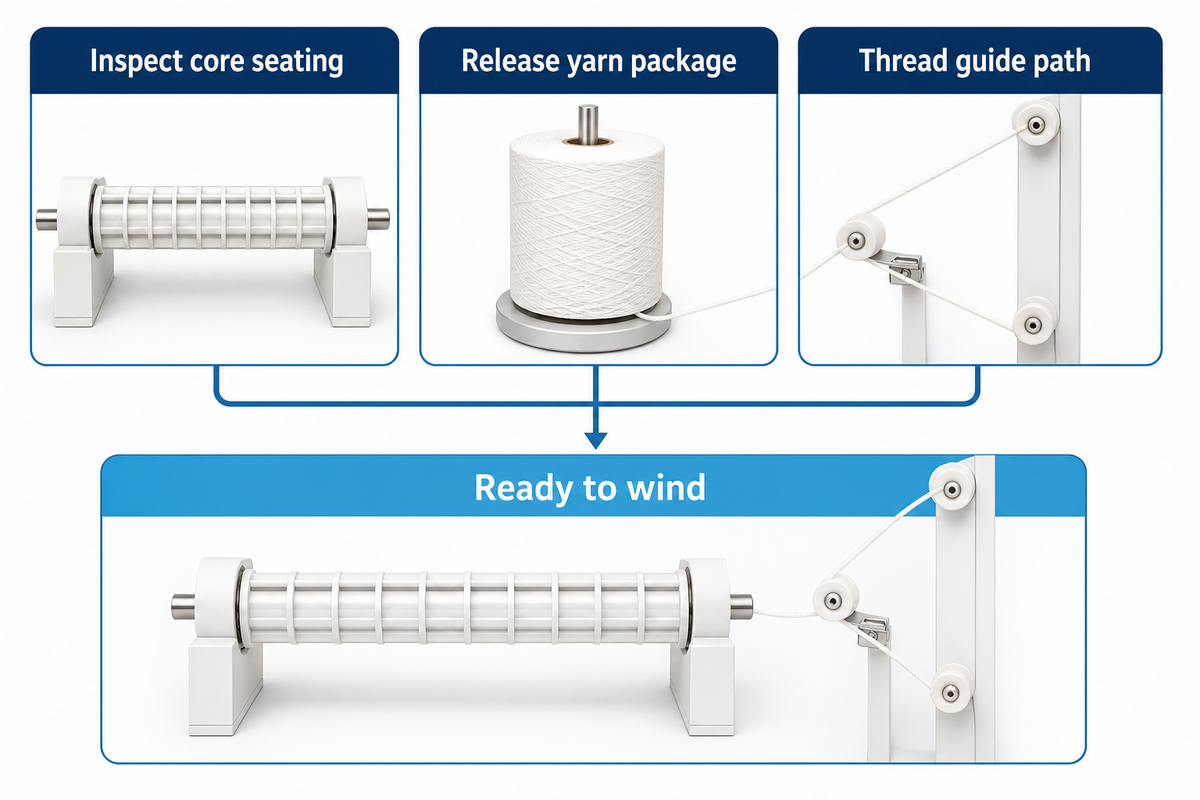
Inspect the core against its drawing and check the perforations and end condition. Inspect the end condition of the core and mount it in the specified fixture. Feed the approved yarn package through the machine’s guides and tensioning path before securing the yarn for winding. NIST’s manufacturing traceability framework supports linking incoming material identity to the events in its provenance chain, which is why the core and yarn lot should be recorded before winding.
What Types of Cores are Used in String Wound Filter Cartridges?
For UDTECH’s string-wound equipment, the options given for the cores are Polypropylene and stainless-steel. The core supports the wound media and provides passages for filtered liquid. Selection therefore depends on dimensions, the liquid-contact material and service conditions. A stainless-steel core cannot make polypropylene fibers suitable for temperatures or chemicals beyond the qualified limits of the finished assembly.
Damaged or contaminated cores in the feed area must be removed. Ensure that the fixture supports the intended length without blocking the yarn path. An uneven start can lead to an irregular end region which becomes difficult to control after the wall has been built. This is why the approved setup determines where the starting yarn is secured and how the first layers are placed.
A 20-inch product cannot be specified by doubling a 10-inch program and assuming the rest will fit. For example, core support, travel of the traverse, and the actual sealing length all need to correspond to the drawing. The buyer’s useful acceptance item is a finished sample of each intended length, including its end geometry.
Step 3: Wind the Filter Matrix Around the Core
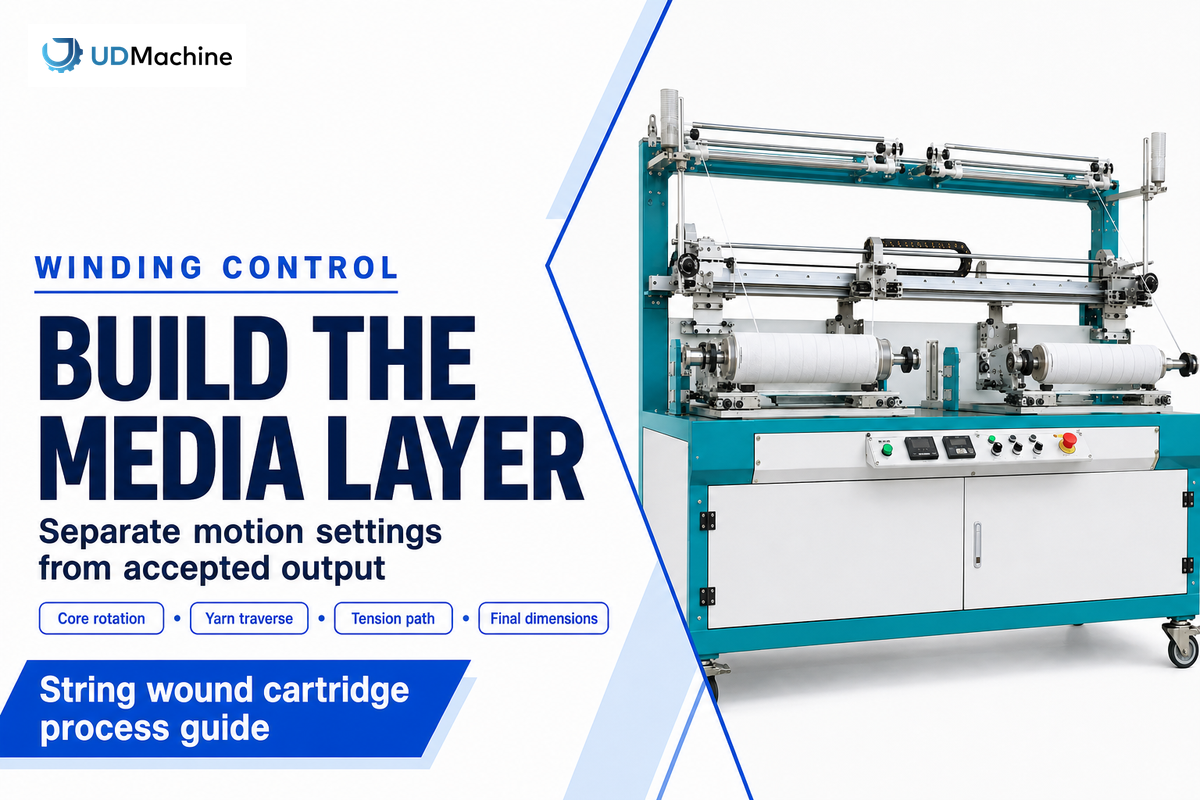
String winding combines core rotation with an axial yarn traverse to build crossed layers around the support. Varying the placement of yarn, tension and diameter of the growing structure affects the spaces within the filter matrix. The machine forms the structure; a finished cartridge test determines if the filtration performance meets the intended service.
Wrapping yarn around a core creates a winding path rather than a uniform, drilled pore. Therefore, the spaces between layers of wound string need to be considered as part of the complete cartridge structure. Liquid flows through interconnecting pores within the media. A denser build alters the resistance and affects the capture of particles. Therefore, adding more yarn doesn’t guarantee high filtration efficiency or dirt-holding capacity.
“Increasing the coil angle at which the wound filters are built resulted in lower yarn content”
The study reported a specific arrangement of polypropylene yarn and winding. The reported values for setting up the study were 55 g yarn tension and 225 rpm with filtration tests at 400 L/h. These values describe the study, not the conditions for the production of every cartridge. Transfer the lesson about interacting variables; establish the actual recipe with the chosen materials.
The way a yarn is constructed also matters. A 2024 comparison by Kanade and Pratihar covers various types of filtration results from DREF yarn and doubled roving. The comparison supports testing the yarn structure rather than assuming that every yarn made of polypropylene behaves alike.
For equipment range, check UDTECH’s string-wound machine configurations. Detailed tension and traverse adjustments belong in the winding setup and process-control guide; this route follows what happens to the product between stations.
A specification of a winding speed of 60-320 m/min describes the speed of yarn travel. Accepted output also includes starting, unloading and any interrupted cycles, followed by downstream work. Buyers should measure completed pieces for their actual yarn and dimensions rather than convert the highest linear speed directly into a cartridge-per-hour promise.
Step 4: Finish the Ends and Remove Loose Material
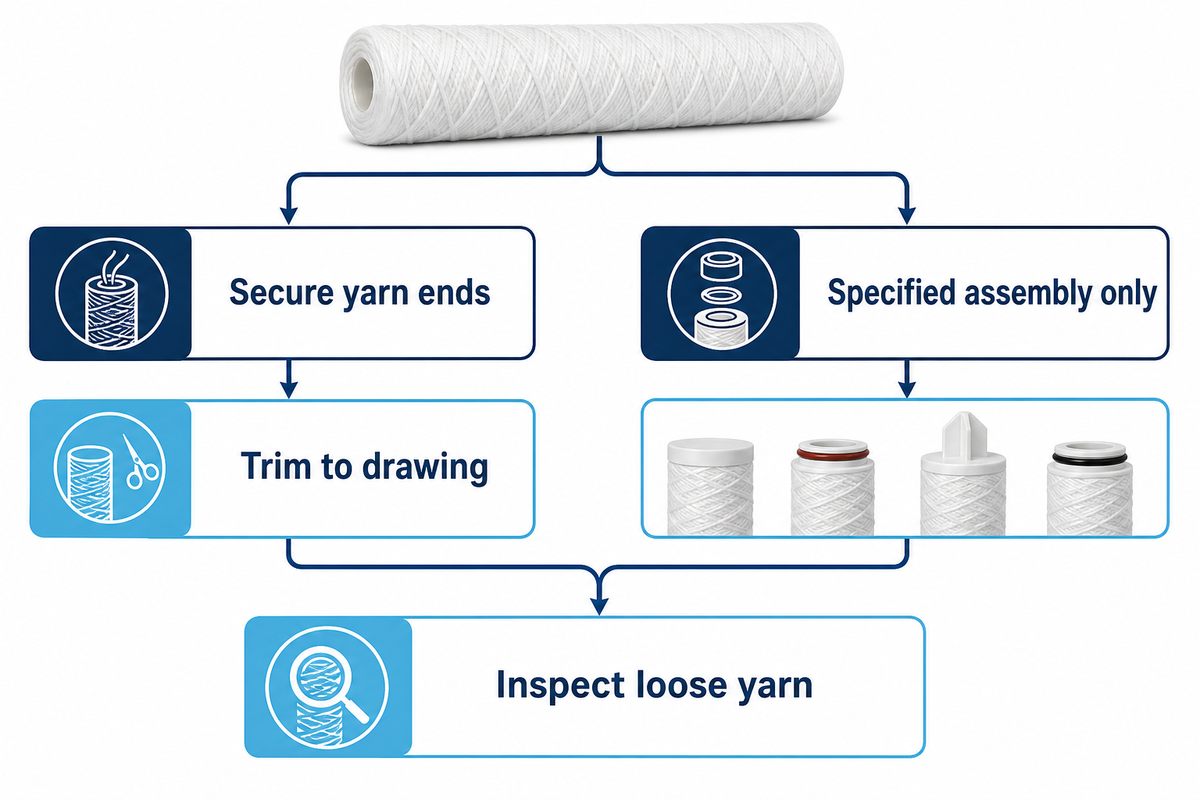
The finished product is a cartridge assembly when the yarn is terminated and trimmed and the removed material is no longer on the assembly. Seals and caps should be added to the assembly only when required by the drawing. Washing, drying and adhesive bonding aren’t universal operations for every wound construction.
The end treatment must preserve the housing interface, and loose yarn shouldn’t enter the fluid path. The approved assembly drawing should identify which surfaces seal against the housing and which features merely support the wound body. Visible unevenness of a piece indicates that the piece is to be inspected. However, appearance alone doesn’t identify a unique cause or establish removal performance. Trace the yarn lot and recorded setup before changing several settings at once.
A historical case illustrates the need for a defined scope for finishing: in US6942106B1, a continuous-filament process with water-related processing and drying prior to packaging is described. This record identifies Ahmad and Hamid Omar, and mentions Syntech Fibres. This patented process doesn’t belong to UDTECH and doesn’t prove all wound cartridges require drying.
Finishing and assembly of cartridges should be covered when a buyer requests end caps. A supplier trial on a plain wound cylinder leaves the joining operation untested, even if the cylinder dimensions are correct.
Step 5: Test the Finished Wound Filter Cartridges
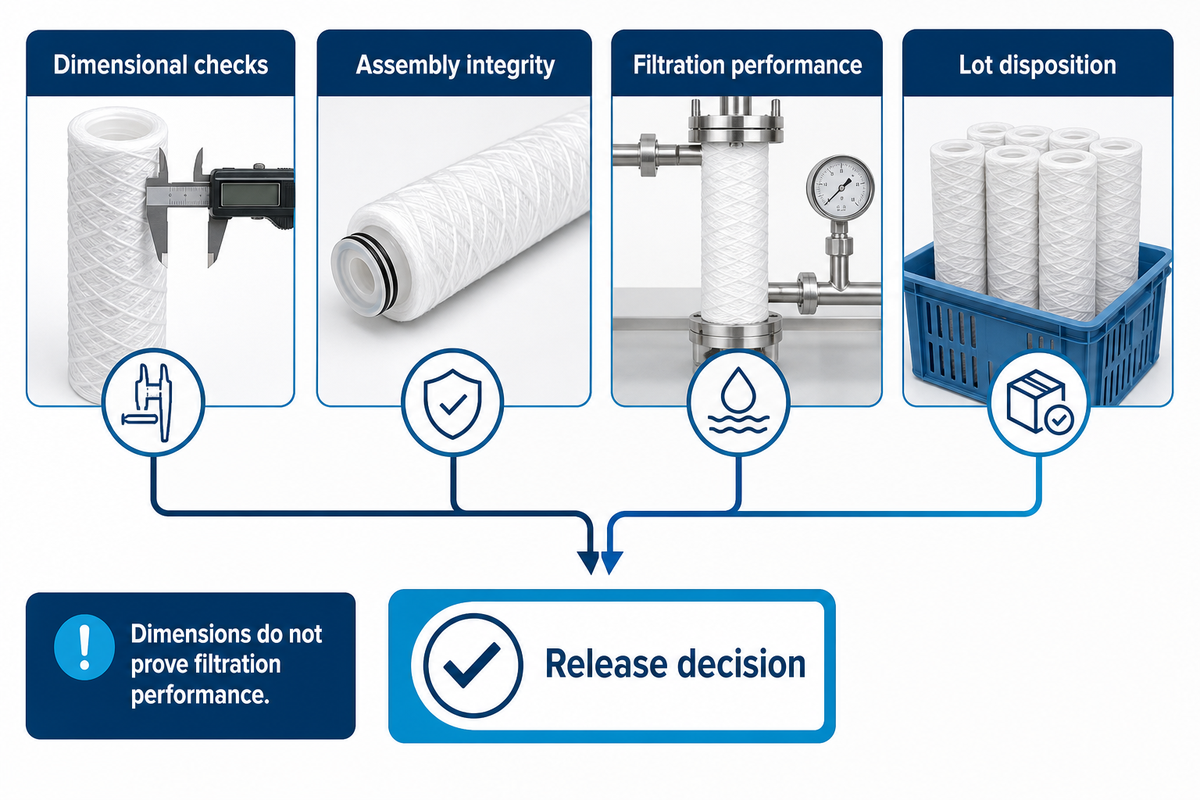
Dimensional conformity of finished cartridges is verified by inspections and measurements; specified flow and particle challenges determine filtration performance. Length, diameter and appearance inspections confirm physical features; specified flow and particle challenges assess filtration efficiency and loading behavior. The acceptance plan must identify the test conditions, sampling and disposition of tested pieces before an accepted lot proceeds to packing.
For a 5 micron string-wound sediment filter, the rating requires an efficiency measure and defined test conditions. The University of Nebraska, Lincoln sediment-filtration guide illustrates the importance of filter selection in consideration of particle removal and flow resistance. A cartridge that can effectively remove sand and rust in well water, doesn’t prove chemical purification: larger particles and a dissolved impurity pose different removal questions.
Product claims for Water pretreatment and pre-filtration upstream of reverse osmosis (RO) differ from a final pure water system.
Common failure modes and test limits
Don’t choose a wound cartridge only because its label claims finer filtration accuracy. Tightening the winding can change pressure drop without proving the required removal efficiency. A product with high dirt-holding capacity under one challenge may behave differently with another contaminant, viscosity or flow rate. Qualification requires both the expected benefit and the operating conditions.
Integrity and efficiency tests answer different questions. The public scope of ISO 2942:2018 covers hydraulic-filter fabrication integrity and first bubble point, and expressly excludes using the result to estimate rating, efficiency or retention capacity. ISO 16889:2022 addresses hydraulic multi-pass testing; it is not a universal drinking-water approval.
Performance-test samples exposed to contaminants must be segregated. Their yarn consumption belongs in the trial record; passing a test doesn’t automatically make the tested piece saleable. Define sample disposition in the quality plan. The NSF standards overview also distinguishes specific reduction claims: a company quality-system certificate or machinery conformity statement doesn’t certify the finished cartridge for every water treatment use.
Do
- State the liquid, flow and particle challenge.
- Separate physical checks from performance tests.
- Track challenged samples outside saleable stock.
Avoid
- Assigning retention from appearance alone.
- Using a hydraulic method as a blanket water approval.
- Transferring another product’s certificate.
Hypothetical viscous duty: A processor requests a cartridge for syrup after seeing a water-filtration sample. Procurement wants to reuse the same product to reduce the number of stock items, but quality has no evidence that the water test represents the syrup duty. The next step is to define the actual fluid temperature, flow and particle removal target, and agree on a suitable evaluation. Increasing the media density of the filter first would change more than one of the unknowns. The manufacturer should hold the identity of the proposed yarn and core while comparing results. If the target flow causes unacceptable resistance, the team can reassess the element construction and system arrangement. The water result remains useful background, not the acceptance result, for syrup.
A nominal 5 μm designation becomes useful only when the stated performance is tied to a method and operating conditions. Neither a finished-weight check nor a bubble-point result supplies that missing definition. Buyers can review how cartridge micron ratings are defined before agreeing the trial.
Step 6: Identify, Protect and Pack Each Released Lot
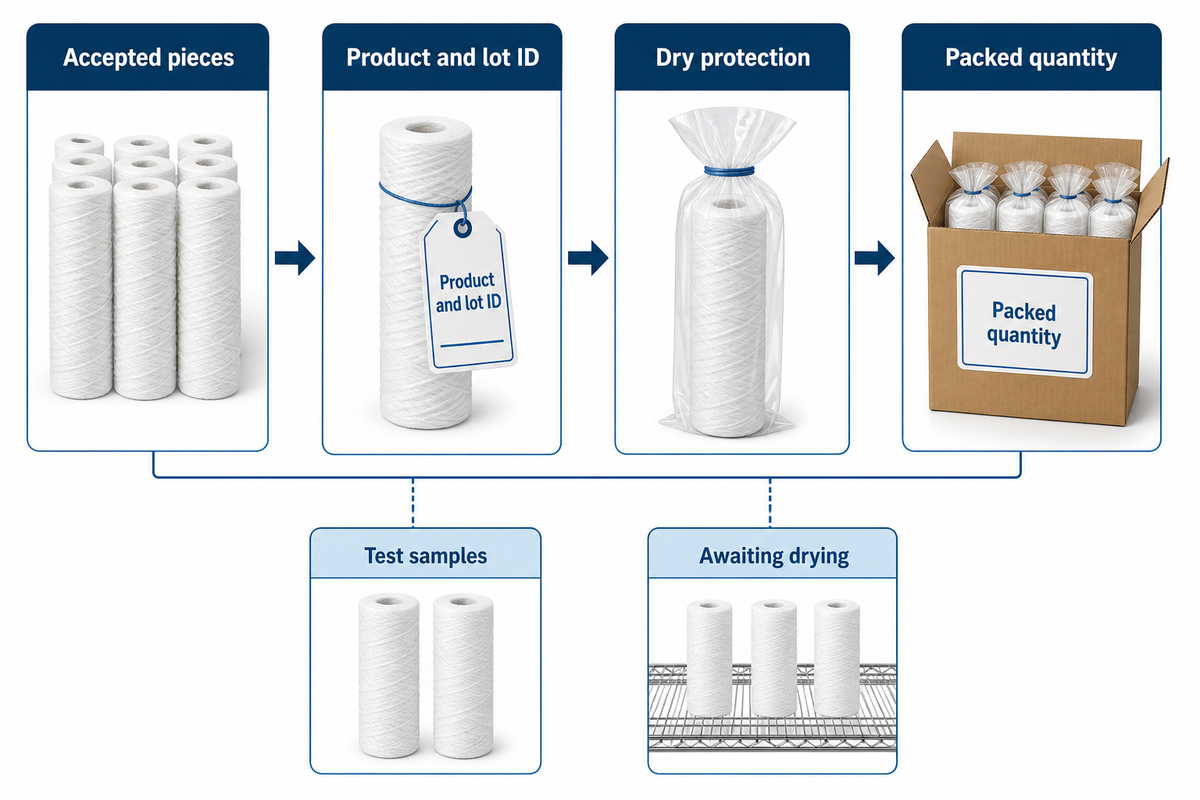
Packing retains an accepted cartridge and links it to its production documentation. Identify the product and lot, confirm the quantity released, and use appropriate packaging to meet the agreed cleanliness level and conditions of transport. Wet or challenged samples require special dispositions and packaging shouldn’t mask unresolved inspection or drying work. ISO 22742 sets minimum requirements for labels carrying linear bar codes and two-dimensional symbols on product packages, which is relevant when defining lot and package data.
The description of the packaged cartridge should identify the yarn/core, and include dimensions and any qualified claim. Packaging should provide sufficient information to trace a complaint to its input lots and production run. A clean wrapper cannot correct media damage, and a carton label cannot substitute for an agreed cartridge specification, so pieces awaiting inspection or drying should remain clearly separate from the released quantity that packing is allowed to count.
For orders containing cartridges of different lengths, reconcile each product code separately. Keeping the counts separate gives finance a meaningful denominator when calculating the consumption of yarn per unit accepted.
Where Material and Production Time Are Lost
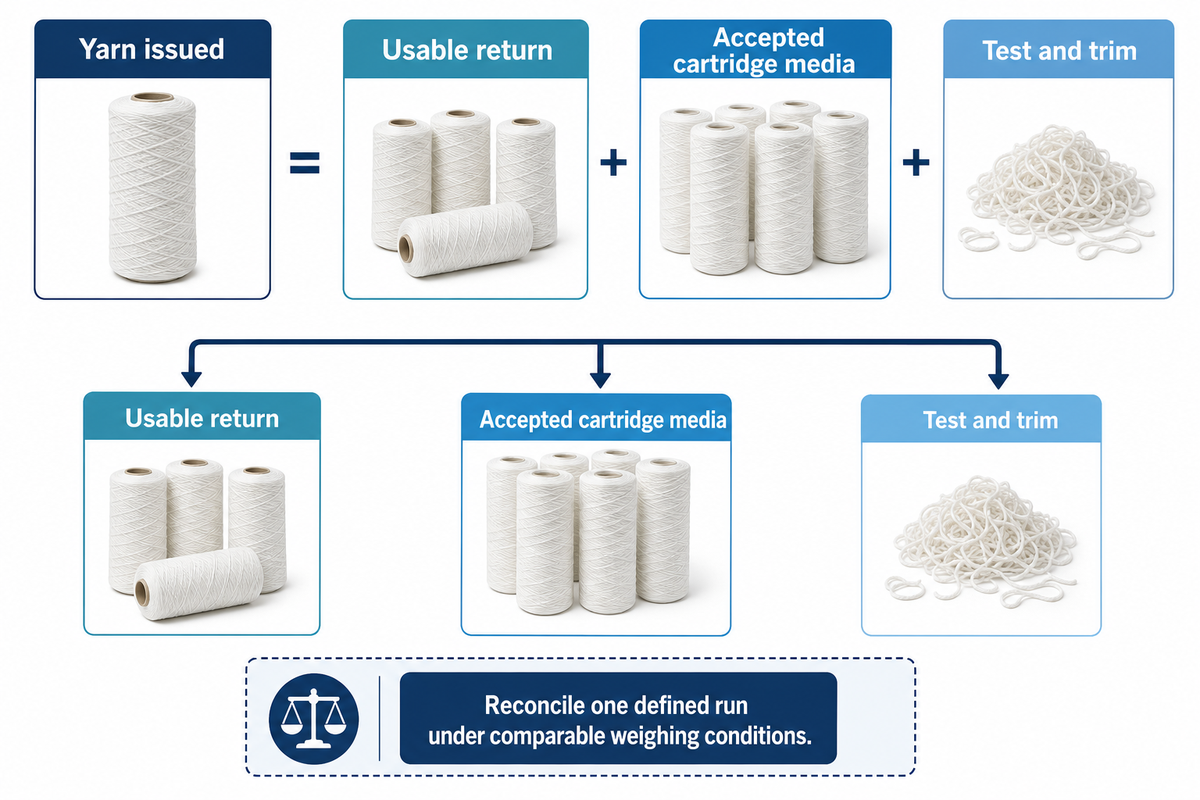
Material loss occurs when yarn used in the process exceeds the yarn in the products accepted by Quality. Time loss occurs when the process spends time outside productive, accepted cycles. Measure both types of loss separately. The EPA’s material-line method relates consumption to the product content and measures process time rather than rely solely on machine speed to gauge productivity of the process.
4-Bucket Yarn Reconciliation
The 4-Bucket Yarn Reconciliation distinguishes issued yarn, usable returns, accepted media, and non-saleable consumption, within a defined measurement period.
| Bucket or calculation | Illustrative quantity | Interpretation |
|---|---|---|
| Yarn issued | 12 kg | Starting issue for the defined run. |
| Usable yarn returned | 1 kg | Measured usable return, not scrap. |
| Yarn consumed | 12 − 1 = 11 kg | Net consumption within the boundary. |
| Yarn in accepted pieces | 10 kg across 200 cartridges | Media mass only; excludes cores and caps. |
| Non-saleable yarn | 1 kg | Here assumed to be rejects and trim. |
| Accepted media per piece | 10,000 ÷ 200 = 50 g | Useful product content. |
| Consumed yarn per accepted piece | 11,000 ÷ 200 = 55 g | Purchasing/cost denominator. |
| Difference per accepted piece | 55 − 50 = 5 g | Non-saleable consumption spread over accepted units. |
| Yarn cost at unit price P/kg | 0.055 × P per accepted piece | Yarn only, before other manufacturing costs. |
The hypothetical run consumes 11 kg of yarn even though accepted cartridges contain only 10 kg. Finance would understate yarn consumption by using 50 g per piece instead of 55 g. Production has a different question: how much of the 1 kg non-saleable quantity came from setup, trimmed ends and/or rejected cylinders? Separating these streams and measuring them individually would answer that question and help make the next improvement decision more precise.
The example assumes no consumed test samples and no unrecorded inventory change. If samples consume yarn, include them in non-saleable consumption and identify that amount separately; do not call it trim. Use comparable weighing conditions and account for measurement uncertainty, particularly when a small difference between two larger measured quantities is being treated as the entire non-saleable yarn stream. In measuring non-saleable yarn, total cartridge weight shouldn’t be used to represent media weight because it includes the core and other components. Core and other components of the cartridge should be excluded when determining media weight.
Hypothetical length mix: A plant runs 10-inch cartridges in the morning and 20-inch cartridges in the afternoon. The owner compares machine speeds across the two shifts. The supervisor observes longer set up times to change fixtures and move the longer pieces. Finance also notices a change in yarn cost per accepted unit. Neither observation proves that the longer product is poorly made. Separate the two runs, record accepted counts and consumed yarn, then time preparation, winding and downstream handling. If a backlog of work is caused by packing that leaves work unfinished, a faster winding setting won’t resolve the backlog. The next equipment decision should address the measured constraint, using the same finished-product mix that the customer intends to order.
Maintain visibility for setup, running, interrupted and packing times in production planning across the line. The 55g example is a yarn consumption example, not a labor cost example, or an expected industry loss rate. A plant needs its own accepted counts and observed times before pricing output.
Integration and Utility Requirements for the Complete Route
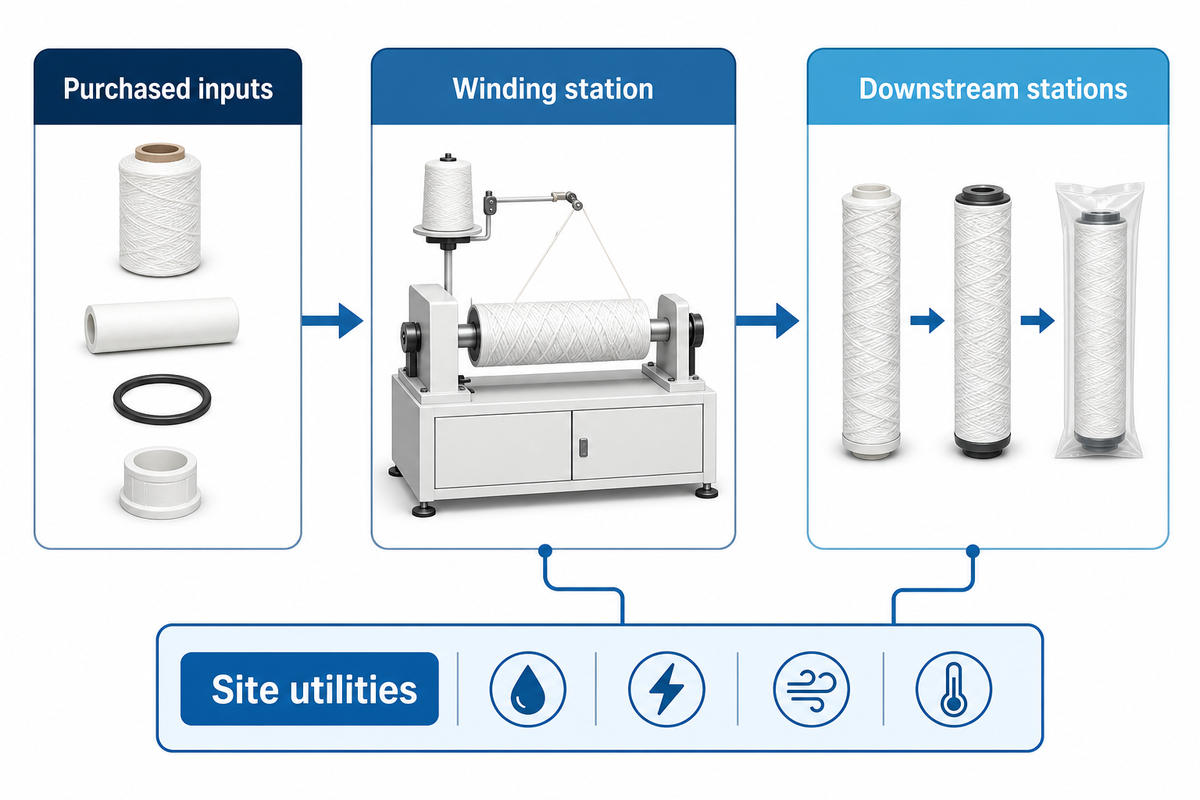
A complete line scope includes winding equipment along with the input, finishing, inspection and packing. Utilities follow that agreed equipment list. UDTECH published a winding envelope and drive ratings, but planners still need the total connected requirements of the supplied equipment along with the demand for any auxiliaries for planning the factory layout.
| Published field | Listed value | How to use it |
|---|---|---|
| Standard length range | 10–70 in (254–1,778 mm) | Match actual finished lengths and fixture travel. |
| Extended length described | 100 in (2,540 mm) | Treat as a discussed build, not the default machine. |
| Standard bore | 28 mm | Confirm core and housing interfaces. |
| Outside-diameter range | 29–150 mm | Check the intended finished diameter. |
| Linear winding speed | 60–320 m/min | Do not read as cartridges per hour. |
| Standard electrical supply | AC 380 V, 50 Hz | Confirm the supplied machine and local connection. |
| 10-inch drive motor | 0.18 kW | Drive rating only; not total connected load. |
| 20-inch drive motor | 0.25 kW | Drive rating only; auxiliaries remain separate. |
| 30-/40-inch drive motors | 0.5 / 0.55 kW | Ratings for stated versions, not a plant energy estimate. |
The public abstract of IEC 60204-1 draws the boundary of the electrical equipment at its supply point. This example keeps the rating of a drive motor separate from a site supply planning example. Confirm the total electrical load and servicing space; other utilities like compressed air or washing/drying, should be drawn into scope only if the chosen equipment and product route require them.
| If the project requires… | Specify or measure… | Owner | Limitations / Not suitable for |
|---|---|---|---|
| Purchased yarn and cores | Incoming specifications and supplier-lot identification | Procurement | Buying a winder does not include making either input. |
| A nominal 10-inch product | Actual length, bore, outside diameter and sealing interface | Product engineering | Nominal length is not a complete drawing. |
| A nominal 20-inch jumbo product | Its actual larger diameter and sample handling | Production | A length-only quote can miss diameter restrictions. |
| A 5-micron product claim | Efficiency criterion, challenge, flow and test method | Quality | The number alone does not define an acceptance test. |
| More than one yarn grade | Separate approved recipes and feed trials | Production | One setting does not qualify every yarn lot. |
| Caps or seals | Assembly materials, joining process and inspection | Engineering | Plain-ended samples do not validate capped assemblies. |
| A packed-output target | Accepted units after finishing, test sampling and packing | Plant manager | 60–320 m/min is yarn speed, not packed output. |
| A yarn-cost estimate | Consumed yarn per accepted unit, with sample/scrap records | Finance | Finished cartridge weight includes non-yarn parts. |
| A factory utility estimate | Whole-machine load and every specified auxiliary | Facilities | 0.18–0.55 kW drive ratings omit other equipment. |
The 0.18–0.55 kW listed drive ratings can’t price a factory’s electricity bill. The entire equipment list, along with the actual operating time and measured demand for the proposed duty must be provided. Use UDTECH’s complete filter cartridge production route to discuss that scope with finished-product drawings and samples.
Industry Outlook: What the 2025 Standard Revision Changes
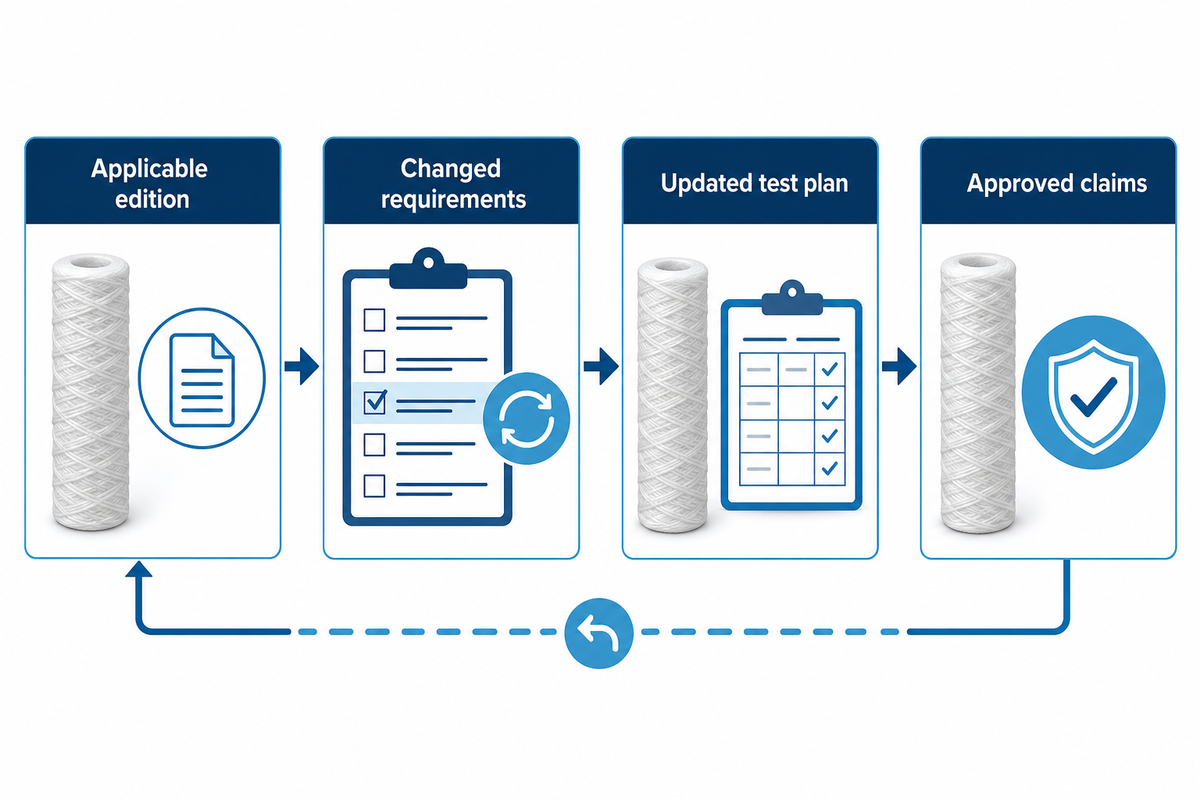
For projects seeking NSF/ANSI 42 evaluation, the 2025 revision makes the current test instructions part of product planning. It does not prescribe a new winding recipe or certify a generic wound cartridge. Manufacturers should agree the applicable edition and claimed reductions with their test organization before fixing the sample and preparation plan.
ANSI’s summary of NSF/ANSI 42-2025 describes changes from the 2023 edition concerning initial preparation, collection for pour-through products and extraction reporting. One change pertains to products for which the initial flushing instructions are longer than four hours. That condition does not mean every filter needs a four-hour flush. The product type and the selected evaluation determine which provisions matter for particular water filtration applications; a change to preparation instructions cannot by itself establish an improvement in delivered water quality.
Generally speaking, a manufacturing organization must make a plan for which finished products and instructions for preparation will be sent to the laboratory. A cartridge tested without the intended caps and/or seals may not represent the product that was sold. Likewise, claims for the purification of drinking water shouldn’t be generalized to other chemical processing or industrial water duties.
For a new project in 2026, confirm the applicable test scope before ordering sample quantities or promising a launch date. Make enough production time available for the sample to be prepared as agreed and determine which pieces, if any, can return to being sold. The planned substitution of one raw material with another should be reviewed to determine if the new material changes the product evaluated. Those decisions belong before the routine packing schedule is fixed.
There isn’t enough research to support an industry-wide output gain, cost reduction or migration to one yarn technology. Reliable filtration and efficient filtration remain claims to demonstrate under stated conditions. The more relevant change, however, is that a named standard has been revised. Projects using the named standard should review the applicable edition. Other projects, outside the named standard, should select filtration standards appropriate to their applications and important claims. In doing so, the evaluation would address the customer’s actual request, rather than cite an unrelated standard.
Key takeaway
Buy the route that produces the specified, accepted and packed cartridge. Yarn speed, finished media weight and a nominal micron label each answer only part of that decision.
Planning a wound-cartridge line? Send UDTECH your finished dimensions, yarn/core choices, intended liquid and packed-output target. Include caps, test sampling and packing so the proposed equipment covers the work you actually need.
Frequently Asked Questions
What is a string wound filter?
Winding yarn around a perforated support produces a depth-filter cartridge.
A string wound filter is a depth-filter cartridge made by winding a continuous yarn around a supporting, perforated core. Liquid normally travels through the wound wall toward the core, while particles are retained within the structure. Its suitability depends on the yarn, core, construction and tested performance; the product name alone doesn’t establish removal efficiency, chemical compatibility or drinking-water certification.
Are string wound filters better?
The better choice depends on the same defined duty and tested performance.
String wound filters aren’t automatically better than melt-blown or pleated cartridges. Their yarn and core choices can suit particular liquids and operating conditions, but a meaningful comparison requires the same flow, contaminant challenge, removal requirement and service conditions. For a manufacturer, compare the complete production route and accepted sample performance as well as material supply, handling, utilities and finishing requirements.
How does a cartridge filter work?
The housing directs liquid through a replaceable media element.
A cartridge filter places a replaceable filtration element inside a housing so the liquid must pass through its media before reaching the outlet. In a string-wound design, the wound wall provides depth filtration and the core supports the structure and collects the filtered flow. Housing seals, bypass prevention, flow direction and operating conditions also matter; a cartridge can’t compensate for a poorly matched or incorrectly assembled housing.
Does manufacturing a wound cartridge require glue?
Glue is required only when the specified assembly calls for it.
Not universally. A plain wound construction and a cartridge with bonded end caps require different finishing operations. Follow the approved assembly drawing and material requirements.
Can production start with purchased yarn and cores?
Prepared yarn and cores can be purchased as production inputs.
Yes. A winding line can receive prepared yarn and cores. Making either input in-house adds separate equipment, process controls, utility demand and quality responsibilities.
Related Articles
- UDTECH guide to winding process control
- Filter cartridge assembly process
- Filter cartridge micron rating
- Filter cartridge production planning
References & Sources
- Kanade and Chauhan, Designing wound filters for cleaner water using winding technology, 2021.
- Kanade and Pratihar, PP Yarn for Filtration, 2024.
- University of Nebraska, Lincoln, Drinking Water Treatment: Sediment Filtration.
- ISO 2942:2018, public scope for fabrication integrity and first bubble point.
- ISO 16889:2022, public scope for hydraulic multi-pass testing.
- NSF, Standards for Water Treatment Systems.
- US EPA, Lean & Environment Toolkit, Chapter 3.
- IEC 60204-1:2016, public abstract and edition information.
- ANSI, NSF/ANSI 42-2025 changes from the 2023 edition.
- See US6942106B1, Wound polypropylene yarn filter cartridge and method for making same.