Get in touch with Suzhou UDTECH Technology Co., Ltd. Company

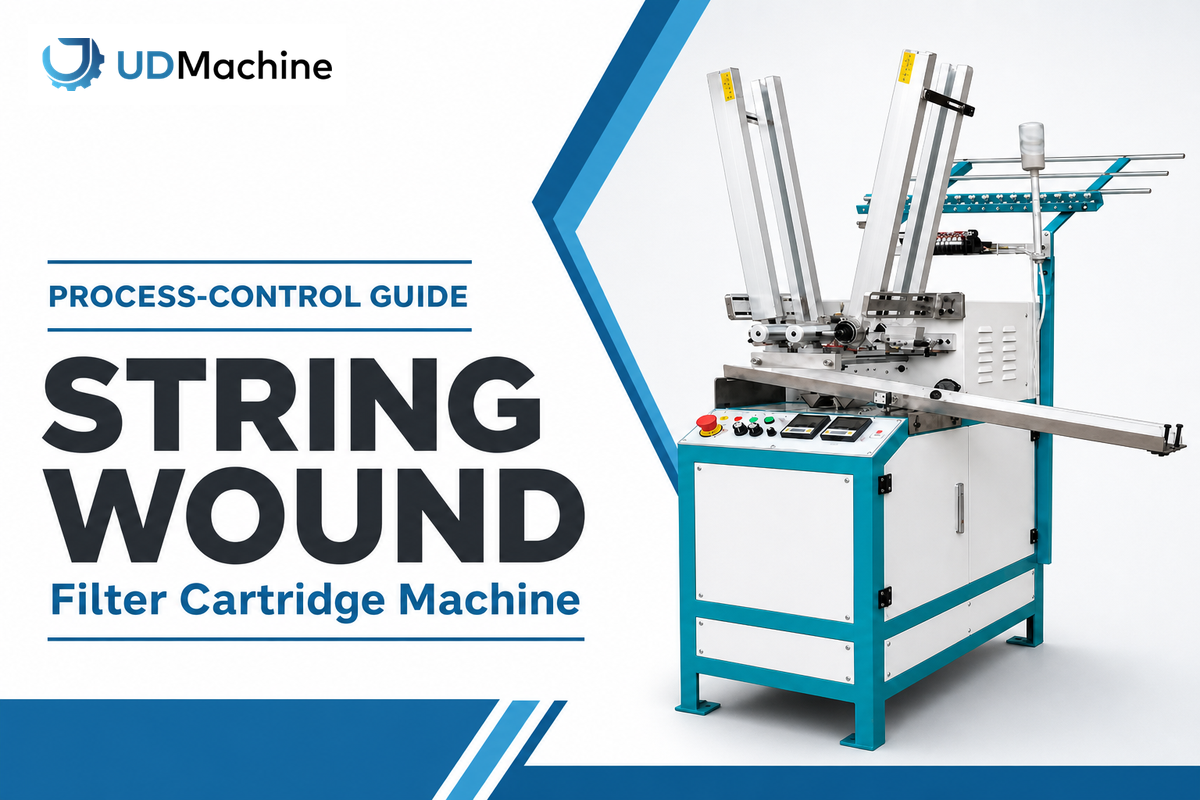
String Wound Filter Cartridge Machine: A Process-Control Guide

A string wound filter cartridge machine coordinates multiple functions: core rotation, yarn delivery, traverse, and layer build. It can repeat a winding recipe. On its own, it can’t prove that the completed cartridge meets a specified filtration rating. The second claim requires identified materials, traceable samples, and a defined test of the cartridge.
Updated October 2026 · Written by Cherry · Reviewed for process, safety, and evidence boundaries
TL;DR
- Freeze the material lot, core, recipe revision, measurement method, and sample IDs before the first article run.
- Don’t use the diamond pattern as a micron certificate. Use it as a process signal.
- When looking at tension, traverse, or build problems, change only one factor at a time.
- Don’t approve only the first cartridge that appears visually correct; review the entire defined run.
- Keep machine-function, process-stability, and finished-cartridge evidence in separate release layers.
Commercial boundary: This article is an operating and quality guide. For assistance with machine models, sizes, configurations, output, prices, lead times, or quotations, visit the string wound filter cartridge machine solution page. Placing buying questions on the solution page will keep this guide from becoming a competing product page.
What Can a String Wound Filter Cartridge Machine Control?
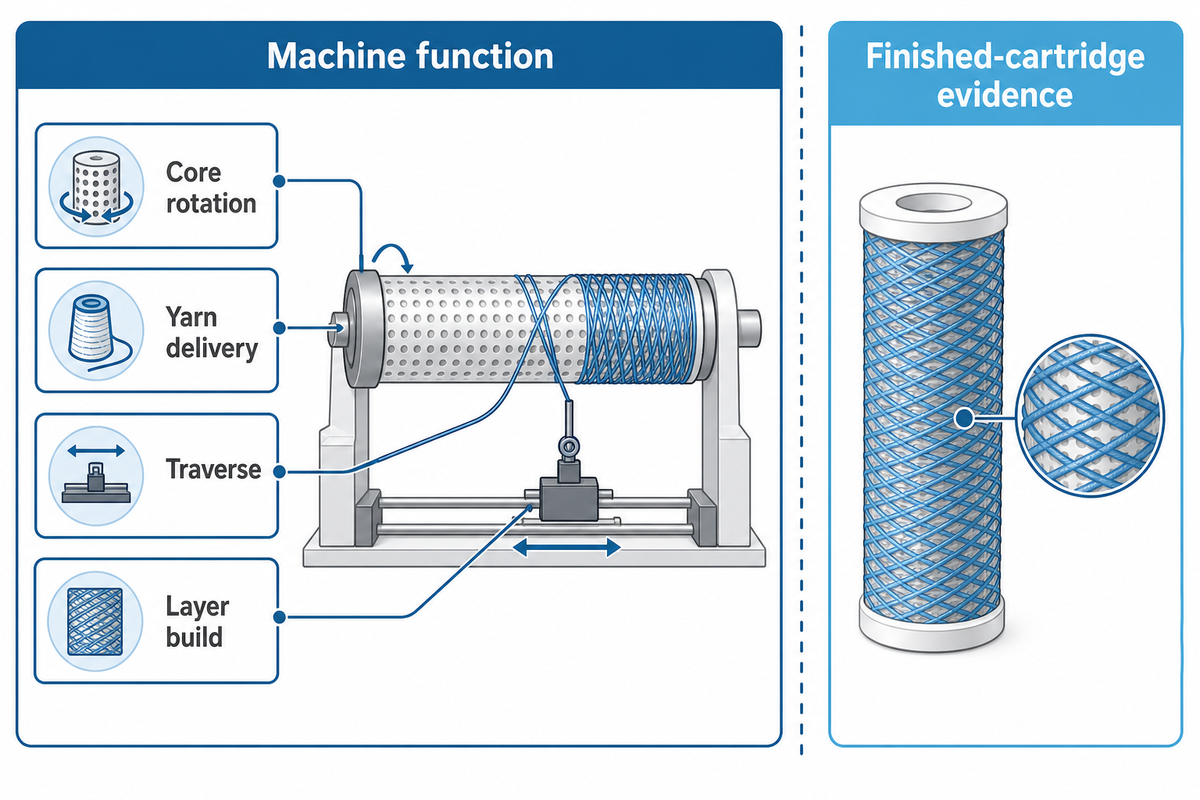
A continuous strand is wrapped around a perforated core while a guide moves axially along the core, an architecture described in historical wound-filter patent literature. The guide moves axially along the core, while rotation creates circumferential progress for each pass. The relationship of rotation and traverse determines where one pass crosses the next. The wall builds out from the core according to strand delivery and tension.
The machine has a limited job: it can perform motion, hold a configured relationship between axes, detect interruptions, and stop on a programmed condition. Depending on the design, it could store recipes, have alarms for broken strands, and control various layers. These functions relate to the machine and aren’t equivalent to a finished-cartridge performance claim.
A manufacturer of machines may term the output a PP string wound filter cartridge when polypropylene yarn is wound on the specified core. That term indicates one material route used in the liquid-filtration industry; it doesn’t replace the application-specific drawing, process record or performance test.
| Evidence layer | Question it answers | What it does not prove |
|---|---|---|
| Machine function | Did rotation, traverse, delivery, stop, and alarm functions operate as agreed? | Filtration efficiency or service life |
| Process stability | Did identified inputs and one frozen revision produce repeatable output across a defined run? | Performance outside the sampled product and method |
| Finished cartridge | Did identified samples meet drawing and test requirements under stated conditions? | Every material, recipe, application, or operating condition |
This three-layer boundary defines the parameters of a useful trial. An attractive photo or a repeated screenshot of a product isn’t sufficient evidence. The evidence must be relayed from a known input to a known output.
Follow the Wound-Filter Control Loop from Input to Release
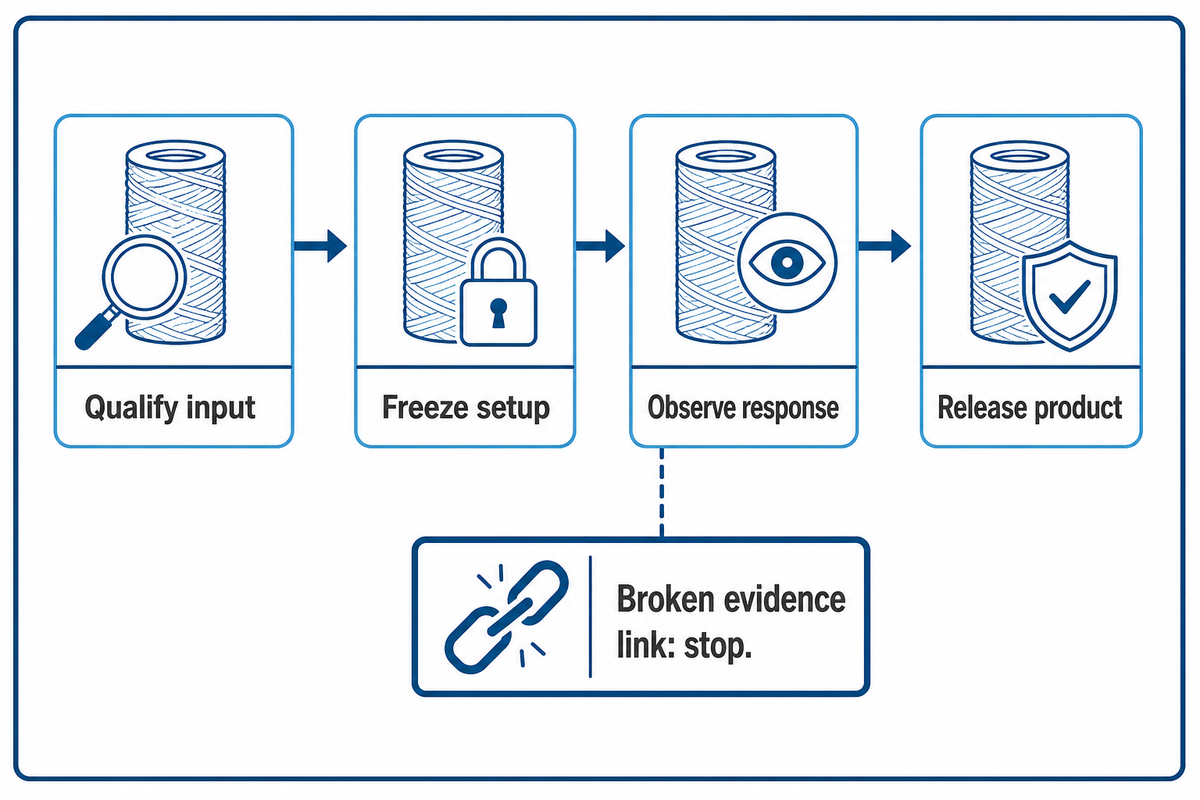
The Wound-Filter Control Loop is a four-step method for keeping production evidence linked. Each step is made up of a decision, an owner, and a retained record.
| Step | Decision question | Minimum retained record | Stop condition |
|---|---|---|---|
| 1. Qualify input | Are the specified strand and core present and identifiable? | Supplier, code, lot, core drawing/revision, incoming disposition | Unknown or mixed lot |
| 2. Freeze setup | Is the intended recipe revision loaded and independently checked? | Machine ID, recipe revision, operator, instrument IDs, pre-run check | Revision or measurement ambiguity |
| 3. Observe response | Does the build remain consistent across start, middle, and end samples? | Sample positions, pattern notes, dimensions, stops, adjustments, rejects | Unexplained drift or lost traceability |
| 4. Release product | Do identified samples meet the agreed drawing and test plan? | Results, method, conditions, limits, disposition, approver, retained samples | Failed criterion or missing linkage |
The loop is intentionally more strict than “set, run, inspect”. Without the Lot Identity at Step 1, it isn’t possible to assign a good result at Step 4 to a known input. If an operator makes an undocumented correction at Step 3, the approved result doesn’t prove the frozen revision at Step 2. The practical rule is simple: Breaking the evidence link means the process stops until the reason for the break is resolved.
For the wider relationship between winding, melt-blown, and carbon-block routes, see the filter cartridge making machines guide. This article sticks to the wound route.
Freeze Inputs and Measurement Before the First Article
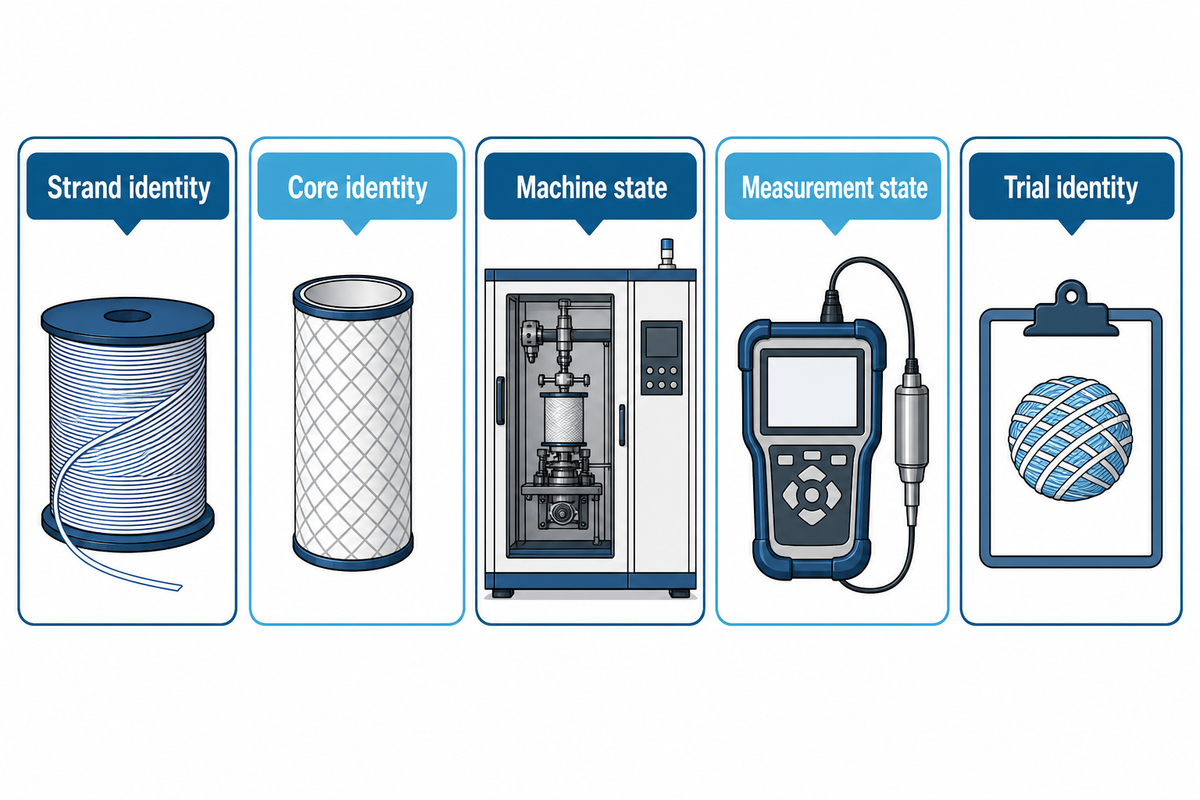
A first article is only comparable when the factory understands what was input and how it was measured. Because published winding results vary with coil angle, wind direction, porosity, surface area, and strand content, freeze the input and measurement system before touching a process setting; the open-access winding study reports those variables inside its stated materials and test conditions.
- Strand identity: Strand identity includes the condition affecting delivery, package lot code, supplier code, construction, material, and anything that may impact delivery.
- Core identity: material, drawing revision, length, diameter, perforation pattern, straightness, surface condition and lot.
- Machine state: Machine and station ID, tooling, guides, tension devices, recipe revision, and maintenance.
- Measurement state: includes instrument ID, resolution, verification state, measurement location, conditioning and operator method.
- Trial identity: Work Order, Start Time, Operator, Planned Sample Positions, Controlled Change, and Stop Rule.
The meaning of “freeze” is that the team agrees on which characteristics of the product are important, the way they’ll be checked, and the limits (or boundaries) that will trigger containment. An example of a bad measurement is: “A dimension taken at an undefined location with an unidentified tool can’t support a later comparison.”
Make one planned change at a time where possible. If changes are made to tension, traverse, speed, and material together, the next sample may look better, but the team cannot tell which change mattered. However, the team has learned very little, and little knowledge can be transferred to the next material lot. This may make isolating future deviations difficult.
The first-article rule states that no setting change receives credit unless the changed factor, held factors, sample identity, measured response, and decision are documented together.
Read the Diamond Pattern as a Process Signal, Not a Micron Certificate
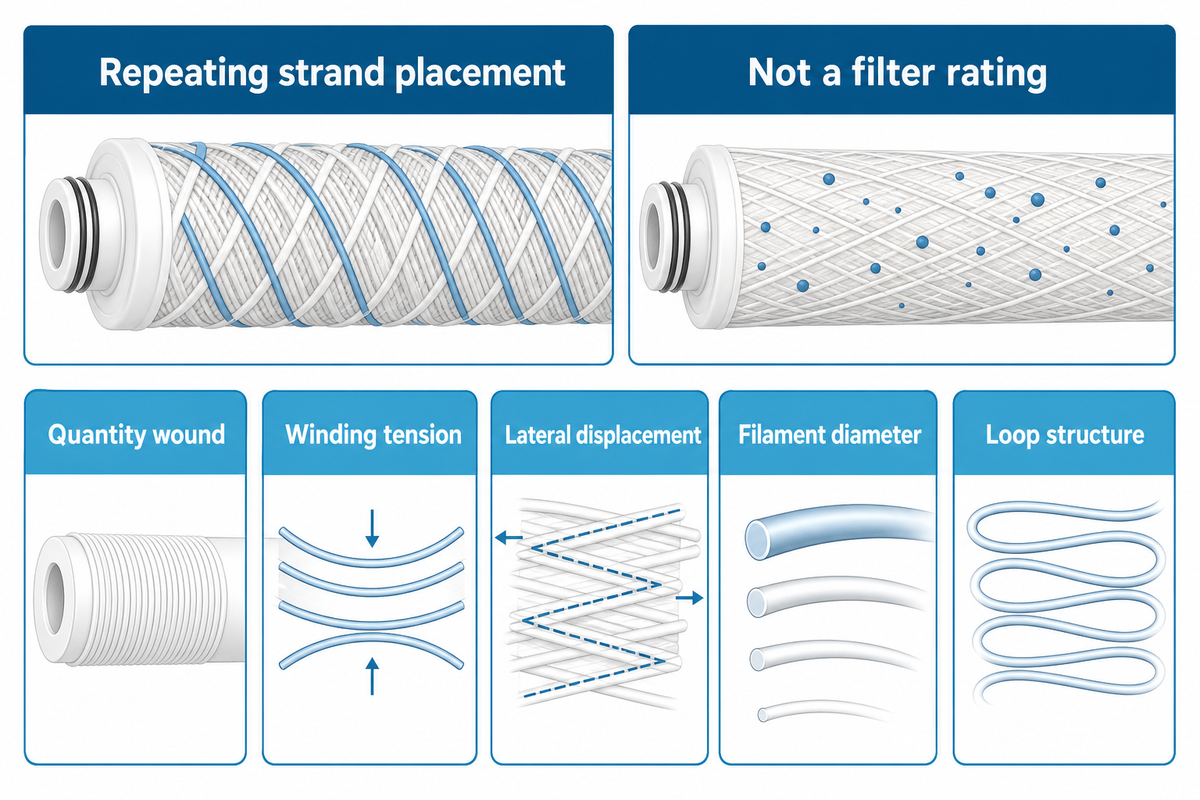
The repeating diamond shape comes from crossing over as the strand moves in one direction and then reverses. A consistent pattern is useful. It can show whether placement is repeating and whether a change in pattern occurred. It doesn’t reflect the removal of particles.
Historical patent literature helps explain the mechanism. US 4,253,228 discusses how yarn dynamics, guide travel, traverse length, reversal behavior, and speed affect location and tension during wound-filter formation. US 4,660,779 describes changed rotation-to-traverse relationships between layers. These expired disclosures show technical approaches that have existed for decades; they don’t establish a setting for a modern production line.
US 6,942,106 is more direct about the cartridge variables in its disclosed design. It identifies the quantity wound, winding tension, lateral displacement between passes, filament diameter, and loop structure as factors in retained particle size. That list is valuable because it prevents a common mistake: treating pattern geometry as the only control.
An open access peer reviewed study on leading and lagging winds in wound filters found differences in pressure drop and nominal micron results due to changes in coil angles, wind directions, porosities, surface areas, and strand contents. The results apply to the materials and conditions of the study; they show that the variables interact and aren’t a recipe to follow.
Decision statement: A repeating diamond pattern could indicate a repeating strand placement. It doesn’t show a filter rating.
Control Traverse, Tension, and Build-Up Without Copying Setpoints
There are no universal constants for tension, spindle speed, traverse relationship and coil angle for all strands and a core. The correct window depends on the behavior of the material being used, the geometry and design of the core, the type of build desired, the behavior and response of the equipment and the finished cartridge evidence plan.
Use a controlled trial:
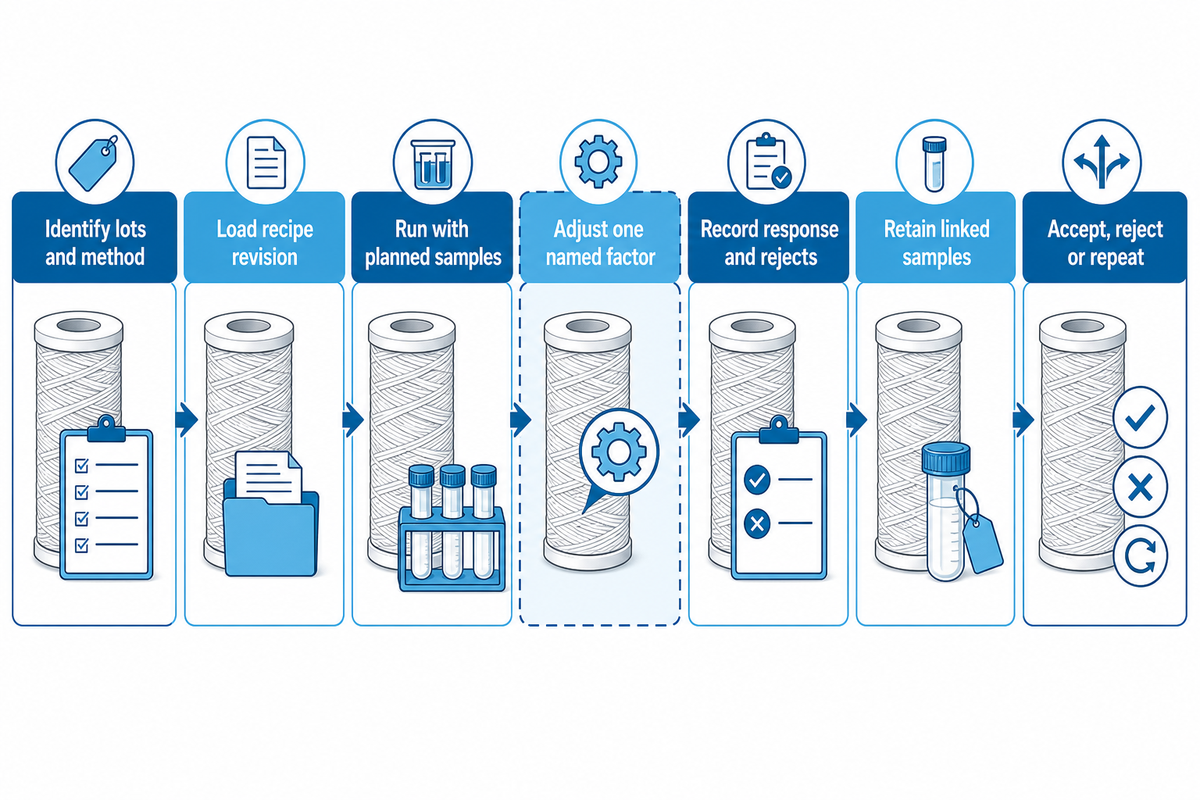
- Identify the strand and core lots and confirm the pre-run measurement method.
- Load a named recipe revision and note the initial state of the machine.
- Run a defined quantity or time with planned samples at the beginning, middle and end.
- If a change is required, adjust one named factor within the allowed trial window.
- Note the observed response, dimensions, mass, or other approved construction checks, stops and rejects.
- Retain labeled samples and associate them with the corresponding finished cartridge test.
- Accept, reject or repeat the revision with a rationale.
| Observed state | Next decision | Why |
|---|---|---|
| Pattern and measurements repeat across planned samples | Hold the setup and complete product tests | Avoid improving a process that already meets the frozen trial criteria |
| One response drifts while traceability is intact | Adjust one plausible factor and repeat defined samples | Preserve causal information |
| Material, recipe, or sample identity is uncertain | Contain affected output and restore traceability | An unidentified sample cannot qualify a known condition |
| Inspection requires reaching near a rotating or energized hazard | Stop and follow the site’s authorized safety procedure | Production diagnosis never overrides safeguarding or energy control |
If the main question is which process route or piece of equipment best relates to the product brief, use the filter cartridge equipment selection guide. A process trial begins after that route decision.
Diagnose Defects with the 9-Signal Winding Fault Matrix
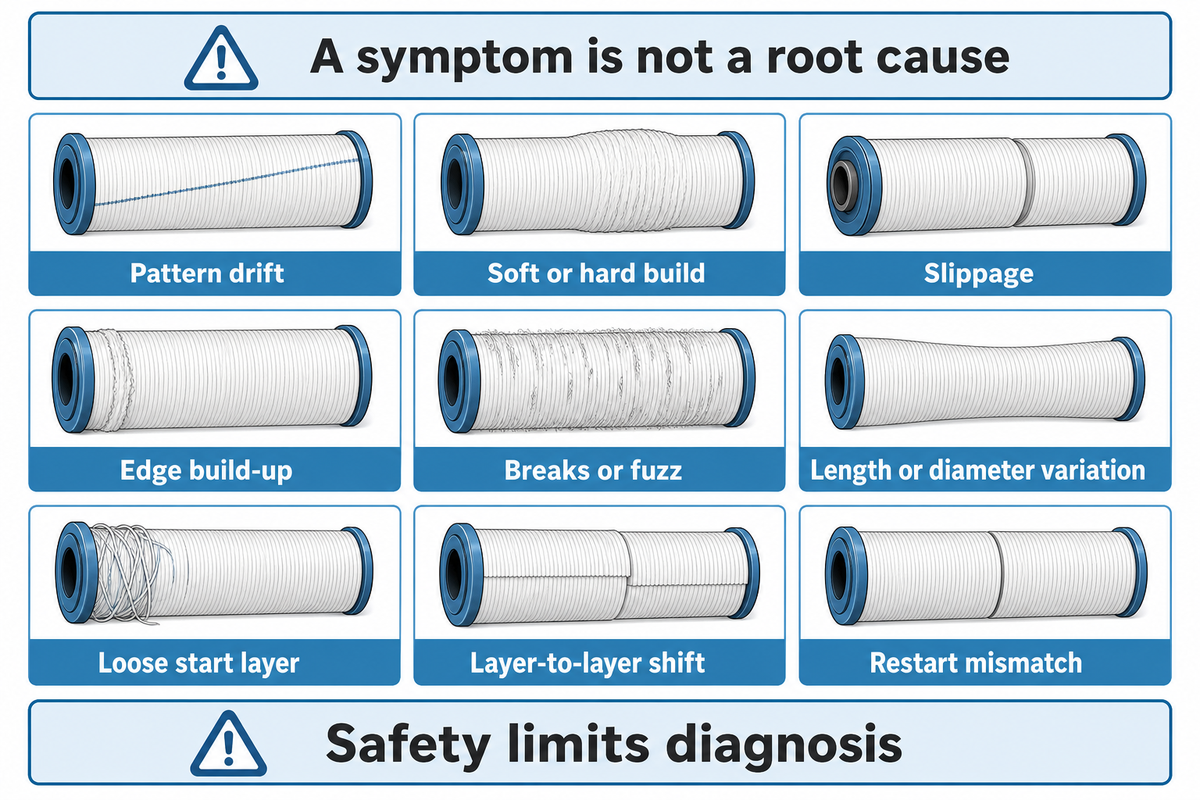
A symptom isn’t a root cause. The 9-Signal Winding Fault Matrix turns each observed signal into an evidence request before a choice of correction is made.
| Fault type / signal | Plausible categories | Evidence to collect | Controlled check | Escalate when |
|---|---|---|---|---|
| Pattern drift | Traverse relationship, guide motion, rotation, slip, revision | Time of onset, machine state, sample position, guide path, loaded revision | Verify revision and observe repeatability at an approved safe point | Motion is erratic, guarding is compromised, or drift recurs |
| Soft or hard build | Input construction, delivery, tension history, amount wound | Lot, package state, dimensions, mass, sample location, approved tension indicator | Hold input and geometry constant; change one authorized factor | Product evidence fails or the cause follows the material lot |
| Slippage | Core surface, start condition, alignment, input delivery | Core lot/surface, start sequence, first-layer image, time of movement | Compare an identified core from the same lot using the approved start method | The core or holding method may be unsafe or out of drawing |
| Edge build-up | Traverse endpoints, reversal behavior, alignment, core length | Left/right profile, reversal observation, core position, endpoint revision | Confirm product and endpoint setup before changing tension | A repeatable mechanical asymmetry remains |
| Breaks or fuzz | Material condition, abrasion, guide surface, package delivery | Break location, guide condition, package/lot, timing, accumulated debris | Compare safe accessible contact points and an identified package | Inspection requires guard bypass or energized access |
| Length or diameter variation | Stop method, build amount, measurement, core variation, spring-back | Instrument, location, timing after winding, recipe, core and sample IDs | Repeat the measurement method before changing the process | The measurement system or product definition is not capable |
| Loose start layer | Start sequence, core surface, holding method, delivery lag | First-layer image, core ID, start event, observed movement | Repeat only the approved start method with an identified core | The holding method or core condition creates a hazard |
| Layer-to-layer shift | Recipe transition, traverse relationship, interruption, restart state | Layer number, transition time, event log, recipe revision | Compare the recorded transition against the frozen recipe | The shift repeats at one defined transition or follows each restart |
| Restart mismatch | Resume logic, strand position, operator method, retained machine state | Stop cause, stop duration, resume record, first post-restart sample | Use the approved restart sequence and isolate the first samples | Traceability is lost or the restart condition cannot be reproduced |
Safety limits the diagnostic route. OSHA 1910.212 covers hazards that include ingoing nip points and rotating elements. OSHA 1910.147 addresses servicing where unexpected startup or stored-energy release could cause injury. These are US requirements; a compliance certificate is not a universal acceptance. Assess the law, risk and authorized procedures at the location.
Record measurements with units and method context rather than bare values. A record should say “63 mm,” not “63”; “248 g,” not “248”; and, where applicable, “6 N,” “480 rpm,” “30 s,” or “23 °C” instead of an unlabelled number. These examples are meant to illustrate notation only. The numbers should not be considered process setting or universal acceptance limits.
Approve First Articles and Changeovers with an Evidence Pack
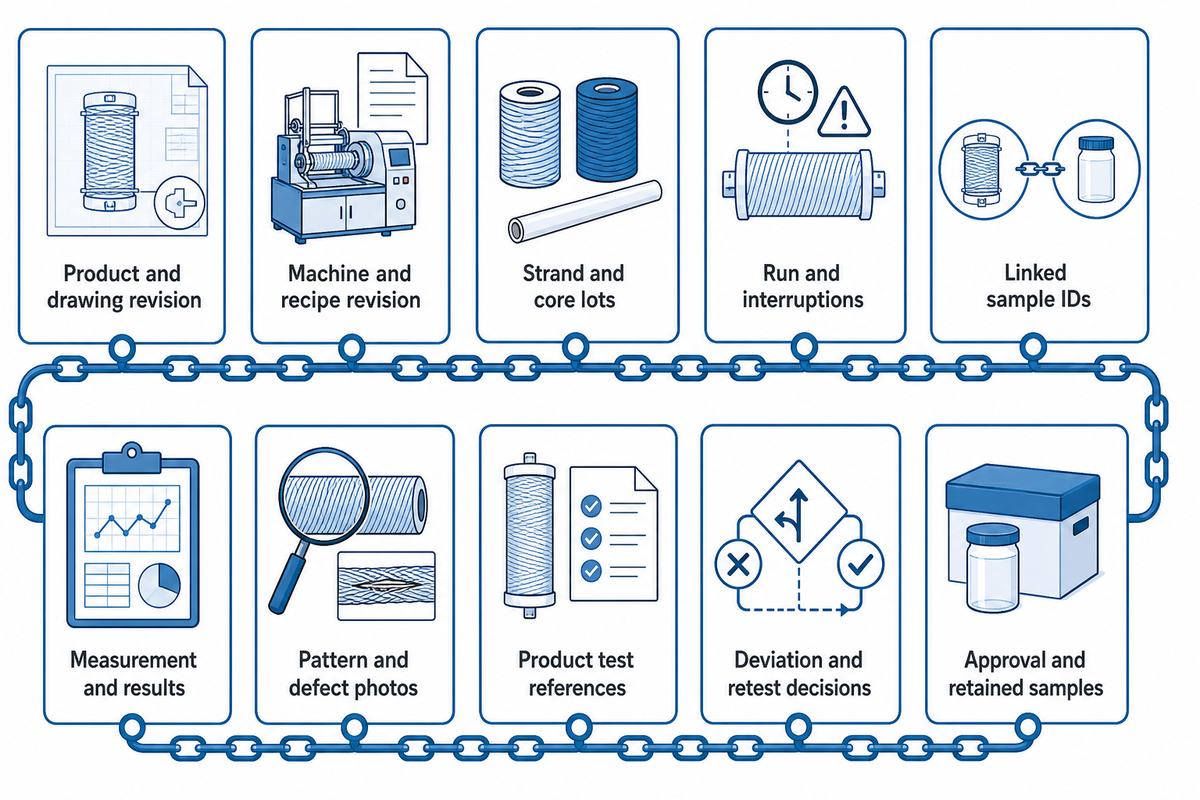
A first article determines whether a named product, material set, or setup revision produces acceptable samples when used in conjunction with an appropriate measurement plan. A first article doesn’t determine whether the entire process will be stable.
The First-Article Evidence Pack should contain:
- product code, drawing, and revision;
- machine, tooling, guide, and recipe revision;
- strand and core supplier codes and lots;
- Operator, start and stop times, planned run duration or quantity, and interruptions;
- Sample IDs associated with start, middle, end, restart, and adjusted conditions;
- measurement equipment, method, location, conditioning, limits, and results;
- pattern observations and identified defect photographs where useful;
- finished-cartridge test report references;
- deviation, containment, rework, and retest decisions;
- approvals and retained-sample location.
Determine what requires a first article. Typical triggers include a new material or core lot when risk requires it, a supplier or construction change, a recipe revision, a tooling or guide change, relevant maintenance, a long shutdown, relocation, and a product drawing revision. The actual list resides in the plant’s control plan.
Changeover evidence should also be in production planning. The filter cartridge production planning guide explains how product mix, changeover, line utilization, and accepted output connect at line level.
Build Sampling and Lot-Release Rules Before Production Starts
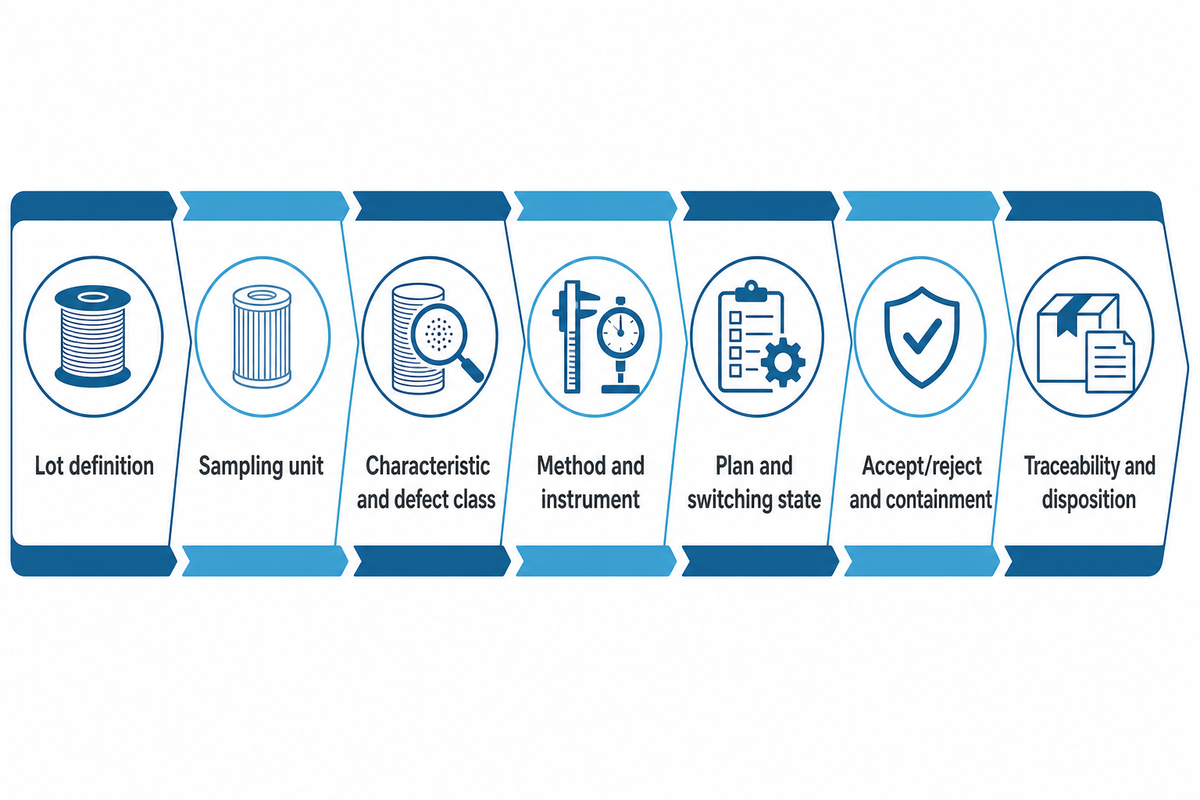
Sampling shouldn’t be “check a few pieces.” Sampling should include a definition of the lot, sampling unit, characteristic, inspection method, sample selection, acceptance and rejection rules, and sampling containment and switching rules, and define who will make the decision based on sampling results.
ISO 2859-1:2026 is the current third edition for AQL-indexed lot-by-lot inspection by attributes. The official summary describes single, double, and multiple sampling schemes as well as switching and skip-lot provisions. That scope is useful, but the standard does not choose one universal AQL, inspection level, or sample size for every wound cartridge. Those choices depend on the contract, characteristic risk, process history, and applicable requirements.
Write these seven items before selecting samples
- lot definition;
- unit to be sampled;
- characteristic and defect classification;
- method and instrument;
- plan and switching state;
- accept/reject and containment rule;
- traceability and authorized disposition.
It’s improper to combine conditions that are naturally dissimilar into a single lot to simplify documentation. Segregation may be required due to a material change, unapproved adjustment, or a break in traceability. On the other hand, it’s improper to create a new lot after observing poor results in an effort to dilute a failure. Lot rules must be established prior to inspection.
Separate Machine Acceptance from Finished-Cartridge Performance
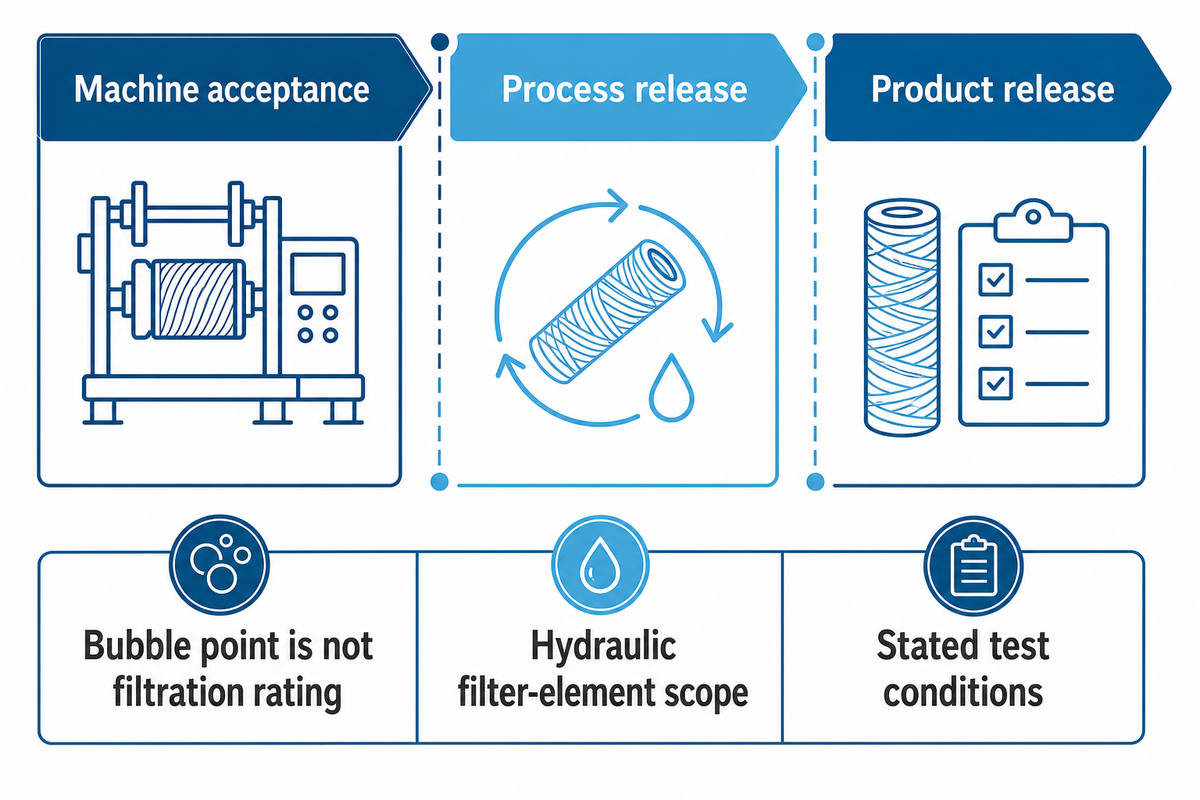
The Lot-Release Boundary Map retains evidence at the layer of creation.
| Layer | Examples of evidence | Release question | Owner |
|---|---|---|---|
| Machine acceptance | Function checks, safety review, agreed alarms, motion, recipe handling, trial documentation | Did the supplied equipment perform the agreed functions under the agreed trial? | Buyer and supplier under the purchase specification |
| Process release | Frozen revision, traceable inputs, start/middle/end samples, dimensions, pattern, stops, rejects | Can this identified condition enter normal production? | Plant production and quality |
| Product release | Construction, integrity, pressure drop, retention or other application tests under stated methods | May this identified lot be released for its stated application? | Quality under the product specification |
Test-method names also need scope control. ISO 2942:2018 covers fabrication integrity and first bubble point for hydraulic fluid-power filter elements. Its official abstract says first bubble point is not a functional characteristic and cannot estimate filtration rating, efficiency, or retention capacity. ISO 16889:2022 is a multi-pass method for hydraulic fluid-power elements under specified contaminant, flow, and test conditions. Neither title should be used as a blanket certificate for every water-treatment cartridge.
The finished assembly may include downstream activities such as cutting, end treatment, bonding, gasketing, and/or packaging. The filter cartridge assembly process guide covers that.
What Is Changing in Winding Control in 2025–2026?
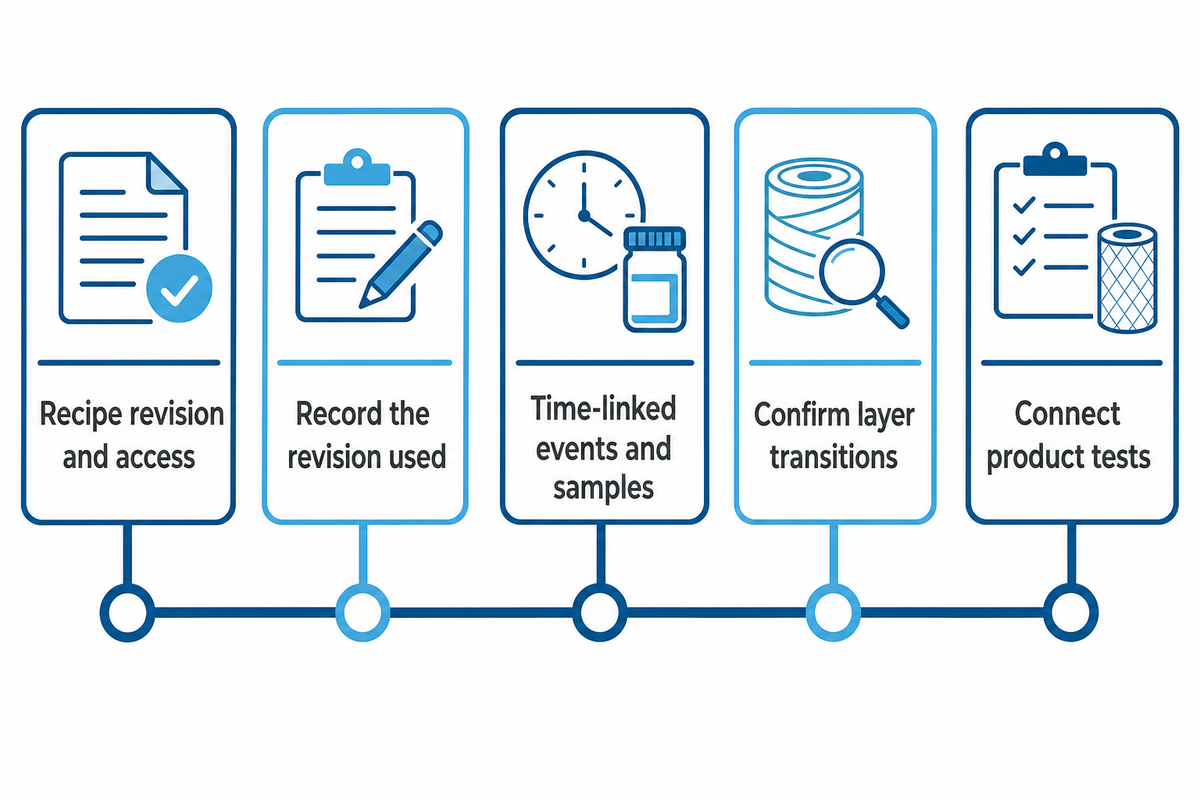
Electronic gearing, servo coordination, programmable multilayer patterns, recipe storage and event handling are becoming more commonplace in supplier web pages. Older patents cover changing rotation-to-traverse relationships and using different patterns between layers.
Improvements shouldn’t be judged by the labels “automation,” “smart,” or “precision.” The improvement is controlled execution, documentation, and record keeping.
- a recipe has a revision and access rule;
- the machine records which revision was used;
- alarms, stops, and adjustments are time-linked to sample positions;
- a transition layer can be confirmed rather than inferred from a final photo;
- the result is connected to finished-cartridge tests.
Demonstrate evidence for “smart,” “automatic” or “precision” claims. Evidence should include the buyer’s identified material and core, an agreed product definition and run, repeat measurements, labelled samples, and event records. Event records should include stops, adjustments, rejects, sample positions, and written dispositions for deviations. An HMI screenshot, nominal speed, recipe count, or polished sample can’t replace that packet.
For more detail, the filter cartridge production line reference breaks down production of wound, melt blown, and carbon-block filter cartridges. A melt blown filter cartridge is made from a polymer resin and extruded in a fibre-forming process. It isn’t made on a wound-cartridge machine by changing the process settings.
Frequently Asked Questions
How do you know a string wound filter cartridge machine setup is stable?
Repeating a stable process should produce consistent results, i.e. dimensions, build condition, finished-cartridge test results, and a defined run of a frozen recipe. Record process observations, adjustments, stops, rejects, sample positions, and IDs. Stability is demonstrated by an evidence trail across time. One attractive sample or screen value doesn’t show stability.
Does the winding pattern prove the cartridge micron rating?
No. The observed pattern indicates how the strand is being laid, but material construction, amount, tension, layer build, porosity, test method, and finished-cartridge geometry also affect retention. The pattern is only one factor; link observations to labelled samples and finished-cartridge results before assigning a micron rating.
What belongs in a first-article approval for a wound cartridge?
In addition to observations, document the product revision, drawing revision, machine revision, recipe revision, core lots, material lots, operator, date and time, measuring equipment, sample IDs, dimensions, patterns observed, performance test, deviations, disposition, approvers, and retained samples. State how many subsequent samples were checked before releasing production for normal operation.
What commonly causes uneven winding?
Non-uniform winding may be related to variation in tension, material delivery, core alignment or condition, traverse timing, spindle behavior, or slippage, or an unknown change may have occurred. Make a working hypothesis from those possible causes. Make sure to capture the exact status of the signal and machine, check inputs if safe to do so, and make changes one at a time in a controlled run.
Can one setup run every material and core combination?
No—the material construction, core geometry, required build, and performance target can change the process window. Approve each defined product family with a controlled changeover.
Release Evidence, Not Just a Good-Looking Pattern
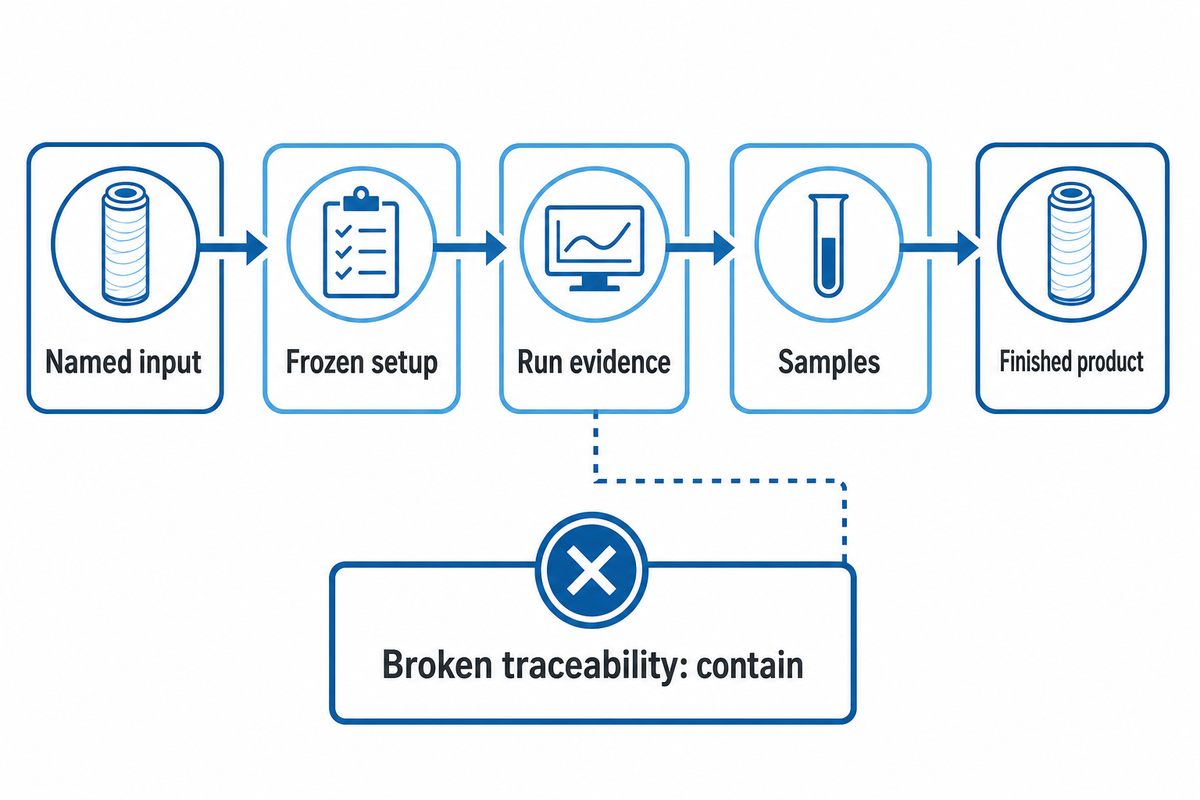
Contain the lot when traceability is broken. Repeat first-article approval when a relevant machine state changes, a material or core changes, or the recipe changes. Release normal production when the named input, frozen setup, run evidence, samples, and finished product connect.
Suzhou UDTECH Technology Co., Ltd. describes its equipment and pre-shipment testing on the company page. For a project discussion, bring the product family, material and core identities, drawing revision, target evidence, changeover list, and proposed acceptance run to the commercial machine page.
Discuss Your Requirements For String Wound Cartridges
References and Sources
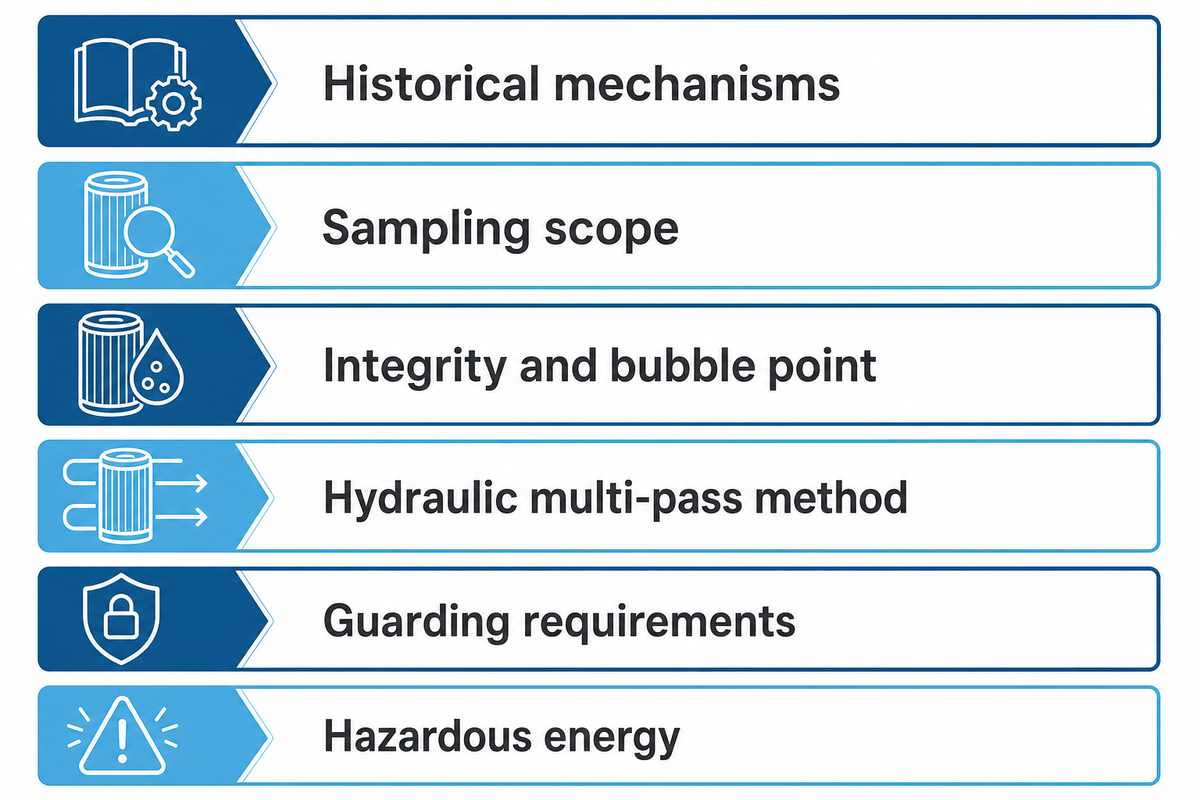
- US 4,253,228, apparatus and system for forming wound filters
- US 4,660,779, multilayer precision-wound filter cartridge
- US 6,942,106, wound polypropylene yarn filter cartridge
- Cleaner Engineering and Technology, Influence of leading and lagging wind
- ISO 2859-1:2026, sampling procedures for inspection by attributes
- ISO 2942:2018, filter-element fabrication integrity and first bubble point
- ISO 16889:2022, hydraulic filter-element multi-pass method
- OSHA 1910.212, general machine-guarding requirements
- OSHA 1910.147, control of hazardous energy
UDTECH / ENGINEERING GUIDE
About UDMachine
UDTECH publishes practical production-line planning guides for filter cartridge making, assembly, finishing, and complete-line projects.
Use these guides to define cartridge type, process route, target output, available utilities, acceptance evidence, delivery scope, and installation constraints before selecting equipment.
Start with the cartridge
Media, diameter, length, end-cap format, and rated output define the real machine route.
Clarify the line scope
Utilities, layout, automation level, inspection points, and acceptance tests vary by project.
PRODUCT / CAPACITY / ACCEPTANCE
Prepare Your Line Brief
Product types
PP Melt Blown · String Wound · CTO Carbon · UDF Tube
Start with
Cartridge type · Target output · Country
Planning inputs
Utilities · Layout · Process · Acceptance standard
Response route
Submit the website inquiry form
Submit Project Brief